


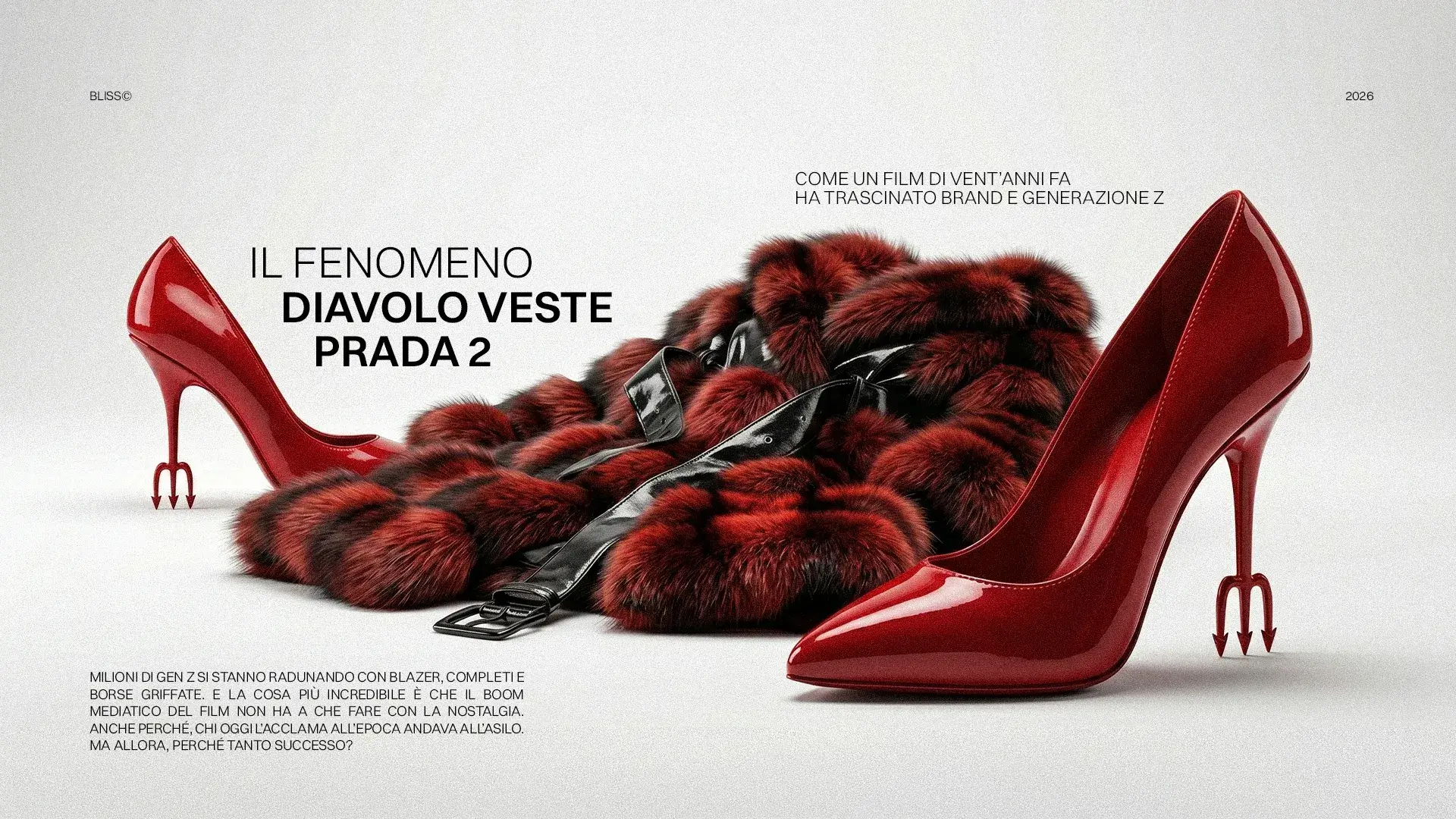
Come un film di vent’anni fa ha trascinato brand e generazione Z
Today, Wednesday 29 April, the long-awaited sequel to ‘The Devil Wears Prada’ opens in Italian cinemas: the 2006 film, as iconic among older generations as among younger ones.
Twenty years after the first film, Miranda Priestly is back, grappling with a world she no longer recognises, one of social media and fast fashion. Yet among the many brands involved and the countless initiatives staged around the world, what stands out most is the wider movement it has sparked, which is getting people talking above all outside the cinema.
Millions of Gen Z are gathering right now in blazers, suits and designer bags. Instagram and TikTok feeds are flooded with trends inspired by the first film, and the most remarkable thing is that the film’s media boom has nothing to do with nostalgia. After all, those cheering it on today were at nursery school when it came out.
So why such success?
The answer lies in our minds, and it has a very specific name.

Transgenerational cultural memory
Recent scientific research has confirmed that the most emotionally charged and visually precise content survives by being passed down through generations.
This is not top-down transmission, as with history or literature. Discovery is more lateral: rewatches, TikTok, quotes, memes, references in other films.
What made the first Devil Wears Prada a cinematic icon is its precise visual identity, strong enough to produce what neuroscientists call flashbulb memory: an image so sharp and distinctive that it seems clear even to those who never lived it. Anne Hathaway’s jumper. Meryl Streep’s coats. The famous outfit-change sequence. Stimuli the brain files away as icons rather than memories.
Twenty years on, that memory has multiplied and now materialises in real behaviour: people dressing as characters from a film to live an experience they expect to match the image in their heads.

The Devil Wears Jean Paul Gaultier (and many others)
Of course, The Devil Wears Prada is much more than its story and its cinematography. This is a transmedia narrative, linking cinema, fashion and pop culture. Its impact, accordingly, is far-reaching.
Jean Paul Gaultier, for example, has benefited enormously from this sequel. The brand was already enjoying a revival, with its ’90s corsets back on the catwalks. Thanks to Emily Blunt, however, who wears a much-discussed Gaultier corset in the film, attention on the fashion label has grown once again. The memory of an iconic character was enough to heighten the desirability of a brand with decades of history.
Coach has followed a similar trajectory. Long seen as a transitional brand, too accessible for luxury and too expensive for the mass market, over the past two years it has become a reference point for Gen Z. In the sequel, Andy carries a Coach bag in a work scene. A placement decision? No, rather a costume decision, consistent with the character.
And these are only the labels linked to previews, trailers and photos taken by fans on set. The fashion brands that, from tomorrow onwards, will be on everyone’s lips are far more numerous.

The Pantone effect
Not to mention the impact the film is already having (despite having only just been released) on the real fashion industry.
The precise term is Pantone effect, and it refers to the way the film’s colours (structured neutrals, slate blue and a crimson accent) influenced the Fall 2026 collections shown at New York Fashion Week.
Before a single screening had taken place, designers did not copy the film; they drew on the same collective memory the film had activated. And so, next season, the wardrobe of the screen and the wardrobe of the catwalk will read as part of the same visual language.
Something the fashion world had never seen before.
The film’s real message
Yet the film’s faithfulness does not stop at its aesthetic; it also reflects the real conditions of the fashion market.
The story follows the crisis at Runway Magazine as it fights to survive against digital media. It is a scenario that genuinely affected Vogue, Elle and Condé Nast over the past decade, and one the film revisits as the leitmotif of its plot.
Titles that for decades dictated fashion’s visual codes found themselves chasing algorithms and creators. Some lost; others transformed. And this is the film’s real message, which applies as much to fashion as to any market: the format is not the identity. True identity is the point of view.
Those who managed to turn a point of view into a system (applicable to digital, social media, podcasts, video) survived every change. Those who defended the format rather than the identity lost everything.

Cosplay as a touchpoint
And now to the trend of the moment: Gen Z going to the cinema dressed to the nines, and using brands as a language of identity.
Nostalgia makes people look back. The search for identity, by contrast, makes them look around: to seek affirmation and recognition in others. A declaration of belonging that needs no explanation for those who share the same frame of reference. It is the same mechanism that makes a Supreme drop more than a purchase, or turns a limited-edition Nike sneaker into an object with social as well as commercial value. You are not buying the product: you are buying the identity that product conveys.
Major film franchises have often leveraged their fan base’s sense of identity, and The Devil Wears Prada 2 has indirectly done the same: it has triggered an unplanned mechanism, with no need for a marketing department.
This is the value brands find hardest to build deliberately: the ability to become a language. To be used by people to say something about themselves, without anyone having asked them to.
A lesson for brands
In a 2026 with Dune 3, Nolan’s Odyssey and the new Avengers on the slate, there is little doubt that The Devil Wears Prada 2 will turn out to be the hit of the year.
It could hardly be otherwise. Whether or not the film proves any good, the machinery of belonging is already in motion, and the trends it touches are already moving people en masse.
An important lesson for every Hollywood production, but perhaps for brands too.
You don’t need Miranda’s furs to succeed. But when an identity is this strong, leaving a mark becomes easier. Even twenty years on.
New Connections (FAQ)
Why has Gen Z fallen for a film it did not experience first-hand?
Because content with a precise visual and narrative identity is passed sideways between generations through rewatches, quotes and memes. This is pure cultural contagion: Gen Z discovered The Devil Wears Prada through TikTok, viral clips and the frame of reference of those who came before them. A strong identity has no expiry date, and it multiplies every time someone discovers and shares it.
What do Gaultier and Coach teach brands that want to become relevant again?
That relevance can be regained through strong cultural associations. Gaultier was already in a renaissance, but a single film scene amplified its desirability without a euro spent on advertising. Coach won over Gen Z through years of strategic work, but the costume choice in an iconic film carries the weight of a cultural validation that no one can buy. Brands that enter the visual vocabulary of a shared story gain something structurally different from paid visibility.
Why do some fashion titles survive the digital crisis while others do not?
Because the former had a point of view. Vogue and the major titles sold a recognisable editorial authority. Those that carried that authority over to digital are still here. Those that defended the format instead of the identity lost both. The crisis in fashion publishing is the best-documented case study of what happens when a brand confuses the container with the content.