


Quanto puoi toccare il tuo nome prima che il brand smetta di essere riconoscibile?
Don’t call it Citroën any more.
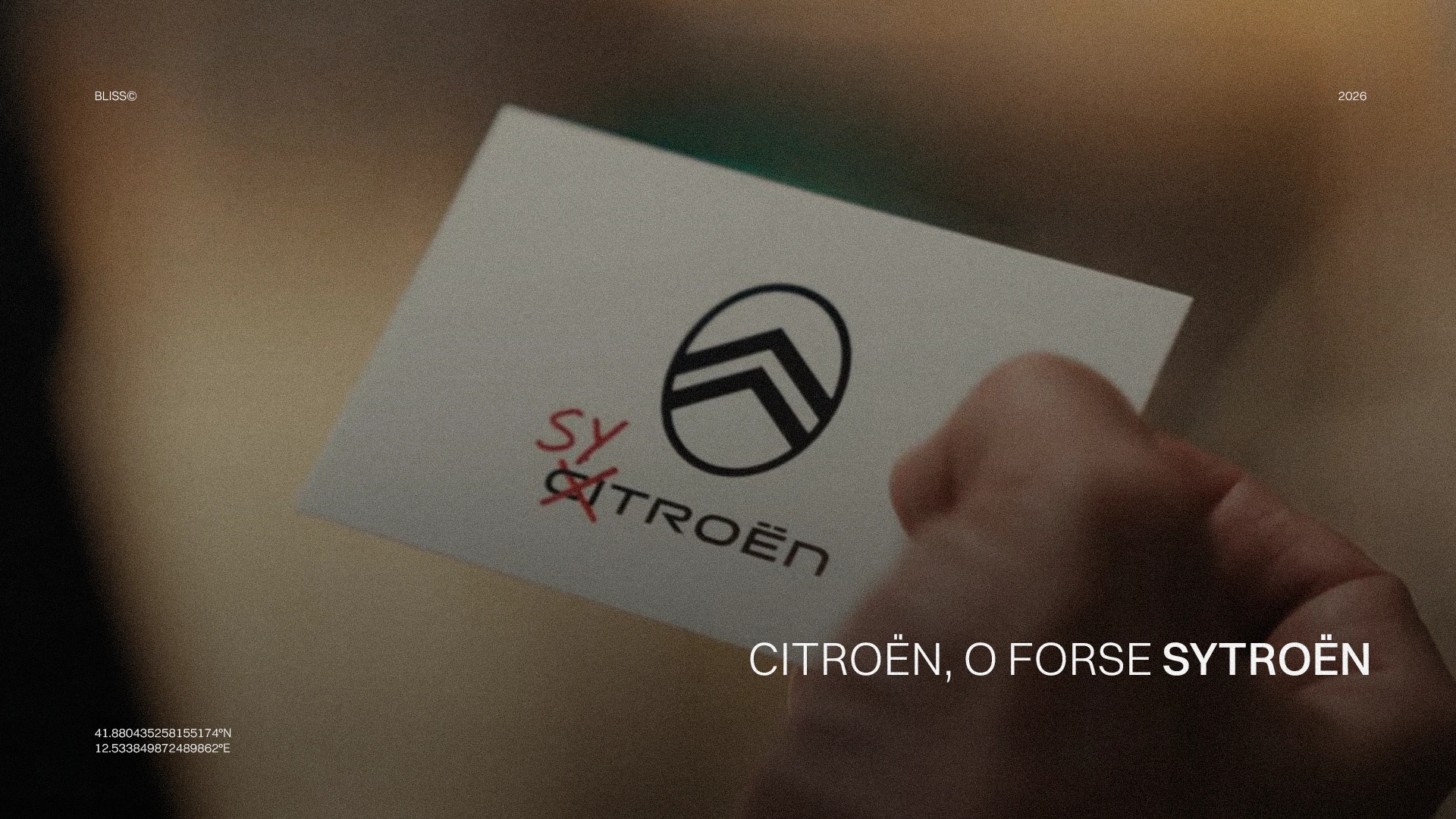
From now on, the name is “Sytroën”. At least for the duration of its new global campaign.
On 16 June Citroën announced its collaboration with French actor Omar Sy, known for playing Assane Diop in the Netflix series Lupin and for the international success of the film The Intouchables. Rather than a brand ambassador in the traditional sense of the term, however, Sy will act as the brand’s “Special Advisor”: an active role, then, designed to bring innovation into the brand.
The campaign, directed by Hugo Gélin and produced by Soldats in Paris for the agency Marcel, comes at a decisive moment for Citroën.
Xavier Chardon has been the brand’s CEO for just over a year, and for the past six months Aline Germain has led global marketing with the aim of giving voice and visibility to a historic brand that has recently been too quiet.
The transformation into Sytroën is designed to drive this new push for innovation.
Here is why.

The game works because it is a game
The initiative consists of replacing the first two letters of the name with the initials of the actor’s surname, playing on the pronunciation of the word.
And so Citroën becomes Sytroën: a different name that nonetheless wrong-foots no one, and that relies as much on irony as on the brand’s recognisability to work.
Nobody took the initiative seriously, and that is to be expected. After all, it is precisely this immediate transparency that makes the initiative safe. The wordplay works because it presents itself explicitly as a time-limited campaign, tied to a specific collaboration, with a start date and a declared scope. No ambiguity about its duration, no doubt about its reversibility.
CEO Xavier Chardon said:
Omar Sy is a beloved figure who has remained authentic, approachable and true to himself, and his ability to connect with people reflects values that have always been at the heart of Citroën.
Olivier François, Global Chief Marketing Officer of Stellantis, added that Citroën and Omar Sy share a rare affinity: the same ability to speak to everyone without becoming ordinary. The same generous popularity: the same freedom to express one’s own individuality.

How far can you change a brand without breaking it?
The underlying question this initiative raises, beyond the individual case, concerns how much freedom an established identity can afford to show with regard to its most rigid asset: the brand name.
Citroën has not altered its logo permanently. It has not changed the product, the range or the brand architecture. It has touched just one element, for a defined period, in a communication context clearly labelled as exceptional (and creative). The rest of the identity (the visual style, the tone, the legacy of more than a hundred years of brand history) remains unchanged and always visible beneath the surface of the game.
This is the line that separates a brilliant operation from a real risk of dilution.
A brand that already has a solid identity, recognised for decades, can afford to joke about its own name because that name, as soon as the campaign ends, goes back where it belongs. For a younger brand, or one whose identity is still being built, the same game would carry a far higher risk: the audience might not yet have a solid anchor to return to once the game is over.
And that is something to be careful about.
The lesson Sytroën offers any organisation that manages a brand, then, is about discipline: before any operation that touches a brand’s visual or verbal identity, defining which part of that identity can be suspended and which must remain identical and consistent in every circumstance. Citroën chose to put its name in play, knowing that everything else would continue to speak for the brand throughout the entire campaign. And afterwards too.
New Connections (FAQ)
Can a brand with less history than Citroën afford a similar move with its own name?
With greater caution, yes. The decisive factor is not the age of the brand itself, but how firmly the public already associates that name with a precise identity. A young brand that has built a very clear positioning within a few years can afford similar games on a smaller scale. The risk increases when the starting identity is still weak or ambiguous: in that case, playing with the name risks adding confusion, rather than generating it in a controlled way, as happens with an already solid brand.
Why did Citroën choose to change its name rather than rely on a traditional brand ambassador?
Because a traditional brand ambassador is perceived as an external voice lending their image to the brand for a fee. The role of Special Advisor, combined with the play on the name, conveys a different idea: a genuine exchange, in which the actor steps inside the brand’s identity for a period rather than simply appearing alongside it. The play on the name makes visible, immediately and almost playfully, a closeness that would otherwise take many more words to explain.
Beyond the public’s reaction, how do you measure whether an initiative like this has worked?
The first indicator comes once the campaign has ended: if the public, once the Citroën name returns, clearly remembers the collaboration and still talks about it, the initiative has built memory. If, instead, recall fades along with the campaign itself, the game has generated momentary attention without leaving a trace. The second indicator concerns consistency: if, in the following months, the more direct and human tone tested with Omar Sy continues to shape the brand’s communication, it means the initiative was not an isolated episode but the start of a broader evolution of the brand’s verbal identity.