


We are in St Petersburg, 1866.
The weather is harsh. The room, barely lit.
A man and a woman sit facing each other in a modestly furnished room with blackened wallpaper. He is a promising university student who nonetheless looks ill. She is a beautiful girl with a clear gaze, though she keeps her eyes lowered.
Their names are Raskolnikov and Sonja.
For those who have not yet worked it out, we are in chapter four of Part IV of one of the most read, loved and debated novels in the history of literature: Crime and Punishment, by Fëdor Dostoevskij. And it is in this very scene that one of the most iconic, if controversial, lines of the entire novel is spoken.
Because, after committing the atrocious murder, Raskolnikov met Sonja and discovered that, to support her alcoholic father, her sick stepmother and her younger siblings, the young woman works as a prostitute. With pity in his eyes, Rodion Romanovič then takes her hand and says to her:
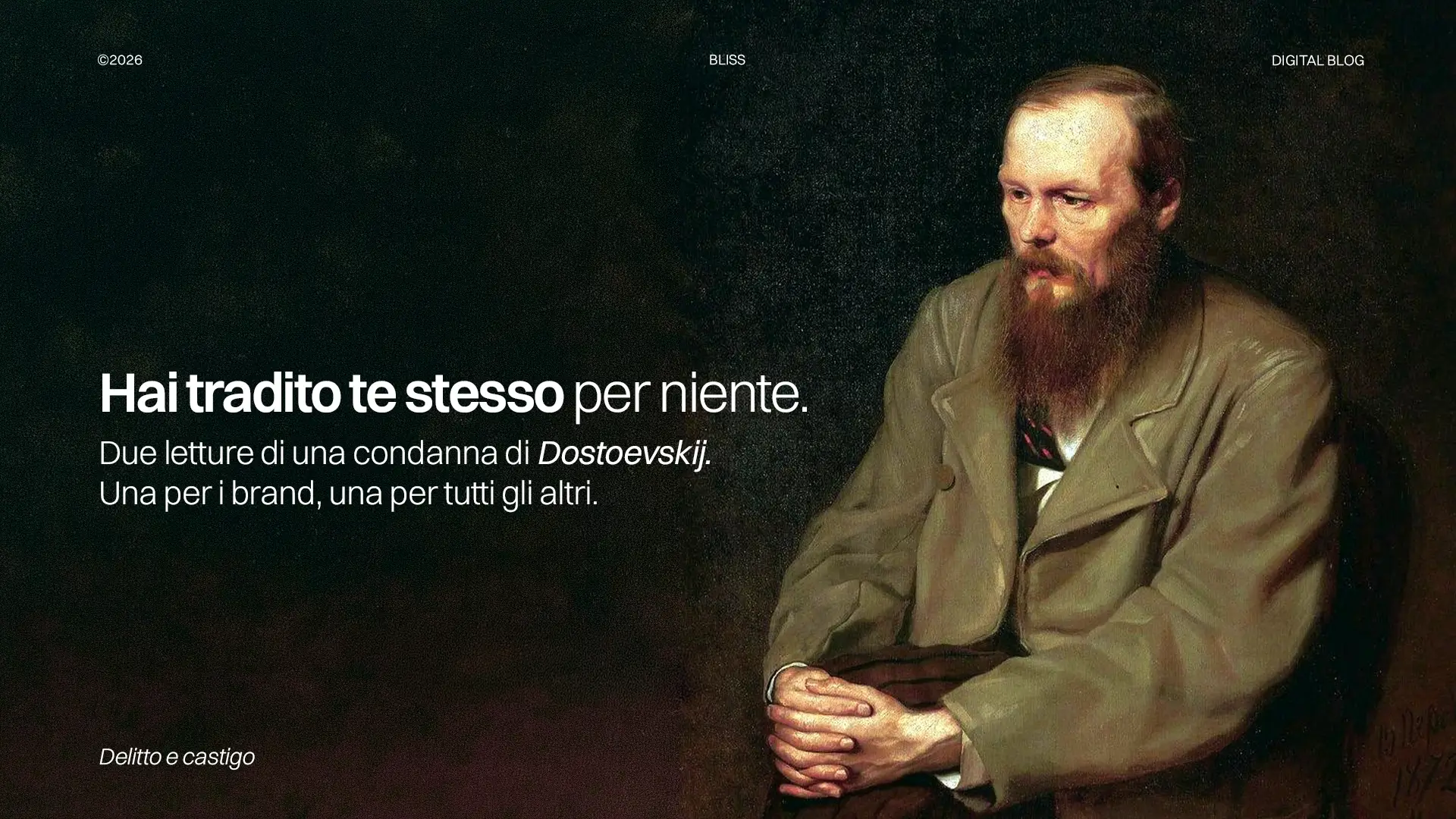
“Your worst sin is that you have destroyed and betrayed yourself for nothing.”
An iconic and at the same time ironic statement which, with its many layers of meaning, still has a great deal to teach us almost two centuries on. About life as much as about work.
Great texts do not age, because they speak of human conditions that markets, management and history have never resolved. The same questions of identity, betrayal, choice and responsibility that Dostoevskij put to Raskolnikov in 1866 are the questions a CEO carries into the boardroom in 2026. Contexts change. Structures remain.
And so, in this new column devoted to art and literature, Bliss brings the great texts into the present. Because the solutions to the problems every person and every company faces have already been found.
You only have to look for them.
The first level: the value of identity
If we look at Rodion Romanovich’s statement from a superficial, immediate point of view, the truth it asserts seems clear-cut. On social media and in marketing, it is the prevailing view.
Betraying yourself for nothing is the ultimate mistake.
Diluting or surrendering your identity “for nothing” always backfires. We saw it with Goleador; we discussed it with Royal Pop. Trading what you are, or what your audience has always recognised as defining, for a quarterly result is a fatal mistake for brands. Because, in doing so, they trade a small, immediate fix for a bigger but more distant problem.
Sell yourself short without gaining any value or any direction, and you pay a steep price. Hidden, but inevitable.
It applies, of course, to individuals as well as to organisations. After all, treating a grenade wound with a plaster is always wrong. With brands and companies, though, this dynamic has now become systemic, and there is a whole body of cases one could cite.
It happens all the time in markets. In 2023, to name just one, Bud Light gave in to the pressure to appear progressive without laying the groundwork to do so credibly. Noticing that its buyers were steadily ageing, and wanting to stand apart from other light beers (in an almost entirely homogenised market segment), marketing vice president Alissa Heinerscheid chose to launch an advertising partnership with Dylan Mulvaney, designed to reach a new audience.
Yet this strategy was flawed in its premise: namely, the idea that a single activation would be enough to shift a positioning built over fifty years.
Mulvaney is a transgender creator with more than 12 million followers, entirely credible for brands that have earned, over time, the right to occupy that territory. Bud Light, however, had not earned it. And so its long-standing audience felt abandoned, while the new one had no sufficient reason to trust it. After all, a campaign is not enough.
Sales fell by 26% in a single quarter. 1.4 billion dollars in lost revenue, while Coors Light and Miller Lite grew by 18% over the same period.
The problem in this case is that, before that move, Bud Light had not answered the hardest question: who are we today, and for whom? Without that answer, any communications initiative, however ambitious or commendable, amounted to a betrayal.
The second level: the value of choice
But in this bare, barn-like Russian room, there is a very large elephant.
Let us return to Dostoevsky.
Raskolnikov condemns Sonja for having betrayed herself. Yet Sonja has not betrayed herself. She has chosen. She has chosen to sacrifice herself so that someone she loved could survive. Hers is not truly an act of prostitution but one of love, carried out in almost impossible conditions.
It is no coincidence that Sonja remains the person she is throughout the novel. Devout, present: capable of loving (and transforming) even the most unapproachable character of all. Rodya himself.
The one who has truly betrayed himself in this story is Raskolnikov.
He is the one who acted on a theory: he is the one who gained nothing from his crime (not least because he literally threw away what little money he took…).
All he has gained is precisely the nervous breakdown that stays with him throughout the novel. He is himself the perfect example of his own statement.
The real message of Crime and Punishment, then, is not “always stay who you are”, because intransigence can sometimes amount to a “betrayal for nothing”, when it leads us to act purely in reaction.
Loyalty and immobility are two different things! No, the real message is that change is the bravest act of all: sometimes even the one with the most integrity. Sonja transforms the circumstances of her life without selling her soul or losing her faith. Something not every young person knows they are capable of.
The distinction that matters, then, concerns the root of the change. For anyone approaching the world of work, changing for a value and changing out of fear or a desire for approval are two entirely different things.
In life you can change everything: sector, profession, country, beliefs, relationships, workplace; and still remain whole, as long as you never lose sight of why you are doing it. Or you can stay put for twenty years and betray yourself every day, without moving an inch.
Out of fear, not by choice.
Lessons from Dostoevsky
Raskolnikov’s hypocrisy lives in all of us whenever we judge the choices of those who give in, without reckoning with where we ourselves are giving in. It is easier to condemn than to acknowledge. That is what Raskolnikov does with Sonja. And it is exactly what the novel condemns in him, by having him say, thoughtlessly:
“Your worst sin is that you have destroyed and betrayed yourself for nothing.”
Brands that lose themselves, professionals who give in to pressure, young people who bow to other people’s expectations. The common thread is always change without a compass.
This compass is called self-awareness. And Dostoevsky wrote an entire novel to show us what happens to those who choose not to use it.
New Connections (FAQ)
How do you tell a change that betrays from one that builds?
From the answer to a single question: are you doing it for something worthwhile, or to avoid something you fear? Sonja changes the circumstances of her life out of love. Raskolnikov acts to confirm a theory about himself. The first kind of change, even when painful, leaves identity intact. The second erodes it, even when it is presented as strength or vision.
Why do brands struggle to recognise when they are betraying themselves?
Because betrayal almost always happens in the name of opportunity. Bud Light did not think it was betraying itself: it thought it was expanding. Nike did not think it was weakening its positioning: it thought it was becoming culture. The narrative of betrayal only ever becomes available in hindsight, once the numbers start to respond. The problem is structural: organisations that have not codified their identity into an operating system have no yardstick for judging whether a decision is consistent or not.
What does Crime and Punishment really have to teach those building something today?
That the harshest punishment for a brand rarely comes from outside. Raskolnikov is not destroyed by his prison sentence. He is destroyed by the weight of discovering that he is not who he thought he was. For a brand, that discovery has a precise name: irrelevance.
It arrives slowly, through the signals the market stops sending. Loyalty falling with no external reason sufficient to explain it. The premium eroding quarter after quarter. Competitors occupying the space the brand left empty while chasing something else. Bud Light did not lose in a week. It lost on the day it stopped knowing who it existed for. The accounts recorded it later. The market already knew.
The harshest punishment is having to keep operating in the knowledge that the story the brand tells about itself no longer matches what the market recognises. It comes when the positioning still exists in the documents but no longer in the minds of those who should be choosing you.
BLISS®
© 2026. ALL RIGHTS RESERVED