


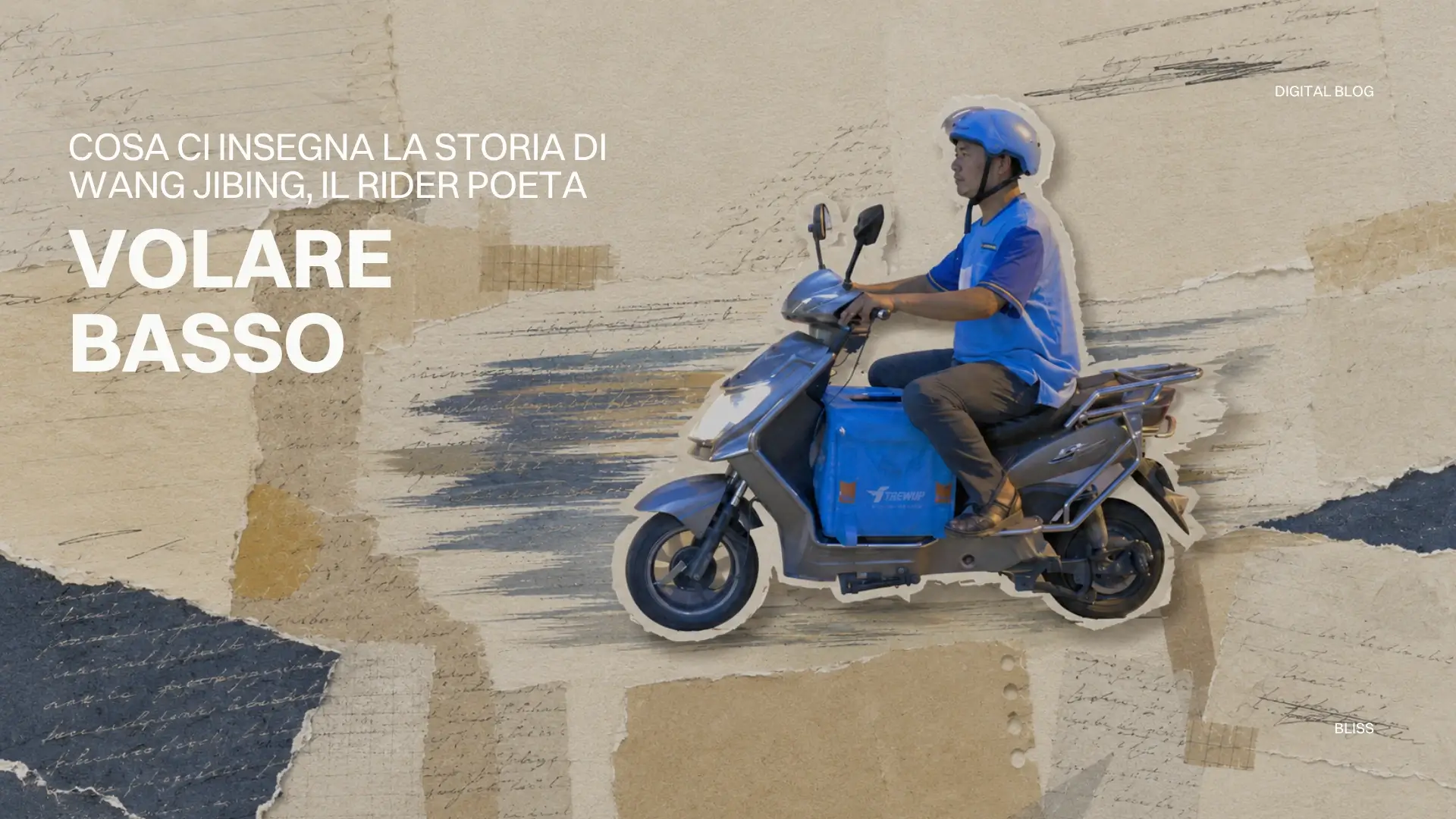
On 15 July 2026, Wang Jibing won a prestigious literary prize. In the days that followed, however, he was back pedalling with his backpack on as if nothing had happened.
And it is a harsh image, certainly. Terrible, perhaps, and even, in its own way, violent. Yet there is tenderness in this scene. Especially if we consider that in Low Flight, the poetry collection with which Wang Jibing won the 9th Lu Xun Literary Prize, there is a line that reads:
“Who says spreading your wings means flying high? Flying low is still flying.”
This is his story, and the great lesson an example like his can offer (to brands and beyond).
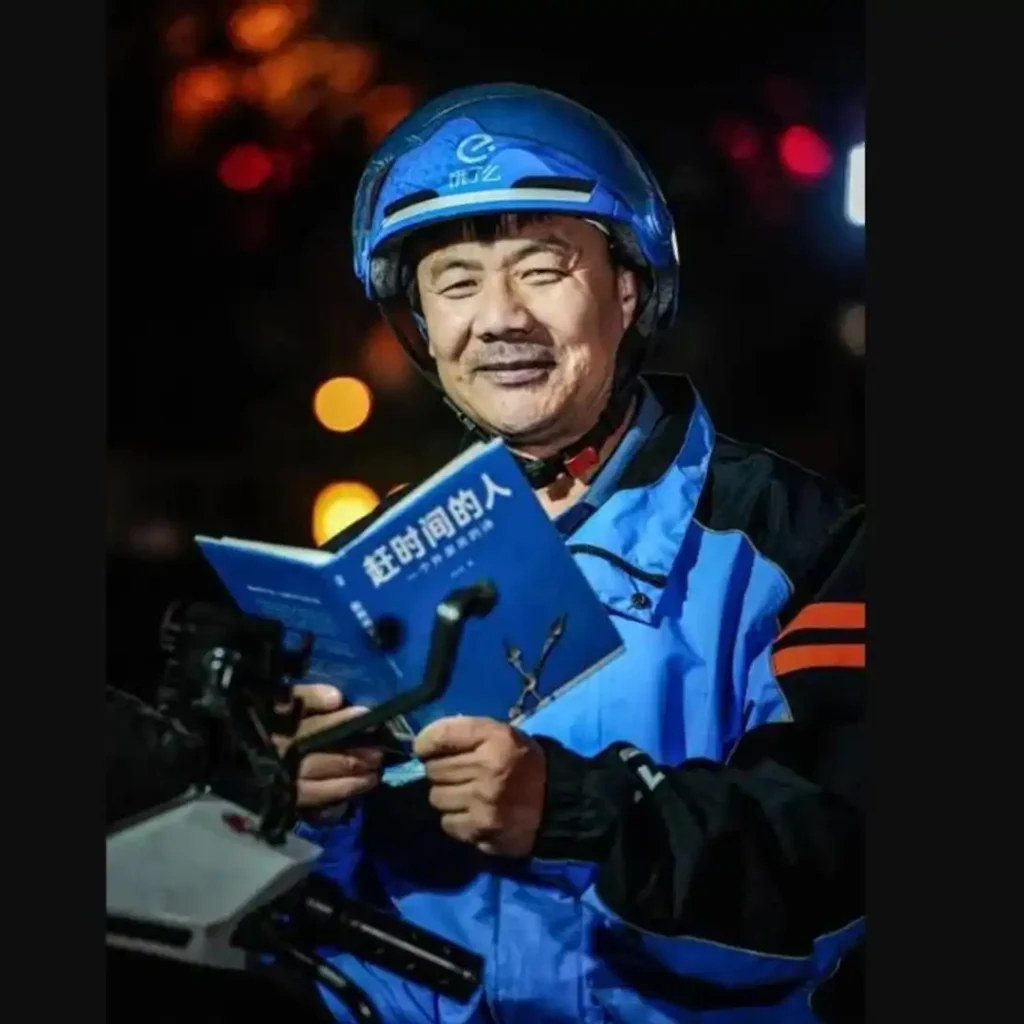
Who is Wang Jibing
Born in 1969 into a rural family in Xuzhou, in Jiangsu province, Wang has always lived a life of enormous sacrifice.
Because of his parents’ financial difficulties, he was forced to leave school as a teenager to help support the family. He thus joined the wave of Chinese migrant workers who, in the 1980s, moved from the countryside to the grey industrial megacities. For decades Wang did every kind of job to survive: porter, river dredger, driver, waste picker, street vendor.
Now 56, he has been delivering food in Kunshan since 2019. Work that, alongside his true passion, has earned him the nickname of “rider poet”.
A passion for poetry
Because, alongside all the humble jobs and immense hardship, Wang never set aside his passion for writing over the years.
Despite having no formal education, he began composing poems in his head during deliveries, then hastily scribbling them on scraps of paper or cigarette packets. Over the course of 150,000 kilometres of deliveries by bicycle, he has written more than five thousand poems: one of which (Gan Shijian De Ren, a man in a hurry) went viral on Weibo in 2022 with over 20 million views.
The poem grew out of a bad experience: a customer had entered the wrong address, forcing him to race from one side of the city to the other and, as a result, incur penalties for delays on his subsequent deliveries.
Those who live on the run know no seasons,
Only the last stop, and the one after that.
Since then Wang has become known across the country: until this July, when his third poetry collection won the Lu Xun Literary Prize, bringing him firmly into the spotlight.

The secret behind the breakthrough
Low Flight is a reportage drawing on interviews with around 200 riders, and through its verses it gathers the perspectives and lives of the overlooked who now form the backbone of the gig economy.
A paradox, considering that financially Wang no longer even needs the job to earn a living. He said so himself after his win. “But I love the atmosphere, and it keeps me fit. I want a down-to-earth life, and the prize will never change who I am.”
A line that perfectly captures the author’s admirable relationship between his identity and his work. For Wang, work is not a means of building something “higher”, but the ground in which the material exists. Poetry, then, is not an escape from humble work but its direct product. The streets, the waiting, the conversations, the toil and the dignity of an entire class of workers produce the art: art that in turn produces the serenity needed to keep working.
If Wang gave up deliveries, he would give up the source of his inspiration. His muse, we might say: no longer the angelic lady but experience, conflict, resistance.
Mind you, I have no intention of romanticising hardship, but this alone is a splendid lesson that Wang Jibing leaves us: value never comes from fleeing the world, but from the courage to cross (as often as proves necessary) that raw, exhausting world we call home.
A phenomenon, not an isolated case
Wang is not an isolated case. Chinese literature is going through a season in which the gig economy is producing outstanding authors (perhaps more than other countries and other languages are). Hu Anyan, a former courier, published I Deliver Parcels in Beijing in 2023, a memoir describing the life of delivery riders in the capital. Other authors from factory work, logistics and digital platform work are finding space in a literary landscape that had traditionally built its hierarchies around academic training.
This is also why the Lu Xun Prize awarded to Wang is an institutional signal: quality literature does not have a single social origin. On the contrary, it flourishes only out of hardship, in these times of deceptive comfort.
Flying low is still flying. And it shows you the world in a way that height never could.
New Connections (FAQ)
Does the Lu Xun Prize matter?
The Lu Xun Prize is one of China’s four most important national literary awards, alongside the Mao Dun Prize (long fiction), the Junma Prize (ethnic minority literature) and the National Prize for Children’s Literature. It is regarded as the benchmark award for poetry, essays, literary criticism, translation and short fiction. It is awarded every four years by the China Writers Association and is named after Lu Xun, the pen name of Zhou Shuren, the writer considered the father of modern Chinese literature. His best-known work, The True Story of Ah Q, is a social critique of early twentieth-century China. The overlap between Wang’s theme and Lu Xun’s legacy, the voice of workers and of society’s margins, is no coincidence.
Does the fact that Wang went viral on social media before winning the prize say something different from traditional literary paths?
Yes, and significantly so. The traditional path to literary recognition runs through academia, literary journals and publishers. Wang reached the Lu Xun through social media: a viral poem in 2022, a first collection in 2023, the prize in 2026. Traditional poetry has never had a path like this. It shows that platforms have created an alternative channel of visibility for authors whom the conventional literary system would not easily have picked up, but it also says something more precise: Chinese online readers recognised a value that the institutions then confirmed. The sequence differs from the conventional one, but the end result is the same.
What does it mean that he will not give up his job?
It means that Wang has rejected the redemption narrative, the idea that the prize marks the end of something hard and the start of something better. For him, working as a rider is not a phase to get past: it is the condition that makes his literary work possible. Leaving it would mean losing the vantage point that produced everything. He has said he will carry on until he is 60. Not out of financial necessity. By choice.