


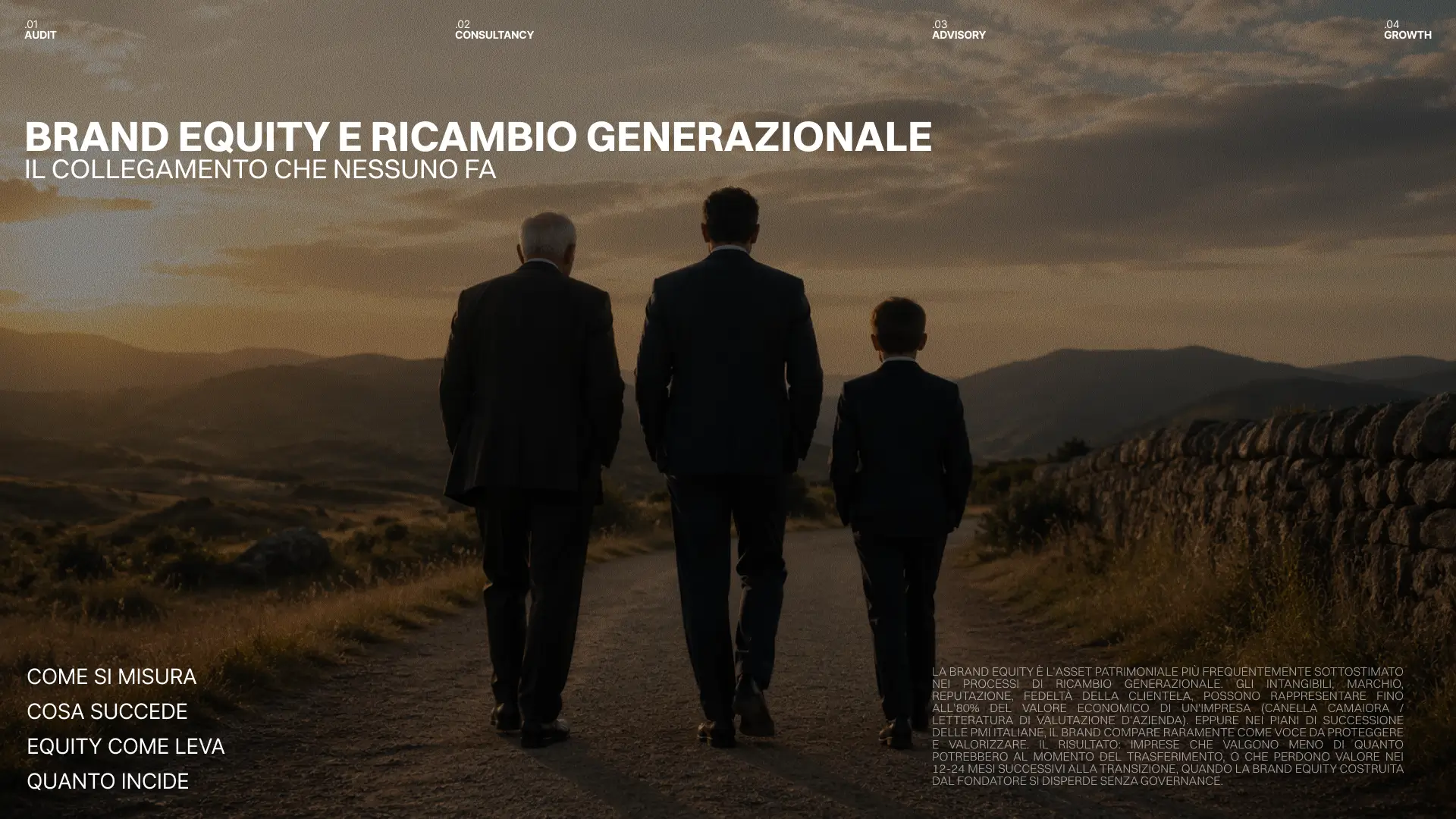
Brand equity is the most frequently underestimated asset in generational handover processes. Intangibles, brand, reputation and customer loyalty, can account for up to 80% of a company’s economic value (Canella Camaiora / business valuation literature). Yet in the succession plans of Italian SMEs, the brand rarely appears as an item to protect and enhance. The result: companies worth less than they could be at the point of transfer, or that lose value in the 12-24 months following the transition, when the brand equity built by the founder disperses without governance.
When the brand depends exclusively on the founder as a person, this risk is amplified further. The key person discount on company valuation, the reduction a buyer applies when the organisation depends excessively on a single individual, can be worth between 10% and 25% of the final price. A cost that could have been avoided by acting early.
Structuring a brand generational continuity plan before the transition is the operational difference between transferring value and dissipating it: it is not a communications exercise, it is an act of asset governance.
Brand equity and generational succession: the link nobody makes
In business valuation processes, whether for a sale to third parties or a buyout of shares between heirs, brand value directly affects the multiple the buyer or valuer is prepared to recognise. Factors such as brand reputation, customer loyalty and low dependence on the owner can significantly increase the perceived value and the multiple applied (b2beffect.it, 2025).
This is the critical point: in many Italian family-owned SMEs, brand equity is built around the person of the founder, not around the company’s value system. This means that when the founder leaves, whether through generational succession, sale or retirement, a significant share of brand equity leaves with them. A rational buyer discounts this risk in the price. An heir who does not govern the brand’s transition experiences it in revenue in the months following the succession.
The problem of biographical goodwill
In business valuation, the component of value not explained by tangible assets is known as goodwill. Goodwill includes brand equity, know-how, established commercial relationships and reputation. In family businesses, part of the goodwill is institutional, belonging to the company as a system, and part is biographical, belonging to the founder as a person and not transferable without explicit governance work.
A buyer in an M&A process distinguishes between the two components. A valuer handling a buyout of shares between heirs rarely does so explicitly, but the market does it anyway, in the months after the transition, when biographical brand equity dissipates and revenue signals the difference.
How to measure brand equity before generational succession
There are three internationally recognised brand valuation methods, each with its own specific scope of application:
| Method | Logic | When it is used | Limitation in a succession context |
|---|---|---|---|
| Cost approach | Sum of the costs incurred to create and maintain the brand | Young brands, internal accounting purposes | Systematically undervalues established brands, the ones most relevant in succession |
| Market approach | Comparison with comparable transactions (sales, licences) | Availability of reliable comparative data | Difficult for SMEs with niche brands: comparables do not exist |
| Income approach | Present value of future income streams attributable to the brand (royalty rate) | M&A transactions, financing, changes of ownership | Requires an estimate of future cash flows that depends on how much brand equity is institutional vs. biographical |
The income method is the one most widely used in significant transactions, and the one that most clearly exposes the problem of biographical brand equity. If a share of the future cash flows attributable to the brand depends on the founder’s presence, that share is either priced into the discount rate or cut directly from the projections. A brand with its own governance, codified values, a formalised customer promise and a documented visual identity holds up in the valuation better than one that depends on an individual.
What happens to brand equity in the 24 months after succession: the recurring pattern
The Osservatorio AUB (2025) documents that well-managed generational transitions produce on average +4.2% ROA and +8.8% revenue over the following three years. The implicit finding, the one that does not emerge from aggregate averages, is that poorly managed transitions produce the opposite effect. The mechanism is predictable:
- Months 1–6 after the transition: long-standing customers who bought from the person slow down or pause commercial relationships while they work out who their new counterparts are. Suppliers renegotiate terms. The market watches.
- Months 6–18: communication fragments: different messages to different clients, visual identity applied inconsistently, client promises that vary depending on who is speaking. Brand equity erodes silently, without any financial indicator yet signalling it clearly.
- Months 18–36: revenue signals the difference. Margins shrink because the premium positioning that justified the price has weakened. Recovering from this position takes twice the time and budget needed to prevent it with brand governance built before the transition.
Case: Prada-Versace and the measurable value of a brand
Prada’s acquisition of Versace, at an estimated valuation of around €1.5 billion (GBB Studio, 2025), is instructive not for its scale but for the principle. Versace is not worth €1.5 billion because it owns plant or machinery of that value: it is worth that because it has a brand with measurable reputation, a clientele with documented loyalty, established international distribution and a recognisable brand identity. All intangibles. All components of brand equity.
For an Italian family SME with turnover of 5 or 20 million, the principle is the same, at a different scale. If 30–50% of turnover depends on the founder’s personal relationships not transferred to the institution, that share is not worth as much in a business valuation as the remaining turnover. A buyer discounts it. An heir gradually loses it. The difference between the two positions is brand governance, built before, not during or after, generational succession.
A case from the Bliss portfolio: Risivi & Co. and brand equity as verifiable data
In discussions of brand equity in family businesses, the most common risk is treating it as a subjective estimate, “the brand is worth a lot”, with no anchor in concrete data. The case of Risivi & Co., a family-run Roman maker of luxury artisan jewellery, offers a different reference point: the growth in brand value is documented in the financial statements filed with the Chamber of Commerce, not in a sentiment report. When Bliss began working with the company, the brand had identity, product quality and cultural recognition, but no governance system capable of turning that perceived capital into measurable demand. The engagement covered full brand governance for twenty-four months: strategy, positioning, content, paid campaigns, PR and connections with artists and key figures on the Italian urban scene.
The figure that qualifies the brand equity of Risivi & Co. as real rather than perceived value is the change in turnover: from €206,000 to €556,000 in twelve months, with parallel growth online and in store. This change cannot be explained by advertising spend alone: it is the measure of what happens when a brand stops being biographical, tied to a person, to intuition, to the moment, and becomes a governed, coherent and scalable system. In the context of generational succession, this distinction is what separates a transferable brand from one that holds its value only while the person who built it is present. The full case study is available in the Bliss portfolio section: Risivi & Co., Case Study.
Brand equity as an active lever in business valuation: what to do before succession
Protecting and enhancing brand equity before a generational succession does not require extraordinary measures. It requires a systematic approach in three areas:
- Codifying the brand identity: written values, a formalised customer promise, a defined tone of voice, a documented visual identity with usage rules. The aim is to make the brand readable and applicable without the founder, by an heir, a manager, or a buyer who needs to integrate the brand into a larger group.
- Transfer of key relationships from the individual to the institution: clients who buy from the founder must be progressively introduced to new counterparts while the founder is still present. It is a process that takes 12–24 months and cannot be arbitrarily accelerated without reputational cost.
- Documenting the track record: case studies, measurable results, structured references. Brand equity is a concept; a documented track record is its verifiable proof, the kind that stands up in due diligence or a brand valuation report.
For the full picture on brand governance in generational transition, including the Bliss 4-phase framework and Italian scenario data, read: Generational Transition: Brand Identity and Continuity in Family Businesses.
New Connections (FAQ)
What is brand equity and why does it matter in generational succession?
Brand equity is the economic value a brand adds to a company compared with a product or service with no recognisable brand. In generational succession it matters because it is often the most exposed component of value: if brand equity is tied to the founder as a person, it partly leaves the company when the founder does. A brand with its own governance, codified values, documented identity and relationships transferred to the institution retains its value regardless of a change in leadership.
How is the brand of a family-owned SME valued?
The method most widely used in transfers and M&A is the income method: it calculates the present value of future income streams attributable to the brand, typically by capitalising the royalties generated or attributable. The method requires an estimate of how much of the future cash flows depends on the brand as an institution vs. the person of the founder: the higher the institutional component, the higher the value recognised by the valuer.
How much does the brand affect business valuation?
Intangibles, brand, reputation, know-how, customer loyalty, can account for up to 80% of a company’s economic value (business valuation literature). Among Italian SMEs the share varies in practice, but the direction is consistent: companies with low dependence on the founder and a documented brand identity achieve systematically higher multiples than those with the same turnover but an ungoverned brand.
Can a brand be lost during a generational handover?
Yes, not suddenly, but progressively. The mechanism is this: customers who bought from the person slow down or end their relationships; communication fragments without brand governance; the premium positioning that justified the price weakens. Revenue signals the loss 12–24 months after brand equity began to erode. Recovering it takes twice the time and budget needed to preserve it with governance built before the transition.
BLISS®
© 2026. ALL RIGHTS RESERVED