


Billboards. Slogans. Speeches in parliament.
Over the past two years an ancient word has returned to the European political lexicon with a meaning almost the opposite of its original one.
In Italian it is traced back to Giordano Bruno, who used it in 1584 to describe the return to the place one had set out from. In European languages it has circulated since at least the early seventeenth century with an equally neutral meaning: to migrate again, to migrate backwards, to return. In 2023, however, a jury of German linguists chose it as “ugly word of the year”, condemning its use as a euphemism for forced expulsions and mass deportations.
The word is remigration.
And even though its etymology speaks of return, the question it raises is: who has the power to decide where another person belongs?
To find an answer, we will need to follow two stories. The long, universal story of return, which belongs to human experience.
And the short, noisy story of a word turned into a political programme.
History of the term remigration
The ancient world
Before it became an electoral pledge, return was a longing.
Homer’s Odyssey is the story of a return that lasts twenty years. Ulysses does not want to stay in Troy, nor does he want to settle in the lands he passes through: he wants to return to Ithaca. The narrative of return as an epic of longing is so deeply rooted in Greek culture that it became a literary archetype for three millennia.
The phenomenon was rooted in historical reality. The Greek colonies founded between the 8th and 6th centuries BC along the coasts of the Mediterranean and the Black Sea maintained living ties with their mother cities. Colonists returned to trade, to take part in religious festivals, to die in the land of their fathers. The great Jewish dispersions of the ancient world, from 6th-century BC Babylon to the Roman exile of the 1st–2nd centuries AD, produced the opposite longing: return to Jerusalem as a religious and political hope that would run through twenty centuries of diaspora history.
Returning to one’s place of origin, in the ancient world, was at once an economic necessity, a religious obligation and a matter of identity.
It was, in other words, a human phenomenon.
Granted, though: the Greek world knew more than return.
It was accustomed to exile.
Being banished from one’s polis meant losing not only one’s home but also one’s political identity, rights and place in the community. Leaving it meant becoming vulnerable, depending on the hospitality of another people and discovering that belonging could be revoked.
A study of political refugees in ancient Greece shows that exiles were a frequent presence in Greek sources. Some were welcomed and protected. Others were seen as vagrants, beggars or threats to the stability of the city. Athens prided itself on its openness, while other poleis practised the expulsion of foreigners.
The story of Themistocles reveals its full ambiguity. Having helped secure the Greek victory over the Persians, he was ostracised by Athens and forced to seek refuge elsewhere, eventually landing at the Persian court itself.
Even then, therefore, being sent back was a political decision, and it drew the line between those who belonged to the community and those who could be excluded from it.

The Middle Ages and the early modern period
In ancient Greece, exile had already shown that belonging was not a permanent right. But it was in the Middle Ages and the early modern period that this same logic changed in scale entirely.
It no longer concerned only individual opponents or groups caught up in political struggles. Entire populations were forced to leave in the name of religious, cultural and, later, national uniformity.
1492 is the year of Columbus. It is also the year of the Alhambra Decree, by which Ferdinand of Aragon and Isabella of Castile ordered the Jews of their kingdoms to convert or leave Spain. Estimates of the number expelled vary, but the decree broke up entire communities that had lived on the Iberian Peninsula for centuries.
People born in Spain were sent elsewhere in the name of an origin that was supposed to determine where their true home lay.
For Muslims the process took longer. After the fall of Granada, forced conversions began. Their descendants, known as Moriscos and formally Christian, nonetheless continued to be regarded as a foreign body. Between 1609 and 1614 Philip III ordered their expulsion from Spain: some three hundred thousand people were removed from lands where their families had lived for generations.
In 1685 Louis XIV revoked the Edict of Nantes, abolishing the religious and civil protections granted to French Protestants. Some two hundred thousand Huguenots left France for England, the Netherlands, Switzerland, Brandenburg and other European territories. They took with them craft, commercial and manufacturing skills that contributed to the development of the economies willing to receive them.
Every expulsion sought to make a society more uniform. Yet it often ended up impoverishing the place that expelled and transforming the one that took people in.
Colonialism added a further ambiguity. Europeans who settled in the Americas, Africa and Asia created communities that, generations later, would face a difficult question: should they stay in the land where they were born, or return to a homeland known only through stories?
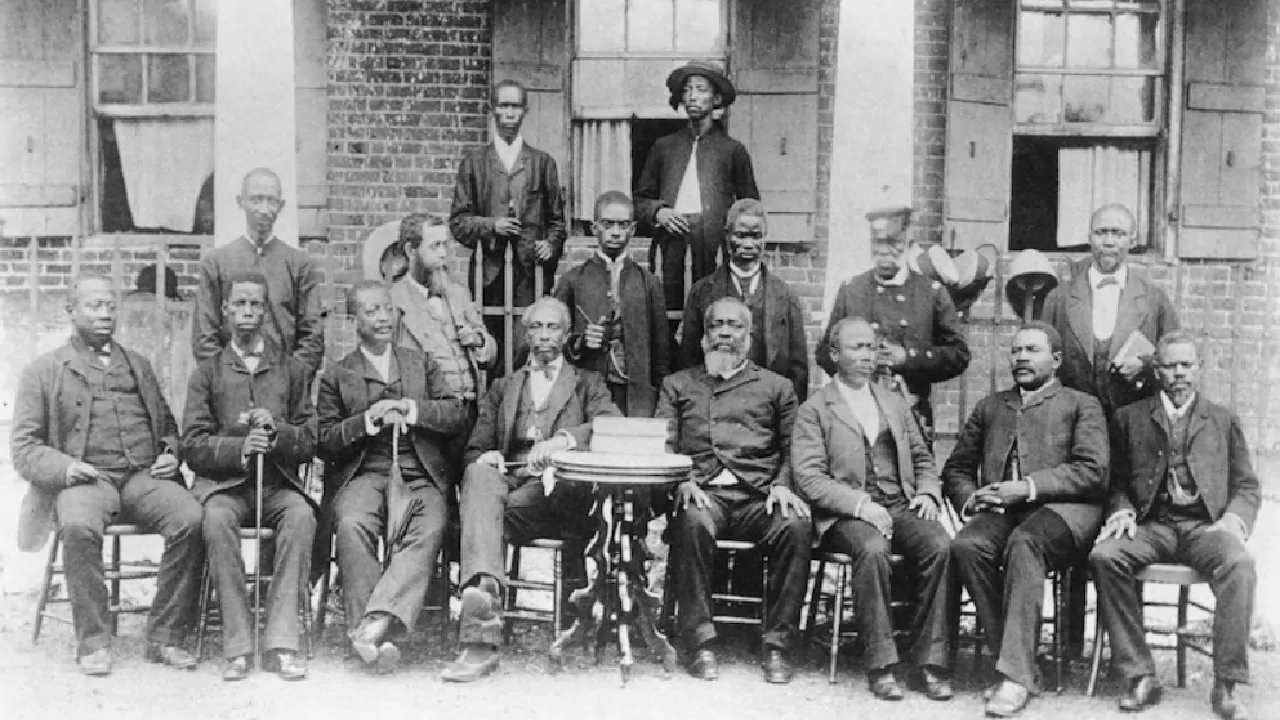
The same ambiguity runs through the founding of Liberia. In 1822 the American Colonization Society established a settlement on the west coast of Africa intended for free African Americans and people freed from slavery. The project was presented as a return to Africa. Many of those it targeted, however, had been born in the United States and had never seen the African continent.
Colonisation held together different and often contradictory aspirations. Some African Americans saw in it the chance to build a society free from American racism. Some white supporters, by contrast, saw resettlement as a way to remove a free black population that called into question an order founded on slavery.
Here too, the word “return” concealed a decision taken by others. It determined where a person’s home was not on the basis of where they had been born or had lived, but of the origin attributed to them.
The post-war period
The twentieth century goes a step further. At the end of the Second World War, more than fourteen million Germans and people of German origin fled or were expelled from the territories of Central and Eastern Europe. They came mainly from the regions assigned to Poland and the Soviet Union, and from Czechoslovakia, Hungary, Romania and Yugoslavia.
Borders had changed. People, at least according to the logic behind those transfers, had to change with them.
Many had lived in those territories for generations. Some had never lived in Germany. Yet their linguistic or family origin was enough to determine where their new destination should be. What was presented as a return was, for millions of people, an expulsion to a country they barely knew.
Decolonisation in the 1950s and 1960s produced further large-scale movements. In 1962, with Algerian independence, some 650,000 people left the country within a few months, most of them heading for France. Among them were the pieds-noirs, the Europeans of Algeria, many of whom belonged to families that had been settled there for several generations.
They too were called “repatriates”. But the homeland they were returning to was an unknown place.
Similar dynamics accompanied the end of the colonial empires in Angola, Mozambique, Rhodesia and Kenya. European settlers were leaving territories in which they had been born, but which the colonial system had allowed them to inhabit from a position of privilege. The return to the mother country was at once a necessity, a loss and a consequence of the end of a political order.
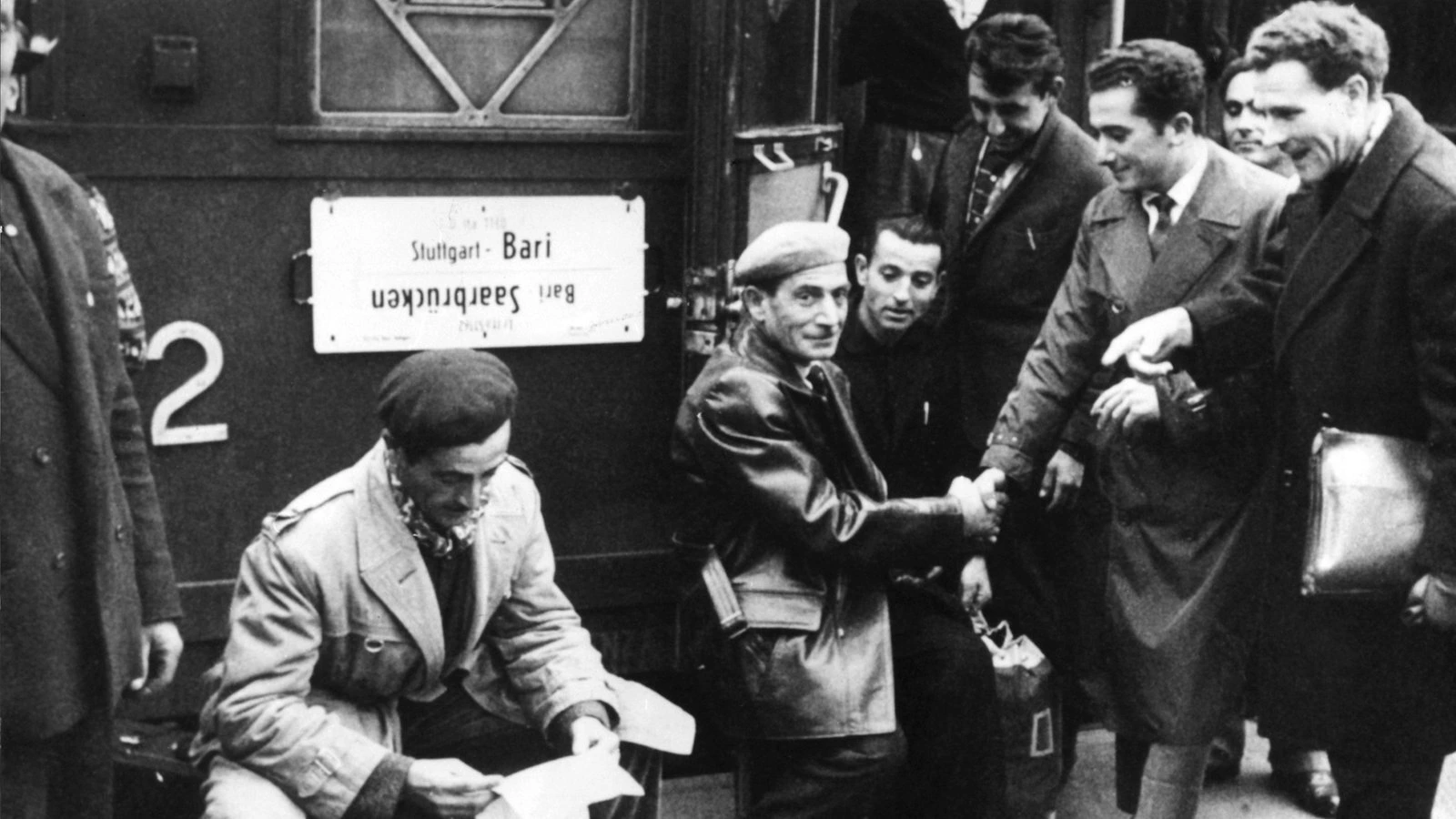
In the years of the European economic miracle, however, return took on a different form. To address labour shortages, West Germany signed recruitment agreements with countries such as Italy, Greece, Turkey and Yugoslavia. The workers who arrived were called Gastarbeiter: guest workers. The name already contained the fate envisaged for all of them: to go back home, as soon as possible.
Between the late 1950s and 1973, some fourteen million foreign workers arrived in West Germany. Eleven million left again. The others stayed, were joined by their families and built part of contemporary German society.
Those who returned brought back skills, habits, objects, expectations and different ways of imagining the future. The communities of origin changed too, through the encounter between those who had left and those who had stayed.
Remigration today
Now to the present day. Specifically, to 2011, when the French philosopher and writer Renaud Camus published Le Grand Remplacement. His theory is that immigration is progressively replacing Europe’s native populations, demographically and culturally; in doing so, he gave a name to a view that had been circulating in certain political circles for some years.
The name most associated with spreading the concept, however, is Martin Sellner, an Austrian activist of the Identitarian Movement, who in 2024 published the book Remigration: ein Vorschlag with the publisher Antaios. The central thesis of his text is that the voluntary or incentivised repatriation of “unassimilated” immigrants would be not only legitimate but necessary for Europe’s demographic and cultural survival.
The turning point came in January 2024. The investigative journalism network Correctiv revealed a secret meeting held in Potsdam in November 2023, in a lakeside villa near Berlin. Among those present were AfD figures, Sellner, members of the German upper middle class and several CDU members. The plan presented envisaged the expulsion not only of irregular immigrants, but of naturalised German citizens and anyone not deemed “assimilated”. The most extreme scenario: the deportation of millions of people to a “model state” in North Africa.
The scandal produced the opposite effect to the one many participants would probably have wished for. A word confined to identitarian far-right circles suddenly reached millions of people.
Streets, ballot boxes and parliaments
The reaction in Germany was immediate.
In the weeks after Correctiv published its investigation, hundreds of thousands of people took to the streets against the Potsdam plan and against the AfD. Hamburg, Munich, Berlin, Cologne, Frankfurt: some of the largest demonstrations in the history of the Federal Republic.
The outcome, however, was counterintuitive. Not only did the AfD not collapse, it won 16% in the European elections of June 2024, and in the following year’s federal election became the country’s second-largest party. The panel of linguists that had named Remigration the “ugly word of the year 2023”, pointing to its euphemistic use to mask the idea of mass deportations, had not stopped its spread. On the contrary, it had accelerated it. Triggering a genuine escalation.
In Austria, Herbert Kickl’s Freedom Party (FPÖ) won the federal election in September 2024 with 28.8% of the vote, with remigration spelt out in its electoral manifesto. It was the first time the term had appeared in an official document of a governing party in Western Europe. In January 2025, for the first time in an Italian national parliament, Lega MP Rossano Sasso declared in the chamber: “Remigration is the only solution”.
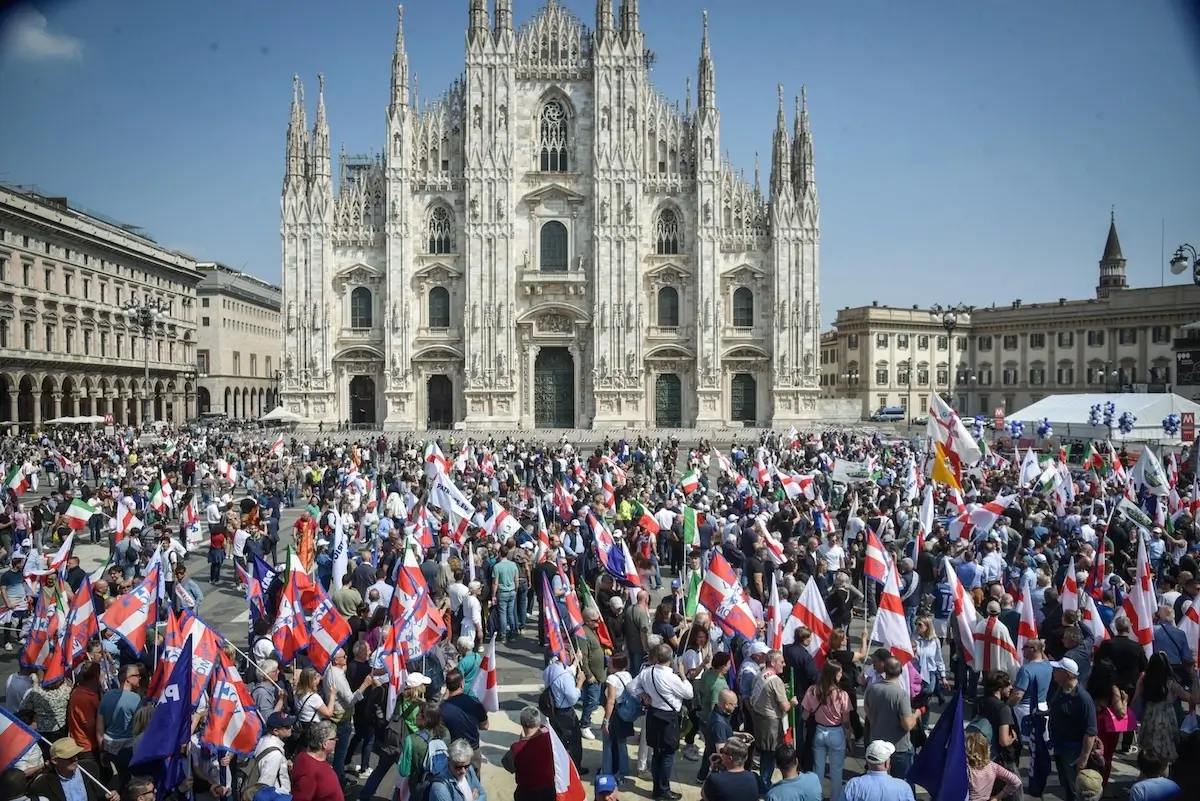
In May of the same year, the first Remigration Summit was held in Gallarate, with four hundred activists from across Europe. In November 2025, the US Department of Homeland Security posted a single word on X: Remigrate. On 26 March 2026, the European Parliament approved the Returns Regulation with 389 votes: detention centres outside the European Union, expulsions to third countries with no direct connection to the migrants, detention of up to twenty-four months. In June 2026, in Rome, a march for remigration was met immediately by a large anti-fascist counter-demonstration.
Twenty-seven months separate the Potsdam scandal from the vote in Strasbourg. In twenty-seven months, a concept that in 2023 cost anyone who uttered it their political career became the subject of a vote in the most important parliament in the Western world.
One word, two stories
Remigration, over its long history, has had two faces.
The first is return as a choice.
The worker who, after thirty years abroad, goes back to their own country. The refugee who returns as soon as conditions allow. The migrant who decides to start again in the place they had left.
In 2024 the assisted voluntary return programmes of the International Organization for Migration supported almost 59,000 people in returning home and reintegrating. Here, return is a supported option, chosen by those who leave and built around their own story.
The second is return as identity-based selection.
It does not concern only those who have no right to remain. It introduces a distinction between citizens regarded as fully belonging to the community and citizens whose belonging remains conditional, incomplete, revocable.
The two faces do not resemble each other. They share a word, and nothing else.
The history of migration has always been a history of departures and returns, of identities that change, of people who carry to a new place what they were in the one before. Every great city preserves traces of this movement. Every language contains words born of the encounter between different peoples.
The question, then, is not whether human beings return to the places they left. They always have. The question is when return stops being a choice and becomes a sentence.
A word can keep its etymology and lose its meaning. Remigration still means return. But our times force us to ask three more questions.
Whose return?
Decided by whom?
To which home?
New connections (FAQ)
What does remigration mean?
In its original sense, remigration means a person’s return to the place they had left. In contemporary political debate, however, the term is used to describe repatriation policies aimed not only at irregular immigrants but, in some cases, also at naturalised citizens or those considered unassimilated.
What is the difference between repatriation and remigration?
Repatriation is a legal procedure concerning a person’s return to their country of origin, either voluntarily or following an official order. Remigration, in current political usage, often introduces a broader, identity-based criterion: it does not merely ask who has the legal right to stay, but questions who can be considered a full member of the community.
Why has the word remigration become so controversial?
Because a seemingly neutral word can make far more radical proposals more acceptable. Talking about return softens the idea of expulsion and pushes a decisive question into the background: who determines where a person’s true home is? The controversy arises when return is no longer an individual choice, but a destination imposed on the basis of origin, culture or ascribed belonging.