


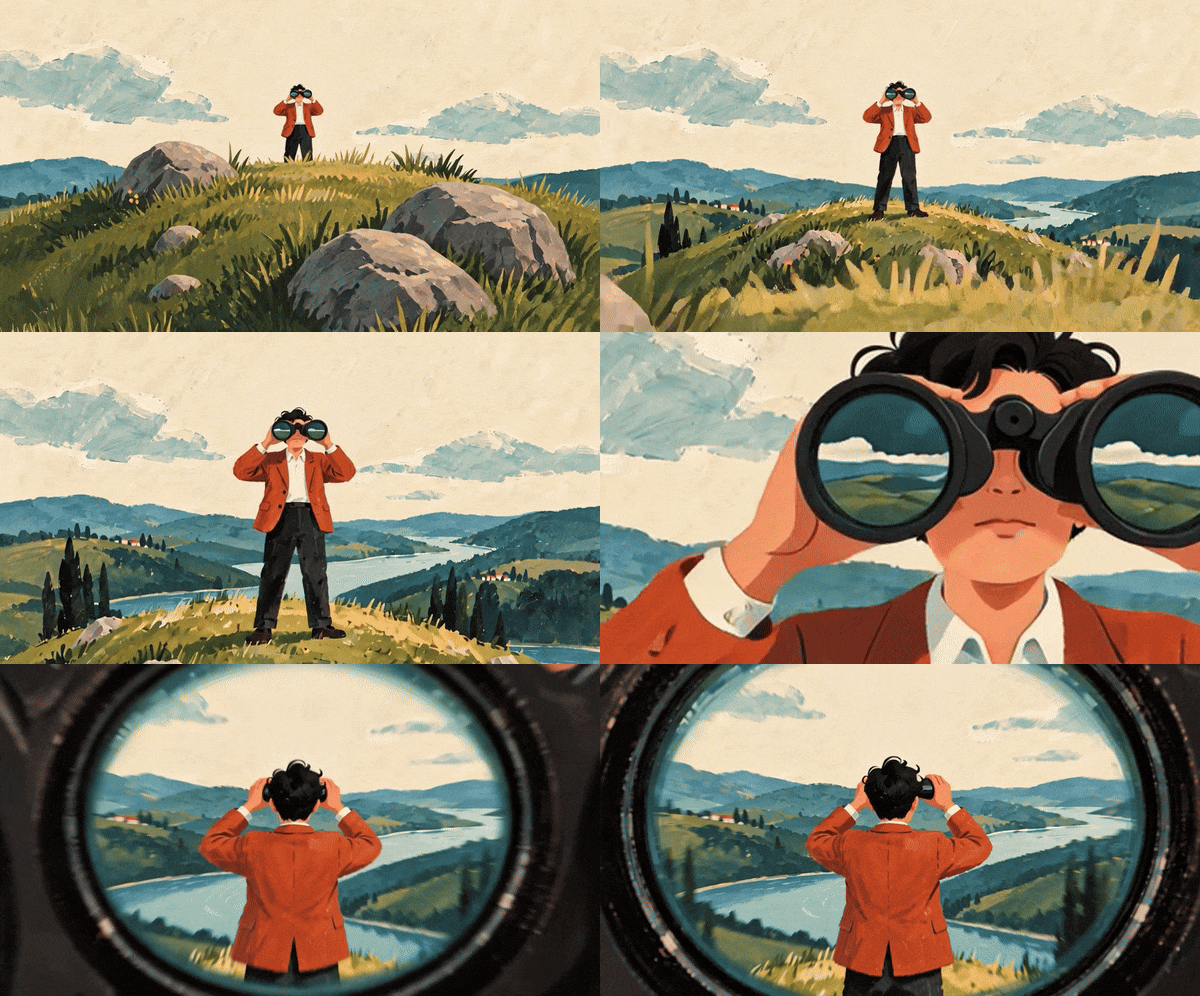
Every decision has a horizon.
For many companies, that horizon is the quarter: they look at the month-end figures and at what the board will want to see at its next meeting. In practice, they drive by sight, through the fog. Eyes on the bumper, and every bend comes as a surprise.
We, on the other hand, see far ahead. And I say so without much modesty. Seeing far ahead comes at a cost: it means thinking in long cycles and accepting that, for a while, it will look as though you got it wrong.
The studio we built while offices were emptying
Take our Rome office. A major investment: an attention to detail that took months of research, and even more months of work. Yet this was a time when many companies were sending their staff to work from home and office space looked like the first cost to cut. Remote working has given a great deal to many people, and we do not say this against them: we were simply looking for something else for ourselves.
So we built a studio. We bet on the people in our team: on the idea that a group works better when it has a place to meet, when people look at a piece of work together and spot problems before they turn into an e-mail. A company is not a sum of people connected to the same screen. It is shaped by small, repeated habits, like the morning coffee, and habits need a place.
A studio costs money, and on the day you build it you cannot prove to anyone that it was a good idea. You pay the rent and fit it out with care, so that whoever walks in each morning feels they are worth something. It is an investment in culture that appears in no column of the balance sheet.
The writer we hired while others were cutting
And so, while everyone else was sending staff home, we built our own home, believing in the power of people. We did the same with words: while everyone was laying off copywriters and automating writing through language models, we looked further ahead and hired a writer.
Granted, our competitors’ reasoning seemed straightforward. If a text can be produced in a few seconds at almost no cost, why pay someone to write it? Do the sums, and the copywriter looked like a line to strike from the budget.
We made the exact opposite choice. We sought out the best writer and brought them into the team. Because when text is everywhere, what counts is having something to say and knowing how to say it. A brand is also made of words: those spoken, those deleted. These are choices that call for judgement, and judgement is formed over years of craft.
We knew the written word would come back. When everyone uses the same tools, texts tend to sound alike. At that point companies look for someone to make them sound different, but how can they manage it?
We wanted that person already on the team, and we did so by giving them time to learn the work, the clients and the way each one speaks.
Meanwhile, to anyone looking in from outside, we were a company hiring in the opposite direction to the rest of the industry. Some thought us mad, others visionary. We were simply looking further ahead.
Why we see far ahead: an occupational habit
Placed side by side, these two choices point towards the same horizon: what is built slowly and what no one can buy in a week. A voice and a team take years to become recognisable, and they are worth more to those who built them before anyone else.
A company that thinks in quarters does not consider them, because neither shows up in the month’s results.
For us it is the opposite, and the explanation is less romantic than it sounds: it is an occupational habit. We are advisors: we work alongside CEOs, founders and Boards of Directors on their strategic decisions. And for anyone who has to decide quickly, a brand has a structural flaw: it always responds late.
When a company cuts marketing to balance the books, the saving shows up in that period’s income statement. The loss of recognisability comes years later and, when it does, it is hard to trace back to the decision that caused it.
Anyone in this line of work spends their days holding two timescales together: the fast one of those who have to close the books, and the slow one of the brand. Our job is to remind each side that the other exists too. After a few years the habit stays with us, and we find ourselves measuring even the decisions that concern us against the long term. That is how the studio and the culture department came about.
The price of perspective
Of course, looking far ahead has a cost, and it is right to say so. For a time the choice looks wrong: one more writer while others cut, one more rent while others save. Those looking in from outside see the expense but not yet the reason. The same happens with details: taken one by one, they seem to have no measurable return, and only when added up over time do they become quality and reputation.
That is why perspective depends so much on who leads. They must hold firm through the months in which the bet has yet to deliver anything, and protect those carrying it forward from those who want results now.
How to look far ahead
Looking far ahead is not easy. Your eyes have to grow used to the horizon before you can manage it.
To do this, we ask ourselves one question: what will we need in a few years’ time, regardless of what pays off this quarter? When the answer is a skill or a team, it usually pays to invest now, because it costs less than chasing it when everyone is looking for it.
Then you fix the horizon. A long-term bet is not judged at the end of the quarter: you decide beforehand when to look and what to expect.
And you, in your company: how far ahead do you see? Take your last five important decisions and next to each one write how long it will be before you know whether it was right. If the answer is always ‘at the end of the quarter’, you are in the fog.