


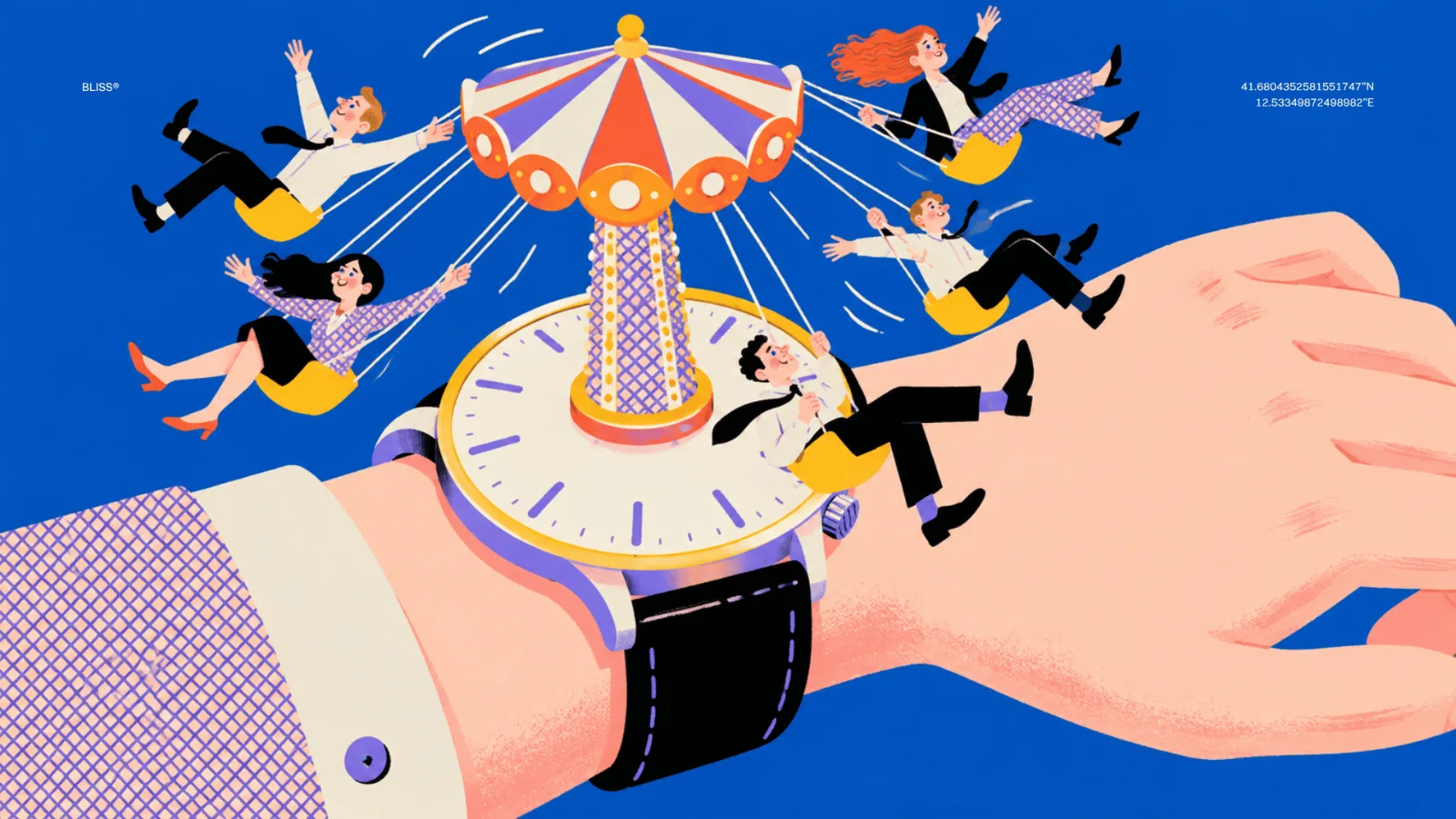
Working hours are a cage.
Granted, they can be useful, but they confine. They imprison. They limit what is possible.
Think about it. There are days (and it happens to us often) when the right idea only comes after the computer is switched off. Others when it comes at nine in the morning, over a hot coffee. Others still when it simply turns up: on a Saturday, or a Sunday morning, when we least expected it.
What should you do in those cases? Should the work be put off until the next day?
If we worked to live, probably yes. That’s not us.
A true advisor knows these scenarios. That is why Bliss has no set hours.
Because we live what we build. And building it well is our one true hourglass.
The clock is a managerial shortcut
Monitoring time requires less expertise than evaluating a result. To know whether someone arrived at nine, a glance at the clock is enough; to know whether they made the right decision, you need context, criteria, experience and a willingness to take responsibility for the judgement.
Many organisations choose the first path. Perhaps without even realising it. Presence becomes proof of reliability, speed of reply proof of dedication. At that point people quickly learn what is rewarded: if the company measures presence, it will get presence. If it measures activity, it will get activity.
The problem isn’t how many hours people work (after all, it’s normal for some periods to demand intensity while others allow more breathing room), but the meaning we attach to those hours. An hour remains a container. Inside it there may be a decision that changes a project, or sixty minutes of simple, banal, empty availability.
Freedom needs clear agreements
In its modern sense, the word freedom seems almost to have become a synonym for anarchy.
In reality, it is not.
True freedom takes into account the freedom of others, the commitments made and one’s responsibilities. That is why agreements matter: what we have to deliver, by when, and to what standard of quality.
Letting the working day dictate commitments of this kind means thinking in silos. But in a confined environment, what room can there be for growth?
A job description clarifies what contribution to expect and which responsibilities to entrust to the person doing the work, but then there is a further level: dedication, before any freedom.
That is why an autonomous organisation needs more clarity. And here lies the part that is often left out when people talk about flexibility. No fixed hours give licence to disappear. No autonomy makes a delivery optional.
In our case, the difference is that time is organised around responsibility, rather than turning responsibility into a by-product of time spent.
Working hard and working well are two different problems
There is another trap, too: replacing the cult of working hours with the cult of permanent availability. Frankly, I think that might be even worse. Someone who can work whenever they want should not become someone who works all the time. Flexibility loses all its value if the price is feeling on call at every hour.
What matters to us is that work has an understandable boundary. It may be a deadline, a meeting, a shared responsibility, a moment when the whole team needs to be present. Outside those boundaries, the organisation should have enough trust to leave people to build their own way of reaching the result.
This trust doesn’t come from goodwill. It comes from structure. When roles are vague, control grows because no one is quite sure who answers for what. When ownership is clear, the need for oversight shrinks. A mature organisation doesn’t give up control: it shifts control from visible behaviour to the outcome someone is accountable for.
What “we have no set hours” really means
It means we don’t celebrate whoever stays the longest. We don’t ask anyone to fill eight hours when the day’s work needs five, nor do we automatically regard someone who takes ten as virtuous. We prefer a person who delivers well, gives early warning when something slips, knows how to ask for help and leaves others in a position to work.
It means we can accept that intellectual work has irregular rhythms. And, above all, it means that freedom must be earned every day through reliability.
Autonomous people put others at ease. If they promise Friday, there is something waiting on Friday. If they see a problem, they raise it before it becomes an emergency. If they need to change plans, they say so. Trust grows from this predictability, not from physical presence or clocking in.
The real luxury is not having to check
A CEO who needs to know where every person is, what they are doing and how long they have been doing it has an organisation that is very (perhaps too) costly to run. Every step demands attention. Every absence creates anxiety. Constant control looks like discipline, but it consumes an enormous amount of energy.
The most evolved form of control comes when the company can stop watching constantly, because deadlines, responsibilities and standards are clear enough to make the work legible even without supervision.
This is the company model we have chosen and want to keep strengthening: a company in which everyone knows what they need to do without someone else constantly telling them when to do it.
We have no set hours. We have decisions to make, partners to respect and standards that don’t change with the time of day. The rest is time.
And time, when an organisation works, should once again belong to the people who work in it, too.
Domande frequenti
What does working autonomously mean?
Being able to organise your own work within clear objectives, responsibilities and agreements, coordinating with the people who depend on that contribution.
How do you hold flexibility and reliability together?
Through agreed deliverables, moments for discussion and timely flagging of difficulties. The quality of the agreements allows others to organise themselves.
Does flexibility mean always being available?
Flexibility also needs boundaries: rest periods, working agreements and the availability needed for coordination must be clearly recognisable.