


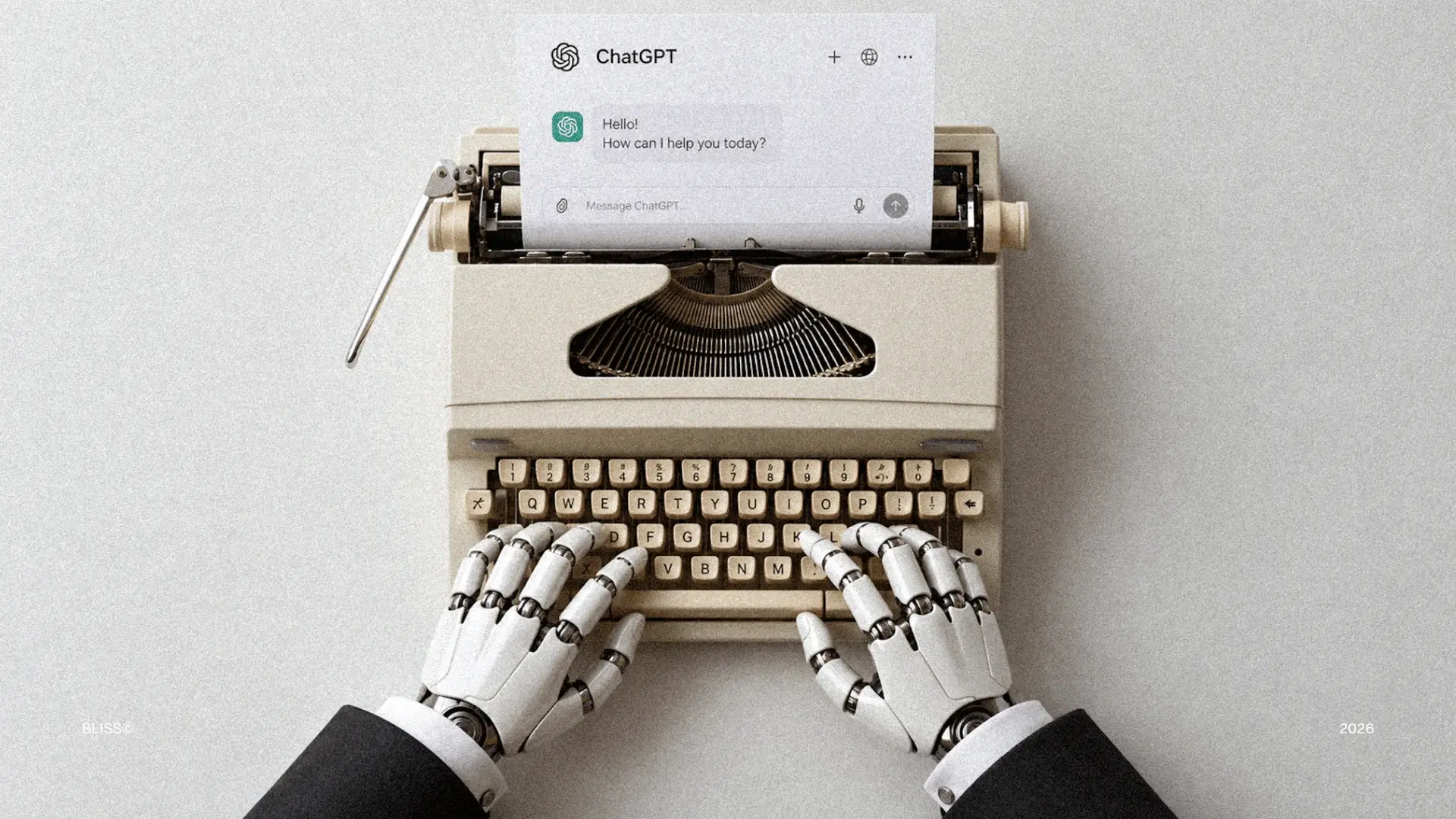
Enough.
Enough, we are tired.
It was 1920 when Karel Čapek first imagined a society that entrusted much of human labour to machines. At the time the idea seemed revolutionary: and so the play reached the stage in Prague in 1921 amid widespread clamour, introducing the word robot.
That was a lifetime ago. A hundred years, in fact. That story was about the dependence that arises when a technology stops being a tool. It was fiction. Today it is normal.
Because if, after the First World War, the robot entered the factory, today it walks straight into the inbox and no longer surprises anyone.
Of course, it does not go unnoticed. You recognise it immediately, from the very first line. Not because it writes badly, but because, for all its correctness, it says nothing about the person signing or the company they represent. It produces communication that no longer builds identity and that comes across as interchangeable.
And let’s say it, let’s shout it loud:
we are sick of reading this kind of email.
And like us, many, many other organisations.

The email is already part of the selection
It is no coincidence that we have started selecting our partners partly on how they choose to present themselves.
Before the call, before the portfolio, before the proposal is even discussed, there is often an email. A generic, mass-produced email, built to be sent to fifty different companies, says something: how much the recipient has been researched, how clear the reason for getting in touch is, how much care goes into a relationship before it even exists.
It is a criterion we also find in organisations used to assessing new opportunities constantly. Y Combinator advises founders who approach investors to write messages that are short, specific and relevant to the recipient. That is because an email, in such contexts, is already a small sample of work. And when you have to choose who to build something with, even the way someone chooses to open the relationship inevitably becomes part of the assessment.
The sound of homogeneity
This happens because AI-written emails, posts and articles are irredeemably homogeneous.
Humans write irregularly. They use odd constructions. They switch register mid-sentence. They leave in unnecessary details because that detail matters to them. They make references that only make sense within that relationship. These imperfections are a signature.
When the tool is used without a clear direction, it drifts towards plausible, orderly, easily acceptable phrasing. LinkedIn coined the term “AI slop” for exactly this kind of output: polished on the surface, but lacking perspective, experience or substance (we wrote about it here).
When everyone uses the same tool with the same prompts, everyone sounds the same. In an ecosystem where everyone sounds the same, those who stand out are the ones who still have a voice of their own, and a firm will.
Further reading
LinkedIn versus AI slop
What is really lost
A recognisable voice comes from a point of view, from linguistic choices that may be controversial but stem from vision and experience, and from the ability to adapt tone without losing identity.
From this perspective, the email written with ChatGPT may be the most visible case, but the phenomenon is broader. It extends to LinkedIn, press releases, sales proposals. Everything levelled: razed to the ground in its most personal traits.
We say it often: when words are interchangeable, the recipient’s memory has almost nothing to hold on to. And even proposals for collaboration no longer carry the same charm, or appeal.
The efficiency paradox
Those who use AI to write emails think they are saving time. In a narrow sense, they are. They produce more in fewer hours.
There is, however, a hidden cost: every communication that leaves no trace uses up an opportunity for a relationship. The recipient opened that email, read it and remembers nothing about who sent it. So they decide not to take the collaboration further: the time saved turns into a cost that cannot be recovered.
An email written by a person can be shorter, less polished and far more effective, because it carries the signal that someone thought about that specific recipient, at that moment, for that reason.
How much web content is still written by people
Quarterly share of all published content, average of three automated detectors
The crossover happened in 2025. Until the end of 2022, AI-generated content was below 5%; over the course of 2023 it rose to 35%, and since 2025 the two shares have hovered around 50%. The dashed line marks the halfway point.
Source: Graphite, based on 55,400 pieces of content extracted from Common Crawl (March 2026). AI detection by Pangram, GPTZero and Copyleaks between April and May 2026.
The real problem with AI-written emails
AI writing emails, however, is only the symptom.
Those who hand their communication over to a generative tool without direction have no voice to express. They do not know what they want to communicate, to whom, in what tone or on which topics. They only know that they must communicate, because ‘you have to be present’. At that point the tool fills the void with what it does best: a plausible version of what anyone might say.
The issue remains direction. An organisation with clear positioning and a defined voice can use AI as an accelerator: it provides examples, constraints, information hierarchies and tone criteria, then uses it to reach a first draft faster. An organisation without direction ends up asking the tool to invent one on its behalf.
The result is the email you have already read a thousand times.
Čapek understood this a hundred years ago: when we delegate a task, the point is to work out what we really want to stop doing and which skill needs protecting.
We don’t have one answer for everyone. But of one thing we are certain: we are sick of reading this kind of email. Don’t send them to us…
Domande frequenti
Can AI be used well in professional communication?
Yes. It works well when given a clearly defined direction: voice, tone, context, objective, constraints and real material. It can speed up drafting, editing and adaptation. When it also has to invent the point of view, it is far more likely to drift towards generic communication.
How do you recover a voice of your own after years of generic communication?
Through the repetition of specific positions over time. It means selecting a few topics on which the company or the person genuinely holds a point of view, defining rules of voice and no longer filling the calendar with content that could belong to anyone. Recognisability is built through accumulation.
How can you tell whether your communication has a distinctive voice?
A simple test is to take a few recent texts, remove the name and logo, and ask people who know the brand well whether they could attribute them. If they could belong to several competitors, the communication may be correct without yet being recognisable.
Why does this matter to Bliss?
Because voice is a consequence of positioning. In Bliss projects we work to turn identity, strategy and brand criteria into a system clear enough to be used by people, teams and generative tools without making every message interchangeable. AI accelerates a voice when that voice already exists.