


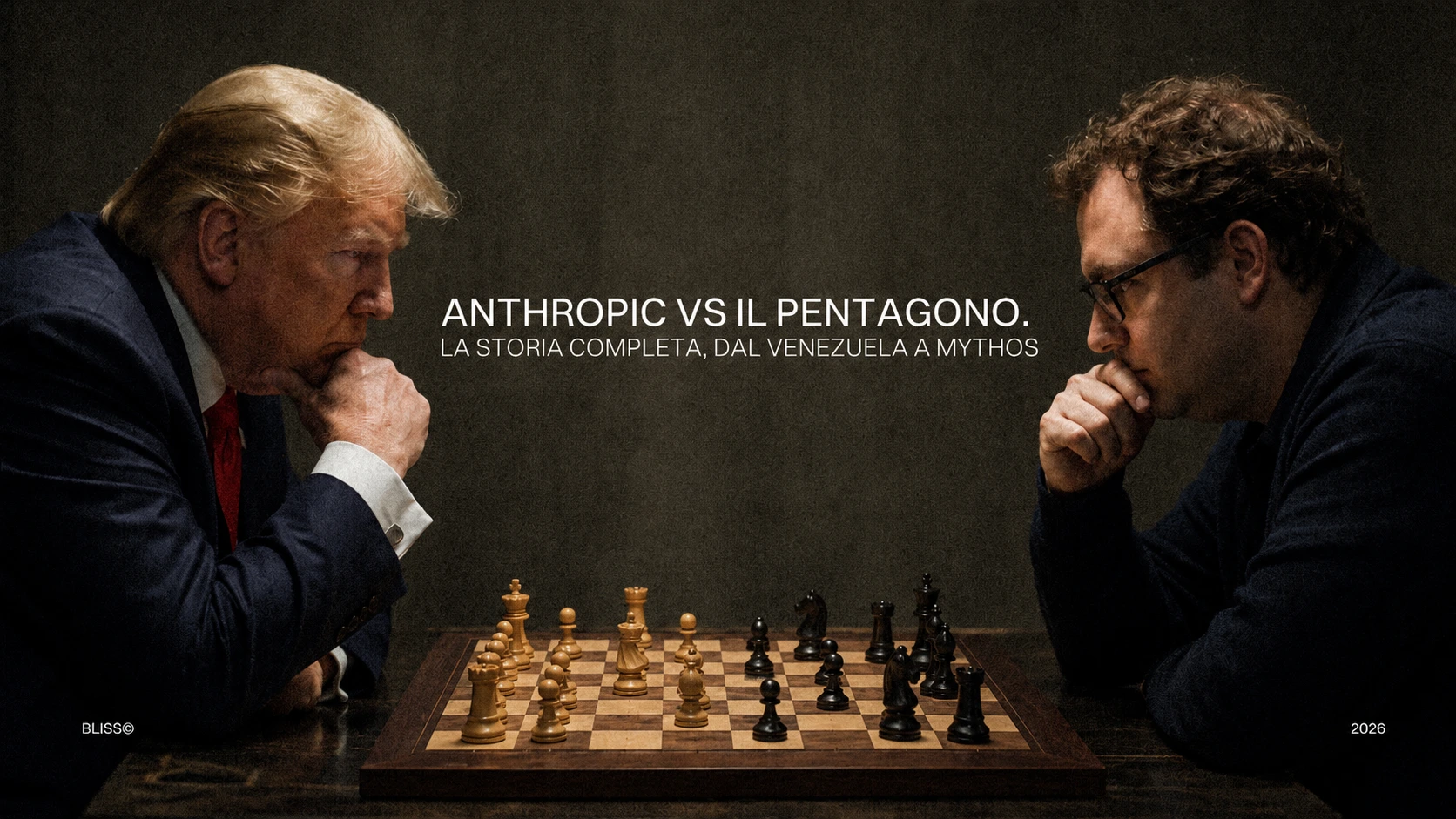
What this sequence reveals is a case without precedent in the history of AI.
What am I saying? It is without precedent in the history of relations between the workforce and politics. Perhaps in the history of humanity itself.
In five months Anthropic (the parent company of Claude and of today’s most advanced LLMs) discovered that its most widely used product had been used in a military operation, turned down a $200 million contract, saw its most powerful model leak by mistake, and built a response.
This is the sequence of events. But it is also more: it is the story of the principles, and the governance, that changed relations between Anthropic and the US government. Between Dario Amodei and Donald Trump. And whose consequences are not yet entirely clear.
January 2026: the raid in Venezuela
On 5 January 2026, Nicolás Maduro arrives at the federal court in New York escorted by federal agents, charged with narco-terrorism, drug trafficking and money laundering. The operation that led to his capture was carried out by US special forces in a single night. In fact, in just one hour. Seven service members wounded. 83 people, according to the Venezuelan government.
A few weeks pass and, while the world is still recovering from the shock of the lightning operation, entirely unexpected, on 14 February 2026 The Guardian publishes a startling investigation. Claude, Anthropic’s flagship model, had been used during the operation. The deployment had in fact taken place through the partnership between Anthropic and Palantir Technologies, a data analytics company that has worked for years with the Department of Defense and federal law enforcement agencies, and which has implemented all its own structures and processes through Claude. According to William Christou, the operation reportedly included an AI-assisted targeting component, with strikes on multiple sites in Caracas.
In short, for the first time in a military operation involving casualties, AI was used as a support tool. The problem, however, is that Anthropic had not been informed of this, and its guidelines explicitly prohibited the use of Claude for violent purposes, weapons development and surveillance.
Pressed by the media, Anthropic stated that it:
“unable to comment on whether Claude, or any other AI model, was used in specific operations, classified or otherwise”.
while specifying that any use of Claude is required to comply with its Usage Policies. The Department of Defense did not comment. Anthropic stated that it would reassess its partnership with the Department of Defense in light of the revelations. And from there, the escalation would begin.
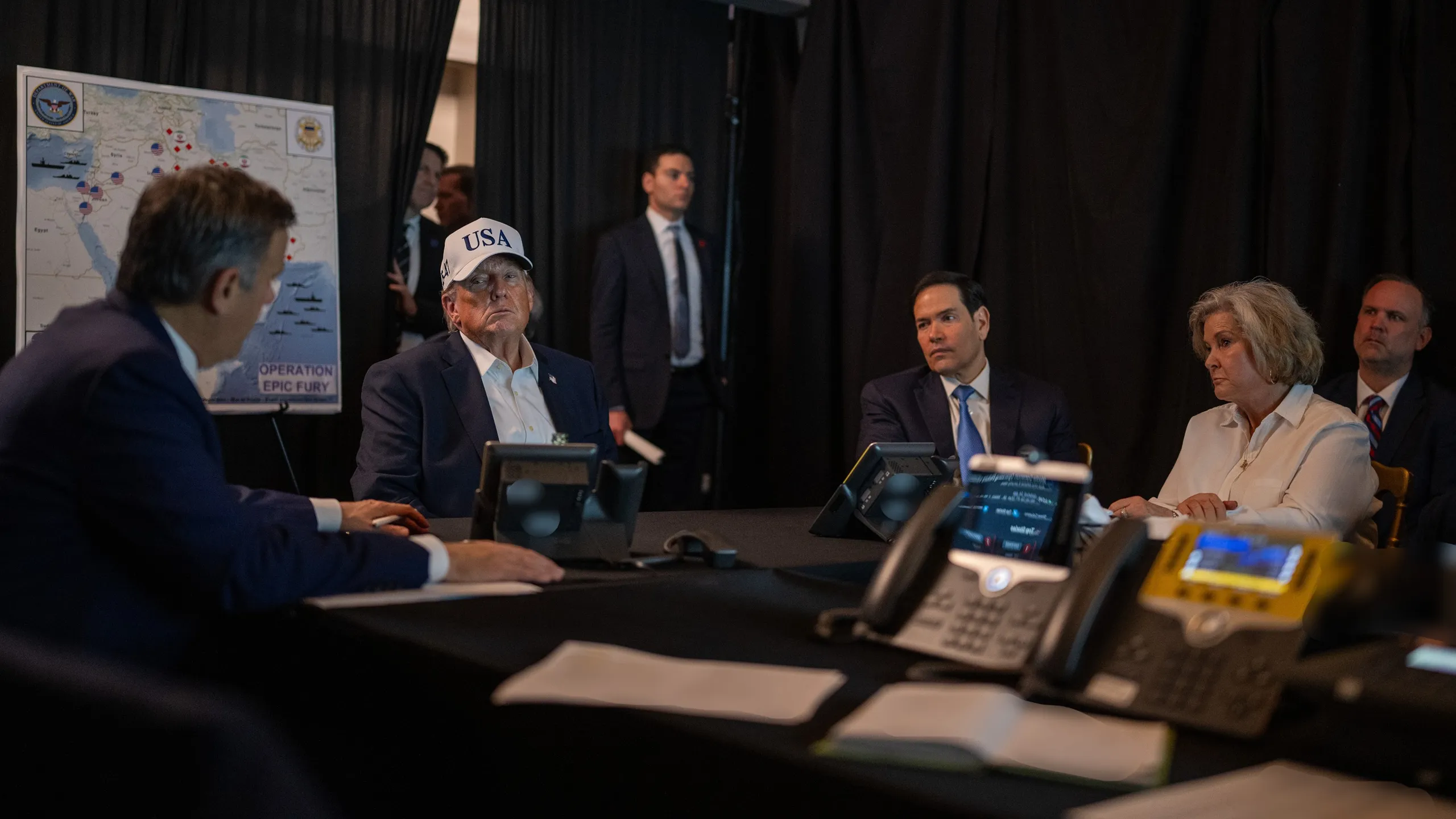
February 2026: the showdown with the Pentagon
In the days immediately following publication, tensions between Anthropic and the Pentagon reach breaking point.
The DoD, renamed the “Department of War” by the Trump administration, held a 200 million dollar contract with Anthropic. Not much, one might think, for an organisation valued at hundreds of billions. But we must bear in mind that working with the government also means winning contracts with Nasa and a great many other governmental or quasi-governmental departments.
Exasperated by Anthropic’s stance, and confident in its own clout, the DoD was now demanding that the contract be renegotiated with a clause allowing Claude to be used for ‘any lawful purpose’, removing the safeguards Anthropic had put in place to prevent specific uses.
Anthropic’s two declared red lines were precise. Mass surveillance of American citizens. Fully autonomous weapons, with no human oversight in lethal decision-making. The Pentagon replied that these restrictions were illegal because they put a private company in a position to dictate operational terms to a government institution, and that in any case it considered both uses already sanctioned by US law, making any form of safeguard superfluous.
Emil Michael, Under Secretary of Defense for Research and Engineering, reportedly stated that Anthropic was about to “cross the Rubicon”.
That step was not long in coming. On 26 February 2026 Dario Amodei publishes an official statement. “I cannot in good conscience accede to their request”, he states.
The text explains that the contractual language received from the DoD
“had made virtually no progress in preventing the use of Claude for mass surveillance of Americans or in fully autonomous weapons”.
Amodei writes that Anthropic understands that it is the Department of War, not private companies, that makes military decisions. But in a narrow set of cases, AI could undermine democratic values rather than defend them: and those cases were the two he had already identified.
The Pentagon’s response is immediate.
Defense Secretary Pete Hegseth sets a deadline for the following day: accept the terms or lose the contract and be designated a ‘national security supply chain risk’. That same evening, Emil Michael posts on X calling Amodei a “liar” with a “God complex”.
Let us pause for a moment on this concept: supply chain risk. What does it mean?
For Anthropic, it essentially means losing any government or quasi-government contract: all those collaborations we mentioned earlier with Nasa, AWS and many other organisations that bring Amodei’s company (in this case, yes) billions.
Just a threat? Not at all, because on 27 February Trump orders federal agencies to cease all use of Anthropic’s technology immediately, with a six-month phase-out period for agencies already using it. The OPM removes Claude from the list of approved AI tools and adds xAI’s Grok and OpenAI’s Codex.
It is a complete break.
The contract OpenAI signed
In the very hours that Anthropic was holding the line, OpenAI was signing the very contract Anthropic had refused, with the US Department of Defense. Sam Altman was no stranger to military collaborations, having already supplied Palmer Luckey’s drones with OpenAI technology. To justify the deal, however, he specified in a blog post that the DoD considers domestic mass surveillance illegal and had no intention of using AI for that purpose.
In an internal memo reported by The Information, Amodei responded by calling OpenAI’s approach “safety theater”.
OpenAI dismissed this account as “outright lies”.

March 2026: the attempt at de-escalation
On 4 March 2026, a few days later, Amodei speaks at the Morgan Stanley Technology, Media and Telecom Conference in San Francisco. He says Anthropic is still talking to the Pentagon to try to de-escalate the situation and “reach an agreement that works for us and works for them”.
On 5 March, according to the Financial Times, Amodei had returned to the negotiating table with Emil Michael in a final attempt to reach an agreement. The compromise he was seeking provided access to Claude models for federal agencies, but with specific safeguards on the two edge cases already declared. Meanwhile, Anthropic stated that it would challenge the supply chain risk designation in court, describing the US government’s actions as “irreparably harmful to Anthropic”.
26 March 2026: the Mythos leak
While all this was happening, and with Anthropic already facing numerous economic, political and legal headaches, a configuration error in Anthropic’s content management system made around 3,000 unpublished internal assets publicly accessible on 26 March 2026. Among them is a draft announcement describing what Anthropic calls “by far the most powerful AI model ever developed”. The name, as we well know, is Mythos. The files remain accessible for several hours before the vulnerability is fixed. By then, the news has already spread.
What the leaked material described was a model whose characteristics made Anthropic afraid to release it. In this article we explain why.
7 April 2026: Project Glasswing
Eleven days after the leak, on 7 April 2026 Anthropic officially announces Project Glasswing: a controlled-access programme that makes Claude Mythos Preview available to a restricted consortium of selected organisations, exclusively for defensive cybersecurity work (vulnerability detection, security testing, code review and penetration testing on the partners’ own systems and on the open-source libraries they depend on).
There are around 45 initial partners, with a roster that includes AWS, Apple, Cisco, CrowdStrike, Cloudflare, Google, JPMorgan Chase, the Linux Foundation, Microsoft, Mozilla, NVIDIA and Palo Alto Networks. The US government is briefed through CISA and the Department of Commerce. Anthropic is committing $100 million in usage credits and $4 million in donations to open-source security projects. Mythos remains off-limits to the public and unavailable through the standard APIs. Anyone wanting access must go through Glasswing.

22 May 2026: the first results
On 22 May 2026, Anthropic publishes the results of the first month of Project Glasswing. Claude Mythos analysed over 1,000 open-source projects and identified 23,019 vulnerabilities. Of these, 6,202 are rated high or critical severity. A sample of 1,752 reports verified by independent security firms confirmed 90.6% as genuine bugs. Mozilla fixed 271 vulnerabilities in Firefox. Cloudflare found 2,000 in its own critical infrastructure. A banking partner blocked a fraudulent $1.5 million transfer mid-execution.
June 2026: expansion and political context
In light of these results, on 3 June 2026 Anthropic expands Project Glasswing to around 150 organisations, extending access to critical infrastructure sectors including energy, water, communications, healthcare and hardware. Access remains by invitation only, bound by NDA and approved in coordination with the US government. Hours after the announcement, the Trump administration signs an executive order on AI with a narrower scope than previous versions: a voluntary framework requiring developers of advanced models to notify the government 30 days before public release.
On 9 June 2026, alongside the public launch of Claude Fable 5, Anthropic distributes Claude Mythos 5 to Project Glasswing partners. The model shares its weights and architecture with Fable 5. The difference is that Fable 5 includes three real-time safety classifiers that redirect sensitive queries in cybersecurity, biology and chemistry to Opus 4.8. Mythos 5 operates without those classifiers. Even so, the US government blocks the release of Fable for around two weeks. Security concerns, or retaliation?
The state of play in July 2026
The formal dispute between Anthropic and the Department of Defense did not end in a public agreement. The original $200 million contract was cancelled. The supply chain risk designation is still being contested in court. Coordination with the US government continues through Glasswing, in a different format from the one the Pentagon had requested.
OpenAI operates under the contract it signed. Google, Alphabet and xAI keep their own agreements with the Department of Defense. Anthropic has chosen a different path: controlled, conditional access. Only time will reveal where it leads.
And so, here we are. Anthropic turned down a 200 million dollar government contract after discovering that its product had been used in a lethal military operation without its explicit consent. It lost access to a significant share of the federal market, faced a designation capable of jeopardising other institutional partnerships, and responded by building a controlled distribution system for the most advanced model it had ever developed.
We do not yet know whether this choice will protect Anthropic or end up weakening it. What we do know is that, with war in the picture, the principles an AI company declares must be able to withstand contracts, political pressure, economic opportunities and the uses others make of its technology.
This is where the Anthropic case goes beyond Anthropic. When a model enters a state’s infrastructure, governance stops being an internal procedure and becomes a question of power.
Who will have the right to decide how far artificial intelligence can go?
And who will still be willing to stop it when that decision comes at a price?
Until we have these answers, the story continues.
New connections (FAQ)
What does the Anthropic case teach us about the governance of artificial intelligence?
It shows that a policy only gains value when the organisation is willing to apply it even under pressure. Anthropic had defined certain uses as incompatible with its principles and found itself having to defend those choices before its most powerful client. This is precisely what genuine AI Governance is for: translating general values into responsibilities, procedures, control systems and limits that keep working when economic, political or reputational interests come into play.
Are terms of use enough to govern how an AI model is used?
Terms of use define what is permitted, but on their own they do not ensure that the organisation knows how to verify usage, identify breaches and intervene. The Anthropic case shows how difficult it can become to retain control when a model passes through technology partners, suppliers and external infrastructure. That is why AI governance must also cover traceability, escalation processes, access criteria, contractual responsibilities and suspension procedures.
How can a company prepare for uses of AI it cannot yet foresee?
You need to define in advance who decides, which risks require human oversight, which uses must be prohibited and how to update the rules when technology, the market or regulation change. Effective governance does not try to imagine every single future scenario. It builds a system capable of recognising critical cases and reacting before a technical decision becomes a legal, political or reputational crisis. This is the principle on which Bliss builds its AI Governance programmes.