


AI Governance
The weight of AI calls for a system
In 2025 companies worldwide invested billions in artificial intelligence. 95% of those investments produced zero measurable return.
Not because of the technology, but because of the way it was used.
With markets buzzing over the technology of the moment, Bliss’s AI Governance was created to guide companies, brands and public administration in managing artificial intelligence, so as to eliminate waste, establish rules of use and ensure compliance over time.
Calculated on the $725 billion of 2026 CapEx declared by Microsoft, Amazon, Alphabet and Meta (+77% on the $410 billion of 2025), broken down to value per second. Source: Yahoo Finance, 2026.


Blissionary
AI Governance: Definition
/eɪˈaɪ ˈɡʌvərnəns/
n. A system that defines rules, responsibilities and measurement criteria for the use of artificial intelligence within a company. It maps the tools adopted, assesses their return and ensures regulatory compliance over time.
The problem we solved
Two dangers,
one common problem
Companies spend on AI without criteria.
Every week a new model comes out. Every month someone in the company adopts it. Within a year, a list of subscriptions builds up that nobody knows about.
The result is twofold. On the one hand, money is spent on AI with no return. On the other, sight is lost of the regulatory framework: just as the AI Act requires transparency and documentation.
Where it all began
The invisible cost
For years, investing in a company meant investing in machinery and infrastructure. Tangible things, with clear depreciation.
Today, AI has changed that logic.
Costs have become subscriptions, tokens, servers: expenses that pile up quietly, across different teams and with no overall measure.
And so we realised the problem was not AI but the lack of a system to govern it.
That is how AI Governance was born.
Our thinking
Governing tomorrow
Artificial intelligence is the future. It should not be feared, nor chased as a fad.
Every tool adopted without criteria is a cost. Whereas any tool adopted with clear criteria can be an investment, and an opportunity.
Bliss is enthusiastic about AI. And we want to help you master it.
Who it is for
Who needs
AI Governance?
AI Governance is designed for organisations already using artificial intelligence, but without a method. Before adopting a new tool, increasing the budget or responding to market pressure, you need to know exactly what you have, what it costs and what it returns.
For those spending on AI without knowing what they gain from it
You use ChatGPT, Claude and perhaps more besides. Subscriptions have grown; tokens are plentiful, but you don’t know how many. Artificial Intelligence Governance starts here: understanding what you use, what it costs and what it really gives back.
For those who want to start with AI without getting it wrong
You know your business needs artificial intelligence. Everyone knows it. You just don’t know where to start, which tools to choose or how to avoid wasting budget. AI Governance builds the strategy before the investment.
Who must comply with the AI Act
The AI Act imposes obligations of transparency, documentation and human oversight on uses of AI. Failing to comply will be costly. AI Governance builds the necessary documentation before it becomes a legal problem.
For those with disconnected AI tools
ChatGPT for copy, Gemini for analysis, Claude for customer service: extremely useful tools, but used without a common logic. The outcome is predictable: multiplied costs, dispersed value. AI Governance reorganises the system.
Our method
How AI Governance is structured
Managing artificial intelligence well means starting from the data, building a system and verifying that it works.
No improvisation is allowed.
AI Audit
2–3 weeks- Map of all AI tools in use: by whom, for what, at what cost and with what results
- Identification of duplicate subscriptions and unused tools
- Identifying implementations with no verifiable result
AI Strategy
3–5 weeks- Identifying the processes that genuinely benefit from AI
- Areas where the return is real and tools to abandon
- Budget allocation for the next twelve months
AI Governance System
4–8 weeks- Who decides what, and through which process
- Risk assessment and classification of every new tool
- Documentation required by the AI Act
AI Monitoring
Ongoing- Continuous monitoring of an AI market that changes every three months
- Flagging only of changes relevant to the business
- Monthly report with real data on agreed targets
Our Output
The end result
AI Governance is a complete system.
You will receive it as an operational document, designed to be consulted every month, not filed away after delivery. You can use it to allocate budget, assess every new tool before adopting it or demonstrate AI Act compliance when someone asks you to.
01.
Tool Map
It means finally knowing how much you spend on AI, and what that spending delivers.
What we analyse
- AI tools in use, by whom and for what
- Real costs per subscription and per token
- Results produced, where measurable
- Ability to generate direct demand

02.
Investment Priorities
It establishes where to invest more and where to stop spending without return.
What we analyse
- Processes that genuinely benefit from AI
- Processes where AI is not worth the cost
- Budget allocation over the next 12 months

03.
Adoption Criteria
It enables anyone in the company to make decisions without needing authorisation every time.
What we analyse
- Questions to ask before every new tool
- Standard evaluation protocol
- KPIs assigned to every implementation

04.
Risk Classification
Demonstrates regulatory compliance before anyone urgently asks for it.
What we analyse
- Mapping of tools by AI Act risk level
- Transparency documentation required
- Human oversight of critical processes

05.
Accountability System
You need to know at all times who is accountable for an AI decision, rather than finding out afterwards.
What we analyse
- Who decides what on AI
- Approval process for new tools
- Authority assigned, not implied

06.
Ongoing Monitoring
The definitive tool for staying up to date without chasing the latest thing on the market.
What we analyse
- Market changes relevant to the business
- Monthly report on agreed targets
- Updating the system over time

CapEx and Opex:
the new spending
In Italy there is no aggregate, public measure of spending on AI: neither in CapEx nor in OpEx. Large companies are not required to report it separately in their accounts. SMEs do not track it internally. The result is that nobody knows what AI spending amounts to. Above all, nobody knows what return it generates.
Governing Artificial Intelligence requires clarity. And the first point to clarify is this.
AI Act:
ignorance is costly
From August 2026 many of the main provisions of the AI Act come into application: the world’s first comprehensive regulatory framework on artificial intelligence.
From 2027, obligations will also become stricter for many companies that use AI systems in their processes, with possible fines of up to 3% of worldwide annual turnover, depending on the specific infringement and the operator’s role
Bliss’s AI Governance exists to prevent this, mapping the tools in use in order to build the evidence, registers, procedures and controls that support compliance.
THE TEAM
Who Governs AI
AI Governance is managed by a team with integrated expertise in business strategy, data analysis and advanced technology.
Every project has a dedicated senior lead, who guides the company from the initial AI Audit through to ongoing monitoring.

Andrea Maso
Head of SEO
Digital Data Analyst and Head of SEO at Bliss, Andrea works directly with clients through the analysis, planning and optimisation of campaigns.

Mario Antonini
Chief Design Officer (CDO)
CDO, more than a designer, Mario is the true interpreter of the Bliss vision. He coordinates visual identity, web architecture and VFX processes, making ideas tangible.


Luca Maletta
Head of Copywriting

Suraksha Kumari
Full stack developer
Develops SEO-oriented architectures and optimises performance, Core Web Vitals and technical structure.

Sajjad Mazaherizaveh
Full stack developer
Combines front-end and back-end development with technical SEO and AI Search Optimisation.
Start here
How much are you gaining from AI?
If the answer is not a precise figure, or if that figure disappoints you, the problem is not the technology but the way you are managing it.
Let’s find out together how to change it.
The comparison
AI vs AI Governance:
why the system wins. Always
Most companies adopt AI on an ad hoc basis: one tool at a time, with no strategy and no metrics.
The gap between them and those who govern it properly is vast. That is why we have focused on artificial intelligence from day one.
| Criterion | Spontaneous adoption | Bliss AI Governance |
|---|---|---|
| How adoption decisions are made | Driven by the enthusiasm of the moment, vendor demos or what competitors are doing. | Three questions before every adoption: what problem it solves, how the result is measured, what we stop doing. |
| How ROI is measured | It isn't measured. Whether a tool is useful is judged on gut feeling. | KPIs defined before implementation. Monthly report with real data against targets. |
| What happens when something new comes out | Tools are adopted, tested, abandoned or piled on top of what already exists. The budget grows, the results stay the same. | Structured assessment: is it relevant to this business? What does it replace? How does it integrate? |
| Who is responsible | IT, the individual head of function, or no one explicitly. | A figure with strategic authority, a defined process and documented evaluation criteria. |
| Updating over time | No system. Obsolescence is discovered only when the gap is already obvious. | Ongoing monitoring and quarterly reviews. The system evolves with the market. |
4.9/5
207 verified reviews
Verified reviews
What brands that chose Bliss's AI Governance say





Bee Lab
“Professional, dynamic team. They work around the clock and fully embrace the projects they take on, led by a highly skilled and visionary leader!”
5.0
Marco Contigiani
“A simply exceptional communications agency.
From the very first contact you sense professionalism, expertise and close attention to the client’s needs”
5.0
Nicole
“Thanks to Bliss Agency we doubled our quote requests and gained more visibility in our area. They proposed a clear editorial plan that was easy to follow and extremely effective.”
5.0
Anna Rossi
“Not just an agency, but a true partner. With Bliss Agency I felt listened to and understood from the very first meeting. They turned ideas into a concrete project”
5.0
Certified Agency
Certifications


ISO 9001 – Process quality and work organisation.

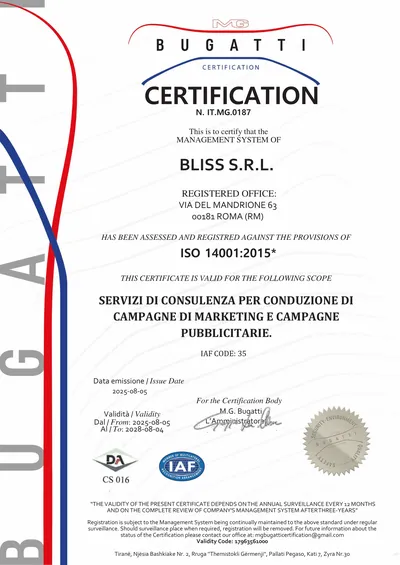
ISO 14001:2015 – Managing the environmental impact of business activities.

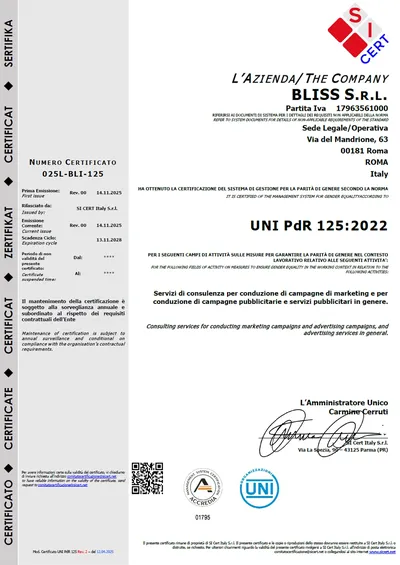
UNI PDR 125:2022 – Gender equality in processes, policies and organisation

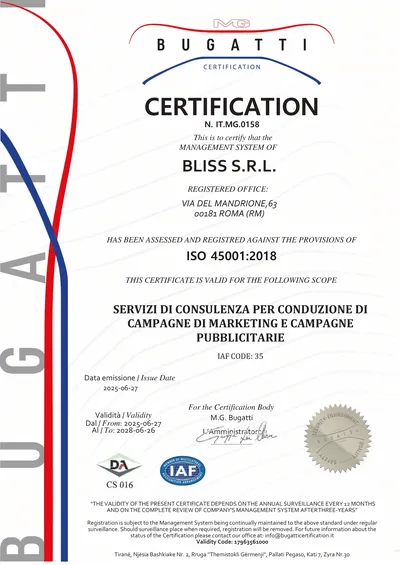
ISO 45001:2018 – Occupational health and safety.

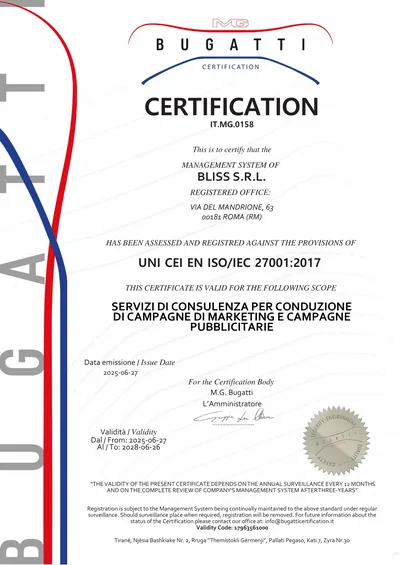
ISO/IEC 27001:2022 – Information, data and access security.
Frequently Asked Questions
Answers to questions about AI in business, AI washing and artificial intelligence in general
1 - What is artificial intelligence, in practical terms?
It is a system that learns from large volumes of data and uses what it has learnt to make predictions, generate content or automate decisions. It does not reason like a human being: it recognises patterns and applies them. It is remarkably effective at defined, repetitive tasks. It is still weak at tasks that require contextual judgement, accountability and genuine creativity.
2 - How do I know if I am spending too much on AI?
If you do not have a precise figure for how much you spend on AI and how much it delivers, you are probably overspending on something. The AI Audit maps every cost and compares it with the results. In most companies, it uncovers active subscriptions that nobody uses and implementations that have never produced a verifiable result.
3 - Will AI replace my employees?
A 2024 MIT study found that AI automation is economically viable in only 23% of the jobs analysed: specifically, those involving computer vision tasks with wages low enough to make automation competitive against human cost. For the remaining 77%, human workers cost less. AI replaces specific tasks, not entire roles. And it does so cost-effectively only where volume is sufficient to justify the cost. AI Governance identifies exactly these areas, without overestimating them.
4 - Where do we start?
Always with the audit. Before deciding what to do with AI, you establish what is already in place and what it is producing. It is the step almost no one takes, and it almost always reveals surprises. Bliss defines the scope of the audit in a working session, before any commercial proposal.
5 - Is AI Governance only for large companies?
It is for any company spending on AI without a system to measure what it produces. An SME with three ungoverned AI subscriptions has the same structural problem as a large enterprise with thirty, just on a smaller scale. The system is calibrated to the company’s size and actual processes.
6 - How long does the programme last?
The AI Audit takes two to three weeks. The subsequent phases up to delivery of the Governance System take around three months. Ongoing monitoring has no set duration: it is structured in quarterly review cycles.
7 - Do I need technical skills to undertake this programme?
No. AI Governance does not require technical skills: it requires clarity on business objectives. What problems do I want to solve? How do I measure the result? Who is responsible for decisions? These are strategic questions. The technical skills for implementation come later, and only once the strategy has been defined.
8 - How does Artificial Intelligence Governance integrate with brand strategy?
AI increasingly shapes the way a brand communicates: the content it produces, how it is described by ChatGPT and Perplexity, the speed at which it responds to customers. Governing AI also means governing these touchpoints, ensuring that the tools adopted produce output consistent with the brand’s positioning.
9 - We have already tried to structure AI internally, but it did not work. What is different with Bliss?
The most common difficulty is not technical. It is that AI governance requires decision-making authority that often has not been assigned to anyone. Who decides what is adopted, through what process, against what evaluation criteria? Bliss builds that structure and hands it over to those who must apply it over time.
10 - Do I really have to adopt AI in my company?
No. AI is not an obligation, it is a tool. And like any tool, it is worth as much as the problem it solves. In today’s market, however, one thing is worth remembering: it is not the big fish that wins, it is the fast fish. A company that learns to use AI well (even on just three processes) gains a real advantage over those waiting for the picture to become clearer. The picture will not become clearer. The market is moving now.
11 - What is AI washing and how can you spot it?
AI washing is the practice of claiming AI capabilities that do not actually exist or are marginal, in order to appear more innovative or attract investment. It is the technological equivalent of greenwashing. You can spot it when a supplier cannot answer simple questions: which model it uses, what data it was trained on, how the result is measured. If the answers are vague, the problem is usually not the question.
12 - Is AI a bubble or is it here to stay?
Bubbles inflate assets that produce no real value. AI produces real value: it shortens execution times, lowers costs on repetitive processes and improves the quality of decisions when used well. That there is excessive speculative investment is likely. That the underlying technology will disappear is unlikely. The right question is not whether AI is a bubble, but whether what you are using delivers a measurable return.
13 - How much are large companies investing in AI? Should we be worried?
The figures are striking. Alphabet has announced 2026 capex of between 175 and 185 billion dollars, almost double the 91.4 billion invested in 2025. Amazon has announced investments of up to 200 billion in the same year. These are the budgets of the global hyperscalers to build the infrastructure needed to compete in the AI economy. For most companies, the relevance of these figures is not in imitating them: it is in understanding that the infrastructure cost of AI has already been borne by others. Today value is created in use, not in construction. And in use, governance is what separates those who invest well from those who burn budget.