


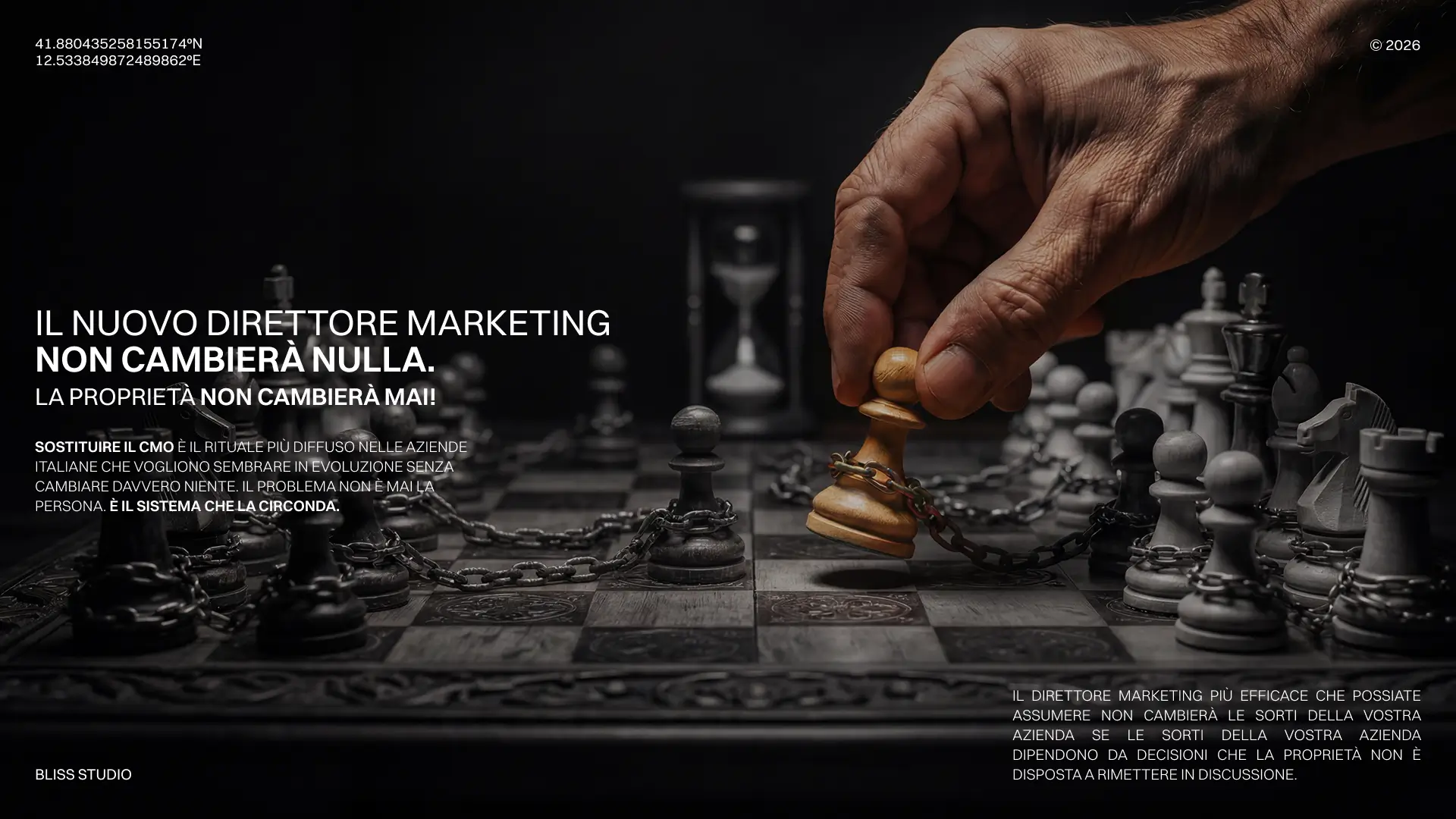
Sostituire il CMO è il rituale più diffuso nelle aziende italiane che vogliono sembrare in evoluzione senza cambiare davvero niente. Il fallimento del direttore marketing racconta quasi sempre qualcosa sull'organizzazione. Raramente sulla persona.
Here we go again.
The marketing director is called in. He is told the results are not what was expected, that the brand is not growing enough, that the revenue KPIs have not been met. He is offered a severance package or simply told his contract is being terminated.
Within a few months the successor arrives. Brilliant, with an impressive track record, convinced they can finally make a difference in a company that seems full of untapped potential.
He is given clear objectives: raise brand awareness, bring in new customers, grow by 20% in twelve months. With a gun to his head from day one.
Two years later, his successor is called in too.
And the cycle starts again.
Average CMO tenure among S&P 500 companies stood at 4.1 years in 2025, down from 4.3 in 2024. This compares with an average of 5 years across the C-suite, 7.6 years for CEOs and 4.7 years for CFOs. The marketing director is consistently the shortest-serving member of the entire leadership team. And has been for decades.
Reading this as a recruitment problem is the most convenient mistake one can make. It is a systemic signal that almost nobody reads correctly.
Why the CMO lasts less than anyone else
The immediate answer is that marketing is hard to measure, that results arrive slowly, or that it is an inherently complex discipline. All true. The main cause, however, lies elsewhere.
Among the main reasons for marketing director turnover are pressure for immediate results (33%), conflicts with sales (13%) and lack of alignment with the CEO (13%). Each group within the organisation identifies a different reason, but they all converge on one point: the problem is the context in which the CMO operates. And that context, in the vast majority of Italian companies, is structurally hostile to the kind of work a marketing director has to do.
Because marketing produces results over years, not quarters. It does not work with a gun to its head. Above all, it becomes impossible if the organisation is not truly willing to change.
The real problem: they do not want change. They want the illusion of change.
Here we need to be honest with surgical precision, because we are touching on something that concerns the deep structure of Italian family capitalism.
Italian companies are 86% family-owned. In these businesses (whether run by the successors of the company’s founder, large owner-led groups, or structures made up of founding-partner families) real power lies in history, in entrenched habits and in decisions taken outside formal meetings.
Only 30% of Italian family businesses have a manager from outside the entrepreneur’s family, whereas in France, Germany and Spain the figure reaches 80%.
In this context, hiring an external marketing director is rarely a sign of genuine openness to change. It is a cosmetic move aimed at the market, minority shareholders and the board of directors: it signals modernity without delivering it.
According to the ESG LAB Report by SDA Bocconi, the main barriers to change in Italian SMEs are a resistant corporate culture (81%), the lack of shared KPIs (71%) and closed governance models (52%): what Mario Draghi described as “a corporate structure often kept closed to outsiders”.
The new marketing director arrives, carries out an analysis, identifies the problems (which in most cases are clear from the first month) and proposes solutions that require real change: in the product, in pricing, in the way the company communicates, in relationships with distribution channels, in the internal culture.
And that is when he hits the wall.
A pervasive resistance: decision-making processes that drag on endlessly, resources that are promised and never materialise, decisions taken “above” without consulting him, initiatives blocked on the grounds that “it’s not the right time” or “it’s not in our DNA”. In Italian family businesses, the past has a very strong impact on organisational structure and behaviour. The founder’s values and beliefs shape procedures and act as a common thread across successive generations. Researchers call this phenomenon the “founder’s shadow”: the founder’s presence that continues to shape every present-day choice.
The founder’s shadow can only be removed if the owners are willing to question themselves. And that rarely happens.
The paradox of impossible KPIs
There is one particularly perverse mechanism that deserves to be named.
When the owners hire a new marketing director while secretly intending to change nothing structural, they need a narrative that will justify that person’s eventual failure. And that narrative is built from the very start: ambitious targets, impossible timelines, KPIs that would require changes the company is not prepared to make.
The marketing director is thus trapped in an impossible position. If he accepts the objectives without negotiating the conditions needed to achieve them, he is doomed to fail. If he tries to negotiate those conditions, he is seen as someone who brings problems rather than solutions. Meanwhile, the owners can say they tried. That they invested in marketing. That they hired a high-profile executive. If the results did not come, the person is to blame.
This is a documented psychological and organisational dynamic, and it repeats itself with almost mechanical regularity.
What can really make a difference for a marketing director?
The honest answer is: much less than is promised during recruitment, and much more than the owners are willing to admit.
A good CMO builds consistent positioning over time, generates real awareness through targeted campaigns, structures a customer acquisition system that holds up over the long term, brings a culture of measurement that did not exist before and attracts talent capable of building in-house capabilities. All of this takes time. At least eighteen months before measurable results: three years to build something solid. It also requires conditions: an adequate budget, genuine decision-making autonomy, a CEO who acts as an ally within the structure and, above all, owners who accept that change carries a temporary cost in terms of comfort and established habits.
The CMO is often poorly understood internally and can seem like a black box. This hampers collaboration with C-suite colleagues, reduces strategic influence and, ultimately, limits the impact on the business.
When these conditions are missing, and in the Italian context they are missing in most cases, the most brilliant marketing director in the world produces marginal results. They are trying to move a building by pushing against the wrong wall.
The question the owners never ask themselves
Every time a marketing director is replaced, the post-mortem focuses on the person: what went wrong, what they should have done differently, whom to hire in their place. Rarely does anyone ask the most uncomfortable question: what in our organisation made their job impossible?
71% of Italian business leaders believe their family nature makes their companies more solid and more resilient to external change. And 81% regard long-term value creation as a priority.
Resistance to change is reinterpreted as stability. Imperviousness to outside input is read as cultural coherence. And the marketing director who tries to bring about real change is treated as a foreign body. The result is that many Italian companies are looking for someone to carry out decisions the owners have already made.
In short, an executive role with an inflated title and a built-in expiry date.
In conclusion, the problem is rarely the marketing director
The most effective marketing director you could hire will not change your company’s fortunes if those fortunes depend on decisions the owners are unwilling to question.
A brand is built through consistency over time. Consistency requires the entire organisation to move in the same direction, with product, pricing, distribution and communication aligned towards the same objective. Revenue grows when marketing is a function integrated into corporate strategy, not an isolated department with an expiry date.
None of this can be delegated to a single person with a forty-month mandate and 20% growth targets.
The next time you find yourselves considering whether to replace your marketing director, ask yourselves one question before launching the search: are we looking for someone to change things, or someone to blame when things do not change?
The answer to that question says everything about what the company is truly prepared to do.
New connections (FAQ)
Why do Italian companies keep changing the marketing director instead of changing the system?
Because it is easier to replace a person than to question a structure. ICSR research indicates that 61% of Italian companies are dissatisfied with their marketing partners: yet the problem is almost never the manager’s competence. It is the context. Decision-making processes that drag on, resources that never arrive, decisions taken without consultation. The marketing director becomes the scapegoat of a system that was never designed to truly change.
What is the founder’s shadow and how does it hold back a company’s growth?
It is the founder’s invisible influence on every business decision, even when he is not physically present. Over time, the founder’s values, habits and decision criteria settle into processes and people. In a healthy company, this is an asset. In a company that needs to evolve, it becomes a filter that slows or blocks any change not implicitly sanctioned by the way the founder has always done things.
How long does it take to see results from a new marketing strategy?
At least 18 months before measurable results, three years to build something structural. This is not an opinion: it is what emerges from Binet and Field’s research on hundreds of advertising effectiveness cases. The Italian problem is that marketing directors are hired with 12-month objectives for phenomena that take 36. The expiry date is built into the starting conditions.
How does a company prepare to welcome a new marketing leader?
By first defining what it is willing to change. That is, the operating conditions. A real budget, decision-making autonomy, access to strategic information, and owners willing to question product and pricing if the strategy demands it. A brilliant manager in a context that does not change produces marginal results. A mediocre manager with the right conditions produces better results. Context matters more than talent.