


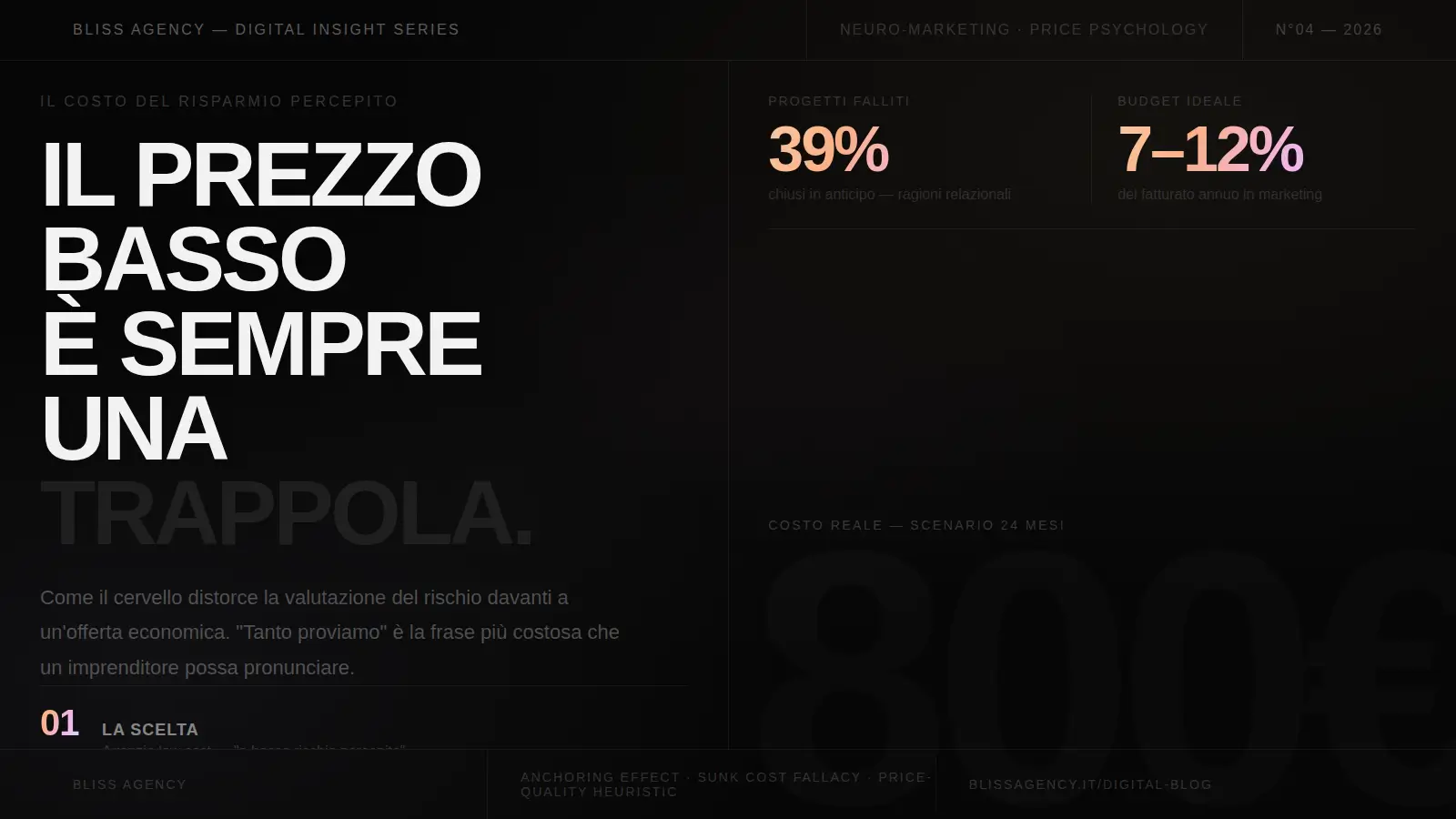
Three quotes on the table. One for 4,000 euro a month, one for 2,500, one for 800.
The content is vaguely similar. The services listed resemble one another. The promises are the same: in fact, the 800-euro one promises even more.
And the entrepreneur’s brain starts working. Not rationally. Neurologically. It activates a cognitive shortcut it has used thousands of times in life (in supermarket queues, at car dealerships, at markets) and applies it mechanically to a decision that has nothing to do with a price tag.
“Let’s just try it. What have I got to lose?”
This sentence, uttered with the air of someone making a prudent choice, is in fact the premise of one of the costliest and most systematic mistakes Italian businesses make in marketing.
This article explains why. Through the neurobiology of price evaluation, the cognitive mechanisms that turn perceived savings into real losses, and the hard numbers of a market that has built an entire system around the illusion of low cost.
First of all: what happens in the brain when it sees a low price
To understand the trap, you have to understand the mechanism.
The human brain does not process price as a neutral data point. It processes it as a signal. And that signal automatically triggers an inference system that behavioural researchers call the price-quality heuristic: the deep-rooted tendency to associate price with value.
It is an efficient evolutionary mechanism. In most contexts (everyday purchases, physical products, comparable goods) it works. If an olive oil costs three times more than the others on the shelf, there is probably a reason.
But applied to professional services, where value is invisible, deferred over time and hard to measure in advance, this mechanism turns into a dangerous cognitive bias. The Hollywood Bowl in Los Angeles sells tickets for its summer concerts at one dollar. Although these seats offer a better view of the city, a prime view of the sunset and the same acoustics as the more expensive ones, they are often empty. Because the low price makes people believe the seats are terrible.
Applied to the agency market: a quote of 800 euros a month is not processed as “a cost-effective opportunity worth considering”. It is processed implicitly, pre-rationally, as a signal that something is wrong. And yet, paradoxically, that same signal does not stop the purchase. It encourages it. Because the second mechanism comes into play.
“Let’s just try”: how low perceived risk creates real risk
When the price is low, perceived risk drops with it.
This is the heart of the trap. The brain is not assessing the value of the service. It is assessing the cost of a possible mistake. And with an investment of 800 euro, the cost of a mistake seems contained. Manageable. Almost negligible.
This is where what neuroscientists call the threshold effect of loss comes in: below a certain level of perceived spending, the amygdala’s alarm system does not fire with the same intensity. The decision is made with less attention, less research and less analysis, and it is precisely this drop in cognitive pressure that lowers the quality of the choice.
But the real cost is not the one in the quote. It is the one that comes afterwards.
What an 800-euro-a-month quote really buys
Let us do a simple calculation. The one almost nobody does before signing.
An agency that bills €800 a month to manage a company’s marketing must, to be economically sustainable, handle a large number of clients in parallel. With minimal fixed costs, a small or non-existent team, and necessarily standardised processes.
A small specialist agency can handle 10 clients on monthly fees of €1,500, generating €180,000 a year; with fixed costs of €70,000 and variable costs of €40,000, its operating margin exceeds €70,000. Now mentally subtract €700 a month from the fee. What is left? Not a more efficient service. What is left is less time, less dedicated expertise, less analysis, less strategy. What is left is mechanical execution with your brand’s name on it.
The hidden cost nobody puts in the quote
There is one item that never appears in any low-cost quote. It is the cost of lost time.
Four projects out of ten never reach the end. And every project that ends earlier than planned does not just leave a wasted budget. It leaves a company that has to start again from scratch: new research, new onboarding, a new learning curve, more time before results can materialise.
In marketing, time is a critical variable. Positioning is built over months, not weeks. Authority builds up gradually. Organic results require continuity. Every interruption wipes out part of the work done and lengthens the overall time to return on investment.
This means that a company that changes agency three times in two years (the classic low-cost pattern) has saved nothing compared with one that chose a serious partner from the outset. It has spent more, in terms of cumulative fees, lost time and missed opportunities.
The anchoring effect: why a low quote taints everything that follows
A third neurological mechanism is quietly at work in this process: the anchoring effect.
Applied to choosing an agency, this mechanism has a devastating effect: anyone who first saw a quote of 800 euro a month can no longer assess a 3,000-euro quote neutrally. That third figure is not read as “fair value for a professional service”. It is read as “too expensive compared with what I have already seen”.
A low anchor does not just make the wrong choice easier. It makes the right choice structurally harder, even when you want to make it.
The “let’s just try it” pattern: how it forms and how it repeats
Anyone working in professional marketing knows this pattern well. It repeats itself with almost mechanical regularity.
Phase 1 — The choice: The business owner chooses the low-cost agency. The reasoning is explicit: “it’s low risk, so I’ll see whether it works”.
Phase 2 — Disappointment: In the first few months, outputs arrive: posts, reports, the odd campaign. But the results are lukewarm. The agency is reactive, not proactive. It does not propose, does not anticipate, does not bring vision.
Phase 3 — Rationalisation: The business owner does not end the contract straight away. They have already put time and money into it, and the sunk cost fallacy kicks in: the tendency to keep investing in something that does not work simply because you have already invested in it. “I’ve paid for six months, I might as well see the seventh.”
Phase 4 — The break: The contract ends. The entrepreneur is disappointed. They update their mental model: “marketing doesn’t work”. And the cycle of distrust closes, ready to reopen exactly the same next time round.
It is not a lack of will on the business owner’s part. It is a self-reinforcing system.
The maths nobody does
Let us do the sums honestly, with real market figures.
A company that chooses a low-cost agency at €800 a month and changes three times in 24 months has spent: €19,200 in cumulative fees, three onboardings from scratch with at least two months of unproductive time each, six actual months of strategic vacuum between one engagement and the next, and a brand that has built no consistency in two years.
A company that chooses a serious partner at €2,500 a month on an annual contract has spent: €30,000, one onboarding with results that build up over time, strategic consistency for 12 consecutive months, and a positioning that begins to take root.
The real difference is not 10,800 euro. It is years of positioning built up versus years of positioning wiped out and started over.
Why a low price is also a signal of the wrong positioning
There is one last point that deserves attention, and it concerns the market as a whole.
An agency that charges unsustainable prices does not do so out of generosity. It does so because it has not yet understood its own value, or because it lacks the skills to defend a different price. Either way, it is a signal.
An agency that competes on price alone has nothing else to offer. It has no distinctive method, no strong case studies, no confidence to ask for more. A low price is not a commercial strategy: it is the absence of one. And choosing a partner with no strategy for itself means entrusting it with yours.
What marketing that works should really cost
The right question is not “how much does this agency cost?” The right question is “how much does it cost me not to get results?”
This is not an arbitrary figure. It is the benchmark that emerges from international research into what it takes to build a marketing system that works over time. Not to buy output, but to produce results.
The difference between the two is exactly what separates an agency that competes on price from a partner that competes on value.
Conclusion: a low price does not reduce risk. It shifts it.
The low-cost trap is not in the quote. It is in the reasoning that comes with it.
“Let’s just try it” is not a low-risk choice. It is a choice that shifts risk from the short to the medium term, where costs are harder to measure, more spread out over time and harder to trace back to the original mistake.
The brain that chooses the low price is not protecting the company. It is avoiding the discomfort of a demanding decision. It is using the cognitive shortcut of low cost to avoid facing the harder question: whom do I truly trust to build something that lasts?
That question has no answer in the quote. Its answer lies in the expertise, the consistency and the responsibility a partner takes for results.
And in the real market, that responsibility comes at a price.
Frequently Asked Questions
Why does competing on price destroy SMEs in the long run?
Because SMEs lack the economies of scale to sustain compressed margins. Lowering prices to compete means cutting into service quality, innovation or people; which are, in the end, the only elements that produce real differentiation. It is a path that leads to doing more to earn less.
How do you stop competing on price and build a premium positioning?
By communicating a unique value that makes price comparison irrelevant to the right client. The point is to make clear why the comparison with the cheapest competitor does not apply. Precise positioning is the only way out of the price war.
What is the relationship between a strong brand and the ability to charge higher prices?
A strong brand reduces the risk the client perceives. People who trust pay more because they perceive greater value. Premium pricing is the natural consequence of a brand that has built credibility over time.