


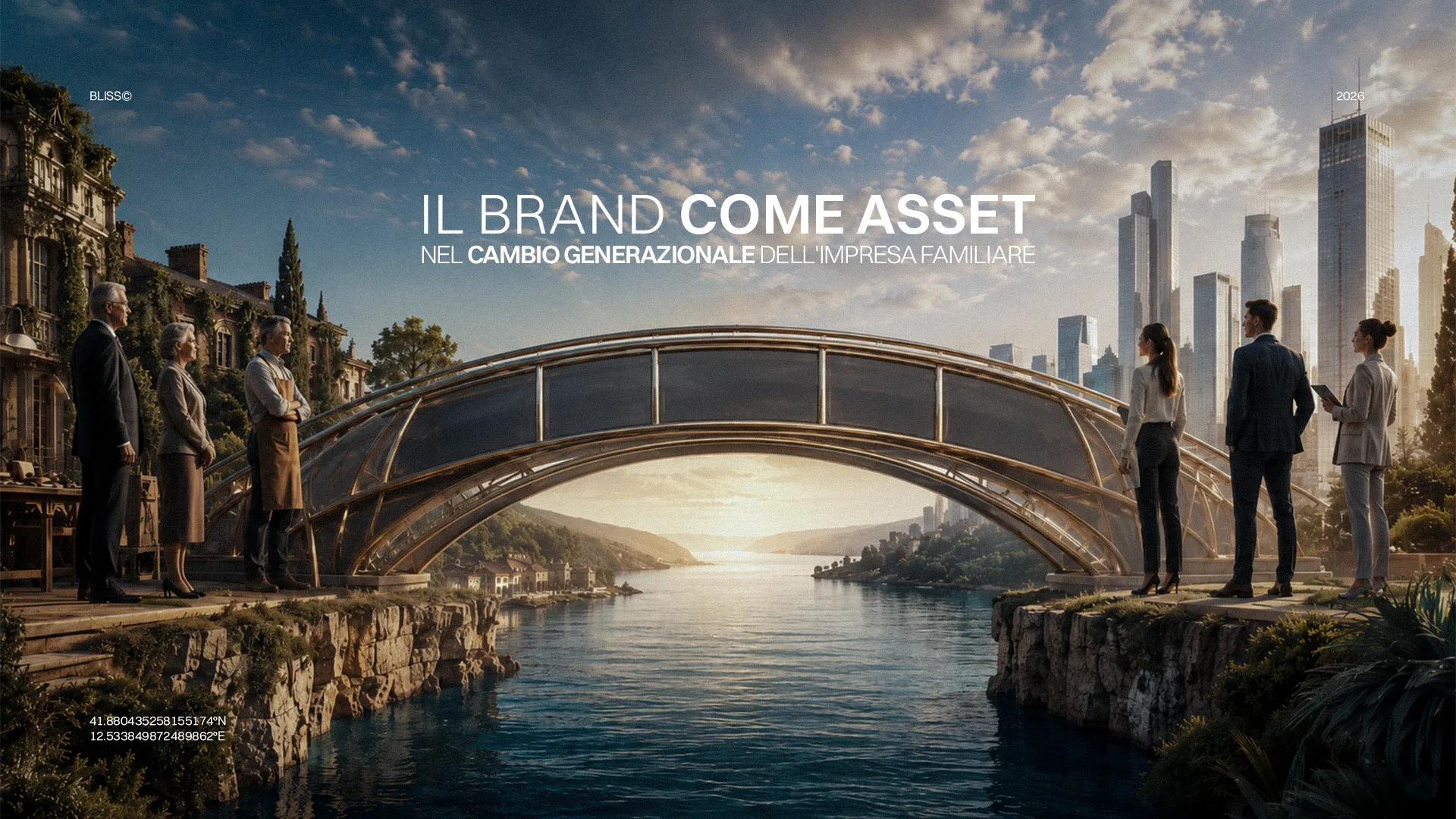
In the generational handover of a family business, the brand is the only asset that can increase in value during the transition, provided it was governed beforehand. Tangible assets are transferred by notarial deed. The brand transfers only if it has an identity of its own, separate from the founder as a person. Companies that document this separation before the transition achieve consistently higher valuation multiples and lose fewer clients in the 24 months following the change of leadership.
The brand as an asset in generational transition: what makes it transferable
The question every entrepreneur should ask before launching a succession plan is not “who will inherit the company?” but “does my brand exist without me?”. The answer is not intuitive: a company can have 30 years of history, loyal clients and solid margins, and at the same time have a non-transferable brand, because all of its perceived value is concentrated in the personal relationship between the founder and the market.
A brand is transferable when it meets three verifiable conditions: the values it represents are written down and shared (not implicit and personal), the promise to the client is formalised so that anyone can apply it, and long-standing clients recognise the brand as an autonomous entity, not as an extension of the founder. According to the AUB Observatory (2025), generational handovers that produce growth in the following three years share one feature: the transition was planned at least 24 months in advance. Brand governance is part of that planning, not a cosmetic add-on.
The brand readiness test: 5 questions before the transition
- Is there a written document defining the brand’s values? If the answer is “yes, in the founder’s head”, the brand is not documented.
- Would clients still buy from the company if the founder changed phone number and could no longer be reached? If the answer is “probably not, for the most important clients”, the brand equity is predominantly biographical.
- Would the brand name survive a change of management without explanations to the market? If it needs a press release to be credible, the brand depends on the person.
- Could a new employee apply the brand’s tone of voice and values without having learnt them from the founder? If not, the brand is not a system but a personal style.
- In a due diligence, did the brand hold up as a standalone asset or was it discounted? If a potential buyer does not recognise value in the brand separately from personal goodwill, it is already discounted
Three cases in which the brand increased value through the transition
Barilla: the brand that went through three ownerships without losing value
Barilla is the best-documented case of an Italian brand that went through a radical change of ownership, the sale to the American multinational Grace in 1971 and the family’s buyback in 1979, without losing either market share or premium positioning. The reason was not luck: Pietro Barilla had built the brand on values (home, family, artisanal quality) separate from his own biographical identity, codified in campaigns and visual assets that did not require his presence to be credible. The brand held without him because it had been built as a system, not as the reflection of a person. In 2022, 145 years after its founding, the brand was updated, with a bolder logo and the founding year as a permanent visual element, without signalling any discontinuity. It is the operational proof that a governed brand does not erode through changes in leadership: it consolidates.
Brunello Cucinelli: the transition as an amplifier of the brand
Brunello Cucinelli built his brand on an explicitly transmissible philosophy (humanistic capitalism, production in Solomeo, responsibility towards the community), documented in books, public speeches and corporate communications with a rigour that no other Italian entrepreneur of his generation has matched. As a result, when his daughters Camilla and Carolina began working alongside their father in running the company, the market perceived no discontinuity: the values were already in the brand, not solely in the person of the founder. The market capitalisation of Brunello Cucinelli S.p.A. rose from around 1.5 billion in 2018 to over 4 billion in 2024, during a period in which the transition to the second generation was under way. Correlation, not causation, but the direction is the one expected by those who govern the brand as a strategic asset.
The pattern in Italian SMEs: what happens when the brand is not ready
The Mediobanca Report on Italian mid-sized industrial companies (2024) documents that companies with low dependence on the entrepreneur and a structured brand identity consistently achieve higher valuations in M&A processes than those with equal turnover but an ungoverned brand. The recurring pattern among SMEs that lose value during generational transition is always the same: long-standing clients slow down their commercial relationships in the first 6–12 months, communications fragment, and the premium positioning that justified the price quietly erodes. Turnover registers the loss 18–24 months after brand equity began to disperse. By then, recovering it costs twice as much as governing it in the first place.
A case from the Bliss portfolio: Risivi & Co. and the brand as a measurable growth variable
Risivi & Co. is a luxury artisanal jeweller based in Rome, with strong ties to the urban cultural scene and a family history that, when the collaboration with Bliss began, already held a rare capital: identity, product quality, recognisability. What was missing, however, was the structure capable of turning that capital into measurable growth. The brand operated without unified direction across strategy, image, content, media and distribution: visibility was there, but it was not converted into systematic demand and sales. Bliss took on full governance of the brand for twenty-four months, building an integrated system that brought together positioning, editorial plan, paid campaigns, visual production, relationships with artists and talent from the urban scene, and SEO, with single direction across all touchpoints.
The result documented in Chamber of Commerce (CCIAA) data is the most direct indicator of the brand as an asset: turnover rose from €206,000 to €556,000 in twelve months, with growth in both online sales and physical stores. This is not an awareness figure: it is a financial figure, describing the direct relationship between brand governance and the economic value generated. Risivi & Co. shows that, in family businesses, the brand is not an investment in communication; it is a growth lever with a measurable impact on the income statement. The full case study is available in the Bliss portfolio section: Risivi & Co., Case Study.
How brand governance turns generational transition into a value opportunity
| Scenario | Ungoverned brand | Governed brand |
|---|---|---|
| Long-standing clients in months 1–12 | Orders slow down, waiting for reassuring signals | Continuity: the relationship is with the brand, not the person |
| Valuation in M&A or shareholder buyouts | Brand discounted as non-transferable “personal goodwill” | Brand recognised as a standalone asset, higher multiple |
| External communication | Fragmented: different messages to different stakeholders | Consistent: the brand book guides all stakeholders |
| Price positioning | Eroded within 18 months through loss of perceived premium | Maintained — institutional brand equity sustains the price |
| Integrating the next generation | Perceived by the market as replacement, not continuity | Perceived as the natural evolution of an existing system |
New Connections (FAQ)
Can the brand really increase in value during a generational transition?
Yes, if it has been prepared in advance. A well-communicated generational transition, with a narrative of the handover built while the founder is still present, legitimises the brand’s evolution in the eyes of the market without signalling a break. The brand can gain relevance if the next generation brings elements of renewal, new markets, new channels, a new aesthetic, within an already solid value system. Brunello Cucinelli and Barilla are the best-documented Italian cases of this mechanism.
What happens to the brand if the generational transition is not planned?
The pattern is predictable and unfolds in three phases: in months 1–12, long-standing clients slow the relationship down, waiting for signs of continuity that never come. In months 6–18, communication fragments; each stakeholder interprets the brand differently, with no frame of reference. In months 18–36, revenue signals the loss of premium positioning. The lag between the moment brand equity erodes and the moment the numbers show it is 12–24 months: by the time the problem is visible, it is already costly to fix.
How do you measure brand value in a family business before a generational handover?
Through a brand audit that separates two components: institutional brand equity, tied to the company’s system of values, promises and visual identity as an autonomous entity, and biographical brand equity, tied to the founder as a person and not transferable without explicit work. The institutional component is the one that holds up in a due diligence or a trademark valuation. The method most widely used in M&A transactions is the income approach: the present value of future cash flows attributable to the brand, discounted for the share that depends on the founder.
When is the right time to work on the brand ahead of a generational transition?
The optimal window is 24–36 months before the formal transition, while the founder is still present and can take an active part in codifying the values and building the narrative of the handover. Starting work on the brand during or after the generational transition is possible, but the cost, in terms of time, resources and brand equity already dissipated, is significantly higher. A brand audit is the starting point in every case: it establishes the current situation before the plan is defined.
BLISS®
© 2026. ALL RIGHTS RESERVED