


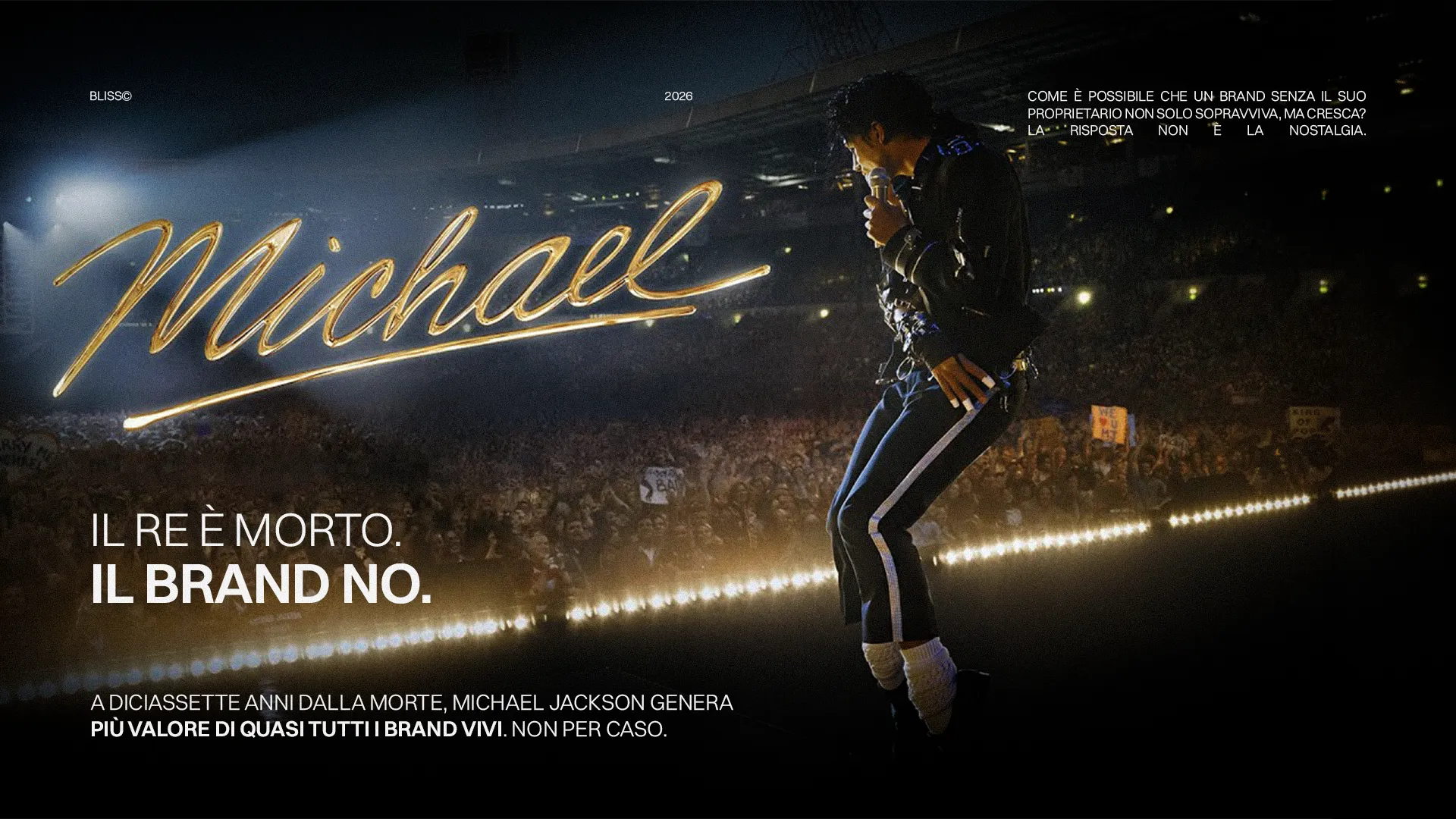
Michael, the film directed by Antoine Fuqua, opened on 24 April 2026 with $97 million in the US market alone and $218 million worldwide in its first weekend. The biggest opening ever for a biopic. After two weeks, the film passed $300 million worldwide, becoming the second highest-grossing music biopic of all time, behind only Bohemian Rhapsody.
Figures that say one thing only: seventeen years after his death, Michael Jackson is still a benchmark economic and symbolic system.
Yet this article is not about the film. It is about what the film represents as an act of brand governance. And what it teaches any organisation that holds a symbolic heritage worth protecting.
A brand without an owner
When Michael Jackson died in 2009, he had debts of over 500 million dollars. The estate was technically in crisis. The name was weighed down by years of allegations, trials and media scandals.
What happened next is one of the most remarkable brand management cases in recent history.
Since then, it has generated around 3.5 billion dollars in posthumous revenue, keeping Jackson at the top of the Forbes ranking of the highest-earning dead celebrities in almost every year since his death. In 2024 came a 600 million deal with Sony for the music catalogue. In 2026, a film with a 200 million budget. The estate is now valued at an estimated 2 billion dollars.
How can a brand without its owner not only survive, but grow?
The answer is not nostalgia.

The science of the posthumous myth
The human brain does not process myths the way it processes people. People are judged over time; they are updated, they contradict themselves.
Myths, by contrast, crystallise.
Frederic Bartlett’s research on reconstructive memory showed in 1932 that memory is not a photograph: it is a narrative the brain rewrites with every recall, smoothing out inconsistencies and amplifying the most salient elements. This is the mechanism Bartlett called leveling and sharpening: contradictory features erode, while those consistent with the existing schema are reinforced.
Jackson is already a myth crystallised in the memory of hundreds of millions of people. The new film was not there to build that myth: it reactivated what already existed. The trailer drew 116 million views in its first 24 hours, the most of any music biopic in history. Pure activation of a pre-existing emotional structure.
A brand that has built solid memory structures keeps accumulating them over time, provided they are overseen consistently. Nostalgia is not sentimentality: it is a neurological mechanism that lowers the cognitive cost of processing and increases ease of access.
The film. The myth. The controversy
But what is Michael about, and what mechanisms has it set off among fans (and non-fans) around the world?
Already postponed twice, Michael had to be rewritten and partly reshot before it could be released, pushing the budget up to 200 million.
The reason is that the original screenplay included a dramatisation of the 1993 allegations. However, a legal clause in the settlement with the accuser required those sequences to be removed, forcing a complete rewrite and an early end to the plot.
The result is a film that stops in 1988, at the peak of the Bad Tour.
A film, then, that does not touch the allegations. That tells the story of the genius and stays silent on the man.
For this reason, critics responded coolly: 39% on Rotten Tomatoes, 39/100 on Metacritic.
Yet audiences responded in diametrically opposite fashion: an A- on CinemaScore, a 90% positive score on PostTrak. A gap that sounds almost paradoxical but in fact shows that the film was not designed for the critics.
The real target is anyone who still holds an emotional bond with Jackson.
Those who want to relive the myth.

Brand governance or censorship?
For this very reason, however, the most uncomfortable question the film raises is not about MJ but about the choice of what to tell.
The Estate co-financed the film and took part in narrative decisions. Partly for this reason, it chose to leave out fifteen years of public life (a choice publicly criticised by Paris Jackson, daughter of the King of Pop).
From a brand management perspective, the choice is defensible. A brand is not obliged to tell everything. If anything, it is bound to be consistent with the positioning it wants to maintain. The estate therefore chose to protect the symbolic value of the musical icon, sacrificing the complexity of the man.
A legitimate choice, but one that invites controversy.
When a brand has no voice
Herein lies the deepest lesson of this case.
Michael Jackson can no longer defend himself. The brand exists and produces value, but no one holds the ultimate authority of the person who built it.
This condition is not exclusive to posthumous brands. It is the condition of any organisation where the founder has left, where management has changed, where the brand has accumulated a history that no single party fully controls.
The result is a $300 million film that divides critics and audiences, tells only half a story, and reignites a debate with no definitive answer. So it is fair to ask: had Jackson been able to choose, would he have chosen this?
Building the answer to that question is work done beforehand. Not afterwards.
A brand with structured governance does not depend on whoever is in charge at the time: it has a framework that outlives individuals. A compass that does not need its builders to be present in order to work.
The brand lives, grows and generates value. But the question remains. And the fact that it has no answer is the most useful lesson this case can offer anyone building something they want to last.
New Connections (FAQ)
Can a great brand survive the death of its creator?
It can, if it has a governance system that extends beyond the individual. The Jackson case shows that a brand’s symbolic value does not depend on the physical presence of the person who built it: it depends on the solidity of the framework that oversees the decisions taken in its name. Without that system, the brand is in the hands of whoever is in charge at the time. With that system, it is in the hands of the original vision.
Why did audiences reward a film that the critics panned?
Because the film was not designed to persuade: it was designed to activate. A brain that already carries an emotional structure built on decades of music, images and memory does not look to the film for new information. It looks for confirmation of what it already knows. When a brand has built sufficiently deep associations, every new touchpoint can draw on them instead of having to build new ones.
Is ignoring a star’s dark side in a film a shrewd marketing move, or simply dishonesty?
Both, and this tension cannot be resolved. From a brand management perspective, the choice is defensible: protecting the symbolic value of the musical icon is a decision consistent with the positioning the estate wants to maintain. From a cultural perspective, telling half the story of a public figure raises questions that no legal clause can ever fully settle. The brand gains in the short term, but the debate stays open for a long time.
BLISS®
© 2026. ALL RIGHTS RESERVED