


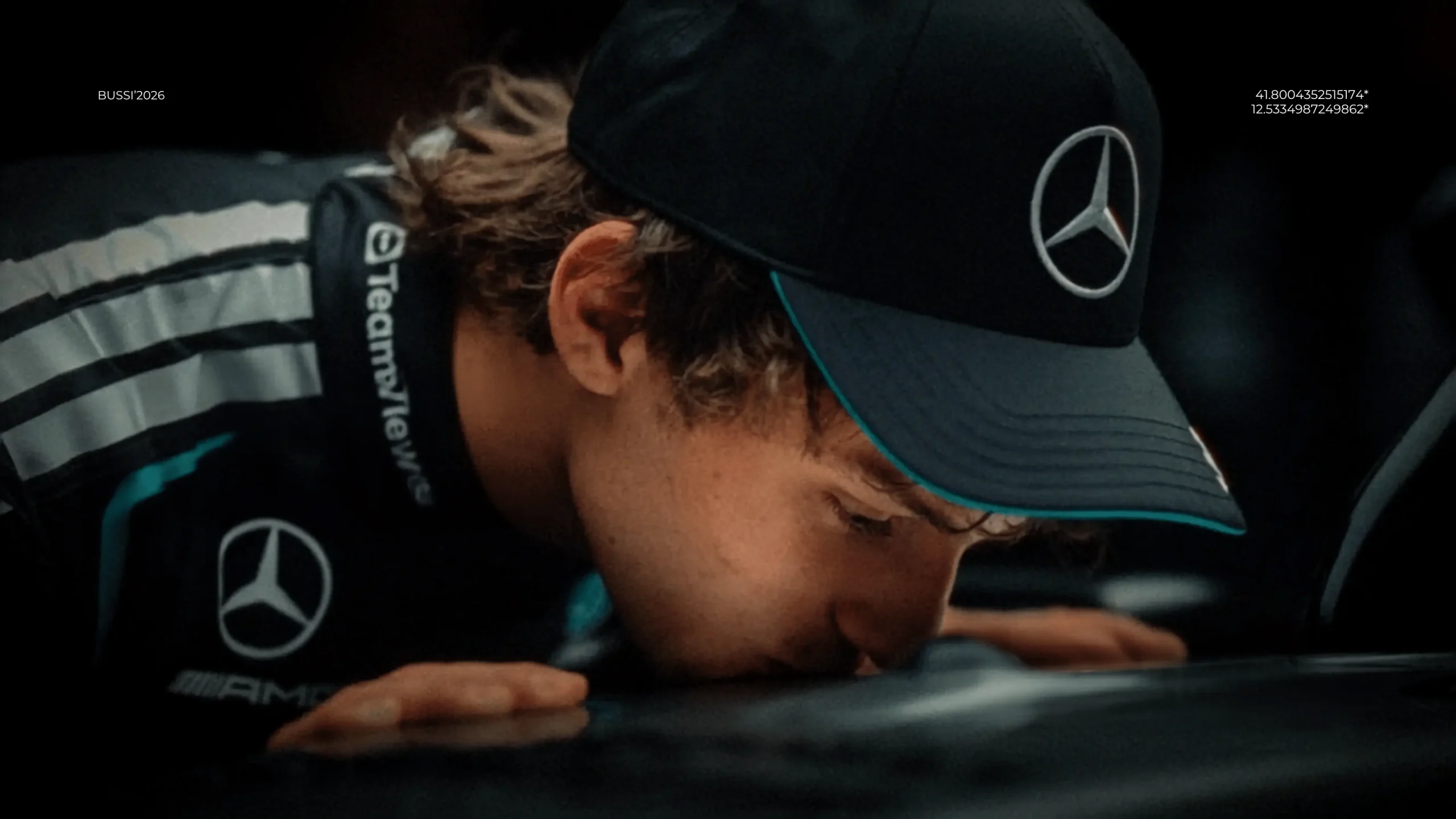
Three pole positions. Three consecutive wins. A record held only by Ayrton Senna and Michael Schumacher.
In qualifying for the Miami Grand Prix, Kimi Antonelli took his third consecutive pole position, equalling a record previously held only by Ayrton Senna and Michael Schumacher. With this win, the 19-year-old from Bologna became the first driver in the history of Formula 1 to win his first three consecutive races, starting from pole position each time. Pause on that for a second. A 19-year-old driving in the most competitive category of world motorsport, racing every Sunday against the best drivers on the planet, is rewriting records that had stood for decades. This is a story about the people who put him in that car knowing he might make mistakes, and decided to wait for him anyway.The courage to bet early
Andrea Kimi Antonelli was scouted by Mercedes during a karting career in which he had collected an almost unbelievable number of trophies. He made his single-seater debut at just 15, winning the Italian and ADAC Formula 4 titles in 2022 and the Formula Regional Middle East and European championships the following year. Most observers expected him to move up to Formula 3, but Mercedes had already realised it had an exceptional talent on its hands. The decision was to skip a step. Straight to Formula 2, bypassing Formula 3. A choice that exposed a very young talent to a level of competition for which he was technically not yet “ready” by the industry’s standard parameters. And that is exactly where the real lesson begins.Why the brain learns from mistakes, and why taking away its time means taking away everything
There is a precise neurological reason why Antonelli’s process worked. A reason that applies to any talent in any field. Sporting, professional, creative. Research on Karl Friston’s predictive brain theory shows that the brain does not merely receive stimuli but constantly anticipates reality, comparing its predictions with experience. Learning comes from error, because it is precisely when a prediction fails to materialise that the brain reorganises its maps. Mistakes produce learning. A talent who is prevented from making mistakes because they are removed too early (or because the organisation fears outside criticism more than it believes in its internal process) is a talent deprived of their main tool for growth. From a neuroscientific perspective, error is a fundamental prediction signal. The brain learns when it notices a discrepancy between what it expected and what actually happened. A climate that punishes error blocks learning through activation of the amygdala, whereas a climate that analyses error fosters neuroplasticity. Mercedes built a climate around Antonelli that analysed error. It exposed him to extremely high-level competitive contexts. Formula 2, skipping a level, then straight into Formula 1. A price Mercedes chose to pay. Mercedes chose to read those mistakes as signals of a process under way. The last part of the brain to mature is the prefrontal cortex, home of the executive functions: planning, prioritisation, impulse control, assessing the consequences of one’s actions. Taking time away from a young talent means taking away the repetitions that build those connections. It means depriving them of the practice that turns potential into consolidated competence. It means, in neurological terms, preventing the growth of the brain structure that produces the best decisions under pressure.
What sport has stopped doing
Look at Italian football over the last twenty years. Media pressure and the hunger for results risk becoming a cultural obstacle: the new is celebrated only if it seizes the spotlight immediately, and those who need time are quickly forgotten. The transfer market, social media and television programmes feed this impatience, even at the cost of wasting the work already done. A footballer who struggles in Serie A at 19 is sold, sent out on loan twice, labelled as unrealised potential. A tennis player who loses in the early rounds of the Grand Slams at 20 is seen as a risky investment. A cyclist who does not win in his first professional seasons is dropped by teams before his growth curve has even had time to show itself. The modern sporting system has built a precise logic: talent must prove itself immediately, or it is replaced by another talent that must prove itself immediately. The result is a generation of athletes shaped by fear of error rather than by the ability to learn from it. And this logic does not belong to sport alone.The problem no company wants to name
Organisations in every sector repeat the same pattern. They hire a bright young person, put them under pressure to deliver results within six months, and when the results do not come they conclude that the problem is the person. The system that never gave them time to mature remains invisible. Companies have developed zero tolerance for mistakes by young talent at precisely the historical moment when feedback cycles are faster and external criticism, spread across social media, the press and industry conversations, arrives before the growth process has even had time to run its course. External criticism has become the parameter that drives internal decisions. And this is the short circuit that burns out talent before it becomes what it was chosen for. Mercedes came in for criticism. When Antonelli, in his first year in Formula 1, was botching starts, losing places and racking up inconsistent results, there were voices calling for a rethink. Mercedes held its course. It read those results for what they were: the cognitive phase of a learning process, the stage at which a talent builds the mental maps that will later be needed to dominate.
The process is the product
There is a distinction that organisations which genuinely grow have understood. Short-term performance and long-term competence are generated by entirely different mechanisms. The first is achieved by putting a person in the best conditions to express what they already know. The second is built by exposing them to situations that go beyond what they already know, creating the conditions for error that produce the learning that produces competence and dominance. When a cognitive discovery is perceived as an internal reward, the release of dopamine strengthens the synaptic connections involved in the event. This process underpins synaptic plasticity, as the useful repetition of neural pathways becomes easier and more stable. Every mistake Antonelli made in Formula 2, every difficult start in his first year in Formula 1, every race in which he did not reach his full potential. All of this was the neurological fuel that built the driver who now wins three consecutive races against Verstappen, Leclerc and Norris. The process was the product. The mistakes were the path. Time was the most precious resource Mercedes could give him.
What it really means to believe in a young person
Believing in a young talent means something far more precise than giving them an opportunity. Opportunity alone, without time and without protection from outside impatience, produces pressure that blocks the amygdala and prevents learning. Believing in a young talent means building a system around him that reads mistakes as data, that shields the process from outside criticism at the moment it is most vulnerable, and that distinguishes between errors of competence, the ones you learn from, and errors of attitude, the ones that signal a structural problem. Mercedes held Antonelli to the highest standards. It exposed him to the most competitive environment in the world. It built a reading of his progress that treated every difficulty as a signal and every fall as a data point. After his win in Miami, Antonelli said: “This is only the beginning. There is still a long way to go. We are working hard, the team is doing an incredible job, and without them I wouldn’t be here.” Nineteen years old, leading the World Championship, talking about the team before himself; calling what he has just done “the beginning”. This is the product of a protected process. Of an organisation that knew how to wait long enough to see what happens when a talent has the time to become what it can be.The question every organisation should ask itself
How many Antonellis has your sector lost because someone decided too early that the process was taking too long? How many talents have been removed during the cognitive phase, when the brain was building the maps that would have produced dominance, because the intermediate results were not yet the ones expected? How many organisations have chosen the certainty of immediate mediocrity over the risk of long-term greatness? Mercedes made a different choice. And last Sunday in Miami, that choice won three consecutive races against world champions, and let us remember that the only other two to achieve this feat were Senna and Schumacher.Domande frequenti
Why is protecting a young talent's process more important than accelerating results?
Because the brain builds competence through error. The prefrontal cortex, the seat of the best decisions under pressure, matures through repetition. Taking time away from a talent means taking away the neural connections that turn potential into dominance. Intermediate results are process data.
How do you tell a talent who is still growing from one who is structurally unsuited to the role?
The deciding factor is the quality of the mistake. Competence mistakes signal a journey in progress: the brain builds its maps, predictions sharpen, the curve rises. Attitude mistakes signal a structural problem that time will not solve. Those who have built a system for reading the process can tell them apart. Those who manage only for immediate results treat them as equivalent.
What can an organisation concretely do to build the right climate around a young person who is developing?
Error is a process: here at Bliss we are convinced of it. That is why we believe in the importance of building a system for reading the process that separates the assessment of the error from the assessment of the person. Only in this way can the path be protected (in sport as much as in the workplace) from external criticism when it is most vulnerable, by setting the criteria for judgement internally. And so the duration of the development process can be defined in advance, making the final assessment independent of intermediate results. With Antonelli, Mercedes did all three.