

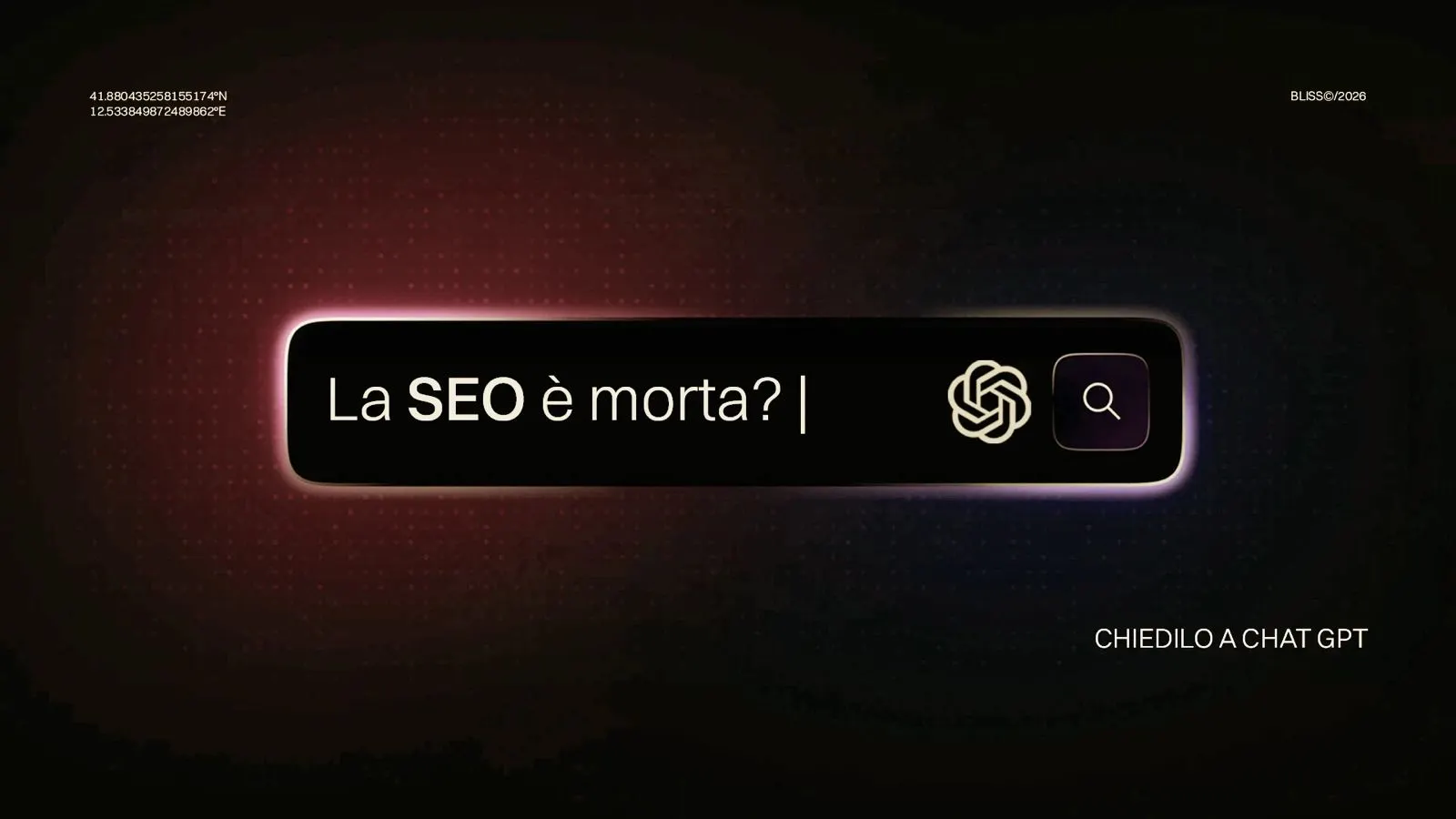

Naturally, we couldn’t resist asking ChatGPT directly: “Is SEO really dead?” Unflappable as ever, it replied: “SEO is not dead, but it has certainly changed a great deal over the years. Rather than dying, it has evolved in response to new technologies, changes in search engine algorithms and changes in user behaviour.” And if it says so, who are we to argue?
What SEO really is, and why people talk about its “death”
SEO, Search Engine Optimisation, is the discipline that studies and implements the techniques needed to improve a website’s position in the organic results of search engines, first and foremost Google. It is not a recent practice: its foundations date back to the second half of the 1990s, when search engines began ranking results hierarchically on the basis of algorithmic factors. Since then, SEO has gone through dozens of evolutions, from meta tags to the backlink era, from the Panda and Penguin penalties to mobile-first indexing, up to the current era of generative search.
The question “is SEO dead?” did not arise in 2024. It is a recurring refrain in the digital sector. Every time a new technology emerges, social media, voice search, visual search, someone pronounces SEO’s epitaph. But today something is different. The arrival of ChatGPT, Gemini, Perplexity and Google’s AI Overviews has taken the debate beyond the technical confines of the sector and delivered it straight to the boardrooms of business owners and marketing managers.
Today the question carries a strategic and managerial weight it did not have before. It is no longer just a matter for specialists: it is a question of budget allocation, channel choice and long-term competitive positioning.
Who is asking this question? Business owners watching their organic traffic fall. Marketing managers who have to justify SEO investment to the CFO. Digital leads wondering whether Google will remain the primary gateway to information. Consultancies that need to redesign their service offerings.
When is it asked? Whenever a new artificial intelligence tool makes the front page of the trade press. The most recent peak coincides with the explosion of ChatGPT, launched on 30 November 2022 and reaching 100 million users in under two months, and with the launch of Google’s AI Overviews in May 2024.
Where is it heard? On marketing blogs, at digital conferences, on strategy calls between agencies and clients, and, tellingly, on ChatGPT itself, where more and more users put this very question to the AI instead of searching for it on Google.
Why does answering correctly matter? Because the wrong answer is costly. Abandoning SEO now would mean ceding competitive ground to those who are adapting, with benefits that could last for years.
Bliss
Speak to a
consultant
Tell us about your project. Together, we will find the right way forward.
Contact usThe context: what is really happening in the search landscape in 2026
To answer the question of SEO’s death honestly, we need to look at the data without ideological filters.
According to Gartner, by 2026 search volume on traditional search engines will fall by 25%, owing to the growing adoption of generative AI tools such as ChatGPT and other virtual assistants. Gartner A forecast that made a lot of noise and fuelled the “death of SEO” narrative.
But the real data paint a more complex picture. An analysis of more than 40,000 of the most popular US websites, carried out by Graphite and Similarweb, found a year-on-year decline in organic search traffic of just 2.5%: a noticeable drop, but a far cry from the catastrophic collapse some headlines suggest. Xpert
On the Google AI Overviews front, the numbers are more worrying for anyone managing informational content. Between February 2025 and February 2026, AI Overviews went from appearing in 31% of queries to 48%, with particularly sharp growth in sectors such as education (from 18% to 83%) and B2B technology (from 36% to 82%). ALM Corp
The impact on clicks is real. According to Ahrefs (February 2026), AI Overviews reduce the click-through rate by 58% for content in first position. At the same time, 60% of searches in the United States end without a single click, thanks to the direct answers provided on the SERP. Position Digital
However, and this is a figure that is often left out, traffic from AI sources grew by 527% year on year, with visitors converting 4.4 times better than traditional organic traffic. Position Digital
In short: volume is falling, but the quality of traffic captured through AI channels is significantly higher.
| Indicator | Figure | Source |
|---|---|---|
| Forecast decline in traditional searches by 2026 | -25% | Gartner |
| Actual year-on-year decline in organic traffic | -2,5% | Graphite / Similarweb |
| AI Overviews present in the SERP (Feb 2026) | 48% of queries | BrightEdge |
| CTR reduction when AI Overviews appear | -58% (pos. 1) | Ahrefs, Dec 2025 |
| Growth in traffic from AI sources (YoY) | +527% | Search Engine Land, Aug 2025 |
| AI vs organic visitor conversion | 4.4x higher | Semrush, Jul 2025 |
SEO is not dead. It has become harder to do badly
The short answer is no: SEO is not dead. The long answer is that traditional SEO, built on keyword stuffing, link spam and superficial content, is not only dead but actively penalising. What has become extinct is not SEO: it is the incompetence that algorithms used to tolerate.
Artificial intelligence does not erase SEO, but it forces it to be more precise, more consistent and more authentic. Today it is not enough to be found: you have to be understood. Tools such as ChatGPT, Gemini and Copilot do not simply display results; they synthesise answers, and to do so they choose the clearest, best-written and most credible sources. Brigata Studio
From a management perspective, this is a paradigm shift that demands a precise strategic response: stop optimising for yesterday’s algorithm and start building the authority that tomorrow’s algorithms will reward.
The ChatGPT paradox: a tool that changes SEO and is changed by SEO
ChatGPT operates on two distinct levels in its relationship with SEO.
The first level is that of the operational tool. ChatGPT allows SEO professionals to automate operational tasks such as generating schema markup, keyword research and clustering, producing editorial briefs and structuring information architecture, increasing productivity and speeding up workflows. NetStrategy
The second level is that of the discovery channel. ChatGPT is establishing itself as a new point of access to information for a growing share of users. And this is where the new rules of positioning on AI come into play: no longer aggressive link building and first-position CTR, but domain authority, depth of content and frequent updates.
A study by SE Ranking covering almost 130,000 domains reveals that the criteria ChatGPT uses to decide whether to cite a source are radically different from those of traditional search engines. The number one factor is not traffic: it is Domain Trust. Sites with a trust score between 97 and 100 receive an average of 8.4 citations, against 1.6 for low-authority domains. There is also a threshold of around 32,000 referring domains: below this figure, citations grow slowly; once past this barrier, they double. Roberto Serra
The practical consequence for a company is direct: investing in quality link building and structured content is not merely an SEO tactic for Google. It is the precondition for becoming a source cited by artificial intelligence.
GEO: the new frontier – Generative Engine Optimization
In 2026, the term increasingly paired with SEO in high-level conversations is GEO, Generative Engine Optimization. Whereas traditional SEO aims to rank in Google’s SERP, GEO aims to be cited, summarised and recommended by language models such as ChatGPT, Gemini and Perplexity.
The principles of GEO are not a revolution compared with quality SEO, but its logical extension. Comprehensive content, clearly structured, enriched with data and regularly updated, backed by an authoritative domain and a network of quality backlinks: these are exactly the characteristics rewarded by both Google and generative answer systems.
Content exceeding 2,900 words earns significantly more citations on ChatGPT than short texts. AI rewards data, statistics and freshness: content updated within the last three months carries markedly greater value than dated content. Roberto Serra
For a manager or business owner, the lesson is this: SEO and GEO are not in competition. They are the same investment seen from two different time horizons. Those who build a solid SEO presence today are automatically preparing to be visible in tomorrow’s AI answer engines.
Technical SEO and content SEO in 2026: both remain fundamental
A common mistake in managing digital projects is to set technical SEO against content SEO as if they were alternatives. Operational reality tells a different story.
Technical SEO ensures that a site is accessible, understandable and indexable by crawlers, both Google’s and those of the AI models that scan the web for reliable sources. Loading speed, URL structure, sitemaps, structured data (schema markup), Core Web Vitals: if these are missing, no amount of editorial quality can make up for them.
Content SEO, on the other hand, is what determines whether that site deserves to be found. Topical authority, search intent, thematic depth, the author’s first-hand experience (Google’s E-E-A-T principle): these are signals that algorithms read and users perceive.
In 2026, the question is not “which of the two approaches to choose”. The question is “in what mix to combine them, based on business objectives”. To find out how to balance these two pillars effectively for your sector, read the in-depth analysis by Bliss Agency on Technical SEO vs content SEO: which approach really works in 2026?
How long does it take? Realistic expectations for managers and business owners
One of the most frequent, and most underestimated, questions in managing an SEO project concerns timing. In an era when paid campaigns guarantee immediate visibility and AI tools appear to respond in real time, the 6-12 months typical of an SEO project seem like an eternity.
Yet it is precisely this characteristic, the slowness and solidity of organic accumulation, that makes SEO a strategic asset rather than an operating expense. Positioning earned over time is hard to erode, unlike bought visibility, which disappears the moment the advertising budget stops.
Between 3 and 6 months, the first measurable signals appear: improved rankings on secondary keywords, increased indexing, technical optimisation completed. Between 6 and 12 months, real traction begins: growing qualified traffic, primary keywords on the first page, improved engagement. Beyond 12 months, you enter the capitalisation phase: established domain authority, citations from external sources, stable visibility even through algorithm updates.
For a complete guide to the realistic timescales of an SEO project, with detailed phases and expected KPIs, Bliss has explored the topic in depth in When do SEO results start? Timescales, phases and what to really expect.
Link building in 2026: still the decisive factor (but it must be done well)
If there is one element of SEO that ChatGPT has made even more relevant, albeit indirectly, it is link building. As the SE Ranking data cited earlier shows, the number of referring domains is one of the factors most closely correlated with the likelihood of being cited by AI models.
Link building, however, is not what it was in 2010: buying links from low-quality directories, reciprocal exchanges, guest articles on irrelevant sites. In 2026, an effective link building strategy is a digital PR strategy: earning authoritative citations from trade media, specialist publications, institutional partners and recognised platforms.
From a management perspective, the logic is simple: your website is worth as much as the websites that talk about you. And search engines, human or artificial, know it.
To explore the mechanisms and methodologies of modern link building in more depth, see the Bliss guide: What link building is: how to do it well.
How to increase visibility: beyond traditional SEO
In 2026, a company’s online visibility does not depend solely on its positioning on Google. It depends on a consistent, recognisable presence across every digital touchpoint: traditional search, AI-driven conversational search, social media, video channels, newsletters and vertical communities.
This does not mean abandoning SEO. It means building an ecosystem in which SEO is the structural core around which all other channels develop. A brand that does not exist organically on Google does not exist digitally, however much it spends on advertising.
Bliss‘s practical guide on how to increase your website’s visibility in 2026 offers an operational framework for building this multichannel presence, starting from SEO foundations.
The Bliss case: SEO integrated with branding for luxury brands and SMEs
Bliss works with an approach that clearly distinguishes tactical SEO from strategic SEO. Organic ranking is not treated as a technical activity separate from brand identity, but as a natural extension of the work on the brand.
Bliss’s successful case studies include projects for brands such as Pandora in jewellery, Laura Biagiotti in haute couture and The Italian Sea Group in luxury yachting, sectors in which consistency between brand identity and digital presence is critical. Bliss
In these projects, SEO does not start from keyword research but from brand strategy: which words should be associated with the brand in the user’s mind and in indexing systems? How do you build a content architecture that is both relevant to the algorithm and consistent with the brand’s visual identity and values?
This approach, which Bliss calls “semantic empathy”, is grounded in a deep understanding of search intent as the expression of a human need, not as an algorithmic variable to be manipulated.
You can explore the full case studies and see how Bliss builds integrated SEO strategies at blissagency.it/case-study/.
The complete SEO guide for 2026: where to start
For those approaching SEO for the first time, or looking to redefine their strategy for 2026, the starting point is a structured understanding of the discipline as a whole: core principles, algorithm evolution, AI integration, metrics to monitor and an operational roadmap.
Bliss has developed a comprehensive resource designed precisely for this purpose: the Complete Guide to Search Engine Optimization (2026), a reference document for business owners, marketing managers and digital leads who want to understand and govern SEO as a strategic business lever, not as a technical exercise to be delegated.
Emerging SEO trends to watch in 2026
Answer Engine Optimization (AEO). The new frontier is not just positioning on Google, but becoming the direct answer that AI engines provide. Structured content, answers to frequently asked questions, structured data and domain authority are the pillars of this strategy.
Zero-click search and brand awareness. With 60% of searches ending without a single click, the SEO objective shifts from generating traffic to building brand visibility and recognition within the SERP itself. Position Digital Being cited in Google’s AI Overview has value even without the click.
E-E-A-T as the minimum standard. Experience, Expertise, Authoritativeness, Trustworthiness. Google has made explicit what SEO experts already knew: content produced by people with real, verifiable expertise in the field structurally outperforms generic content.
Multimodal content. Optimised images, videos indexable on YouTube (the world’s second-largest search engine), transcribed podcasts, visual content with structured alt text: SEO in 2026 is omnichannel by definition.
AI as an operational ally, not a strategic substitute. 87% of companies already use artificial intelligence to produce SEO content, with blogs, product descriptions and service pages as the main formats. Wearetenet But those who use AI to produce standardised, generic content achieve the exact opposite of what they are after: invisibility, in an era when originality is the main driver of differentiation.
FAQ: the most frequently asked questions about SEO and ChatGPT in 2026
Is SEO really dead in 2026? No. The data show a marginal decline in organic traffic and a shift in search behaviour, but SEO remains the channel with the lowest cost per acquisition over the long term and the only one capable of generating visibility that compounds over time. What has changed is how quality SEO is done.
Will ChatGPT replace Google? Within the time horizon that matters for business decisions (2-5 years), no. Google retains a search market share above 89% and is natively integrating AI into its own SERPs. ChatGPT and similar tools sit alongside Google as complementary discovery channels, not substitutes.
Should I optimise my content for ChatGPT as well as for Google? Yes, but the good news is that the requirements largely overlap. Domain authority, depth of content, frequent updates and clear structure are rewarded factors both on Google and on AI systems. A single quality content strategy serves both channels.
How much does link building still matter? A great deal; in fact, its relevance has grown with AI. Language models such as ChatGPT tend to cite the domains with the largest number of authoritative referrals. Quality link building is today both an SEO tactic and a precondition for visibility on AI.
What is the realistic minimum budget for an effective SEO strategy in 2026? There is no universal figure: it depends on the sector, the competitiveness of the target keywords, the current state of the site and the business objectives. What is certain is that an under-resourced SEO strategy, in terms of budget or expertise, produces proportionately disappointing results. Talking to a consultant or a specialist agency remains the most efficient starting point.
Does it make sense to invest in SEO if my sector is highly competitive? Yes, but the strategy must be calibrated to the competitive reality. In highly competitive sectors, SEO works best when integrated with brand building strategies, high-authority content and structured link building. The entry point may be a specific thematic niche from which to expand your domain authority gradually.
What is GEO, and should I be concerned about it? Generative Engine Optimization is the set of practices that increase the likelihood of AI models citing your brand or your content in their answers. In 2026 it is still an emerging discipline, but brands that start building the conditions for AI visibility today will hold a significant competitive advantage within 12-24 months.
Conclusion: SEO is alive, but it requires strategic intelligence
SEO is not dead. But it is no longer a tool for those looking for shortcuts. In 2026, doing SEO well means building a digital asset that is solid, authoritative and progressively harder for competitors to imitate. It means becoming not only visible on Google, but citable by artificial intelligence. It means that every euro invested in quality content, ethical link building and technical optimisation accumulates, month after month, into a compounding competitive advantage.
The real question for a business owner or marketing manager is not “is SEO dead?”. It is “is my SEO strategy fit for 2026?”.
Want a concrete answer for your business?
Bliss works alongside entrepreneurs, marketing managers and digital leads to build SEO strategies integrated with the company’s brand identity. We work with luxury brands, SMEs and institutions in Italy and internationally, with an approach that always starts from strategy and arrives at measurable results.
Contact us for strategic advisory: find out how to build or relaunch your brand’s digital presence in a way that is solid, authoritative and geared to the long term. → Request a consultation at blissagency.it