


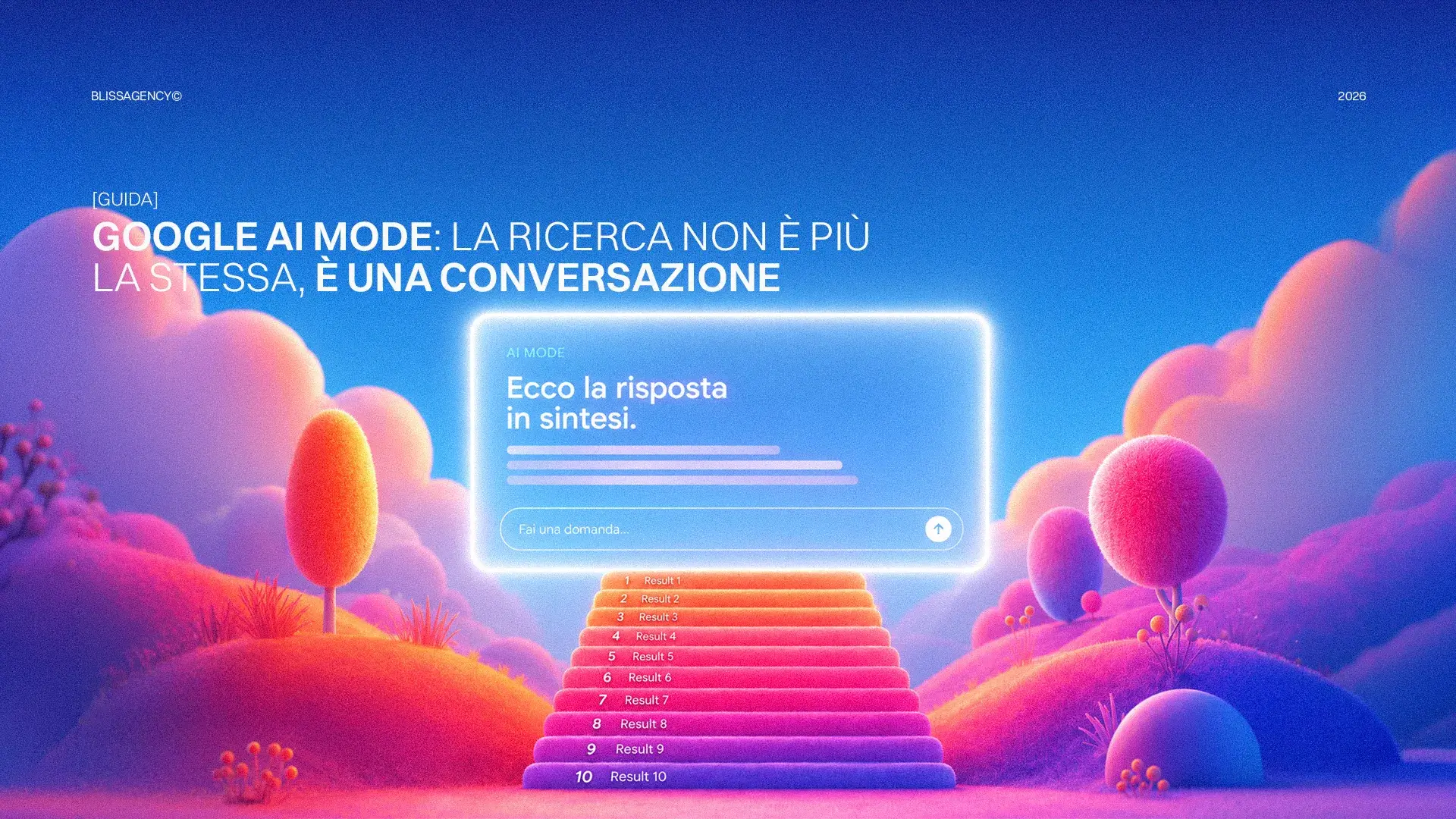
Google AI Mode:
search is no
longer the same.
It is a conversation.
Live in Italy since 8 October 2025. Organic CTR plummets by between 34% and 61% when AI answers appear. This guide explains what has changed, why adapting is urgent and how to do it methodically.
What Google AI Mode is and when it arrived in Italy
For decades, searching on Google meant the same thing: typing a few keywords, scrolling through a list of ten blue links, choosing which one to open. A process that, while evolving with snippets, knowledge panels and AI Overview, had always kept the same underlying logic: the user searches, Google suggests sources, the user decides where to go.
Google AI Mode breaks this logic structurally. It is not an incremental update — it is a paradigm shift. Instead of showing sources, Google answers directly. Instead of a list, it generates text. Instead of a search, it starts a conversation.
Built on the Gemini model, Google AI Mode was announced at Google I/O in March 2025 and rolled out progressively, first in the United States. On 8 October 2025 it officially arrived in Italy, together with 35 other languages and almost 50 new countries, bringing global coverage to over 200 territories.

AI Mode vs AI Overview: the differences that matter
One of the most common mistakes is treating AI Mode and AI Overview as synonyms. They are different tools, with different logic and different effects on your site’s visibility. Understanding the difference is the first step towards optimising correctly for both.


Query Fan-Out: the mechanism rewriting SEO
At the heart of Google AI Mode is a technical mechanism called Query Fan-Out. It is the invisible engine that decides how many results are retrieved and how the answer is built. Understanding it is essential because it completely changes the approach to content creation.
Query Fan-Out works like this: when a user asks a complex question, the AI does not treat it as a single query. It breaks it down into several related sub-queries, each exploring a different aspect of the topic. These sub-queries are analysed in parallel, gathering information from several different sources, and then synthesised into a single coherent answer.
User query: “Which digital marketing strategy is most effective for an Italian SME in 2026?”
Sub-queries generated by the fan-out:
→ “SME digital marketing strategies 2026” → “Recommended marketing budget SMEs Italy” → “SEO vs advertising SME costs” → “B2B social media marketing Italy” → “SME digital marketing case study Italy”
Each sub-query draws on different sources. The final answer integrates all the results. Content that answers only one of the sub-queries has very little chance of being cited. Content that covers them all is almost inevitably in the answer.
The data confirms how central this mechanism is: with the Gemini 3 update of February 2026, pages that correctly capture the fan-out are 161% more likely to be cited than those optimised for the main keyword alone.
It is also worth understanding what sets Query Fan-Out apart from the familiar “People Also Ask” section. The difference is structural: People Also Ask goes deeper vertically, expanding on the same topic. Query Fan-Out expands horizontally, exploring different but connected subject areas and building semantic networks that a human user would take hours to construct manually.

The real impact on organic traffic: the data
The numbers leave no room for optimistic readings for those who fail to adapt. AI Mode’s impact on organic traffic is real, measurable and accelerating.
The most revealing data point is the growing gap between impressions and clicks. A site can see its impressions rise by 49% in Google Search Console and its clicks fall by 30% over the same period. This is not a bug — it is a sign that the site is being shown as a source in AI Mode answers, without the user feeling the need to click through to learn more.
It is important, however, to read the data precisely. The impact is not uniform across all query types:
- Simple informational queries (definitions, “what is”, “how does it work”): maximum impact, with CTR down by up to 61%. The AI answers in full, with no need to click.
- Comparative and decision-making queries (“what is the best X for Y”, “X vs Y”): medium impact. Users read the summary but often want to check the source before making the final decision.
- Transactional and local queries (“buy X”, “marketing agency Rome”): low impact. They remain in the traditional SERP with classic competition.
- Specialist technical queries (content requiring advanced expertise): low impact. Users sense the need to dig deeper at the original source.
The right strategy is not to resist change, but to reorient towards the types of content AI cannot fully replace — and towards the goal of being cited as a source, not just ranking.

Losing traffic without understanding why?
We analyse your visibility in AI Mode, identify the queries at risk and build a concrete adaptation strategy.
Request a GEO & AIO audit →6 strategies for optimising for AI Mode
Adapting to Google AI Mode does not mean rewriting everything from scratch. It means adding a layer of logic to existing content — and applying that logic systematically to new content. The strategies below are ordered by short-term impact.
01 — Covering the complete semantic cluster for Query Fan-Out
Because the AI breaks every query down into parallel sub-questions, content that answers a single main keyword is far less likely to be cited than content covering the entire topic cluster. The pillar + cluster structure is no longer just an SEO best practice: it is the minimum requirement for relevance in AI Mode.
- Map the fan-out sub-queries for every important topic: ask ChatGPT or Gemini “if someone asked X, what related questions might they have?” — it is a rough but effective simulation of the real fan-out.
- Structure the main guide with H2/H3 sections dedicated to each sub-query, not just to the main keyword.
- Create linked satellite articles for sub-queries with enough volume to justify a standalone page.
- Use explicit internal links between pillar and cluster pages — the AI also reads links as a signal of topical architecture.
02 — Answer First: a direct answer in the first 40-60 characters of each section
AI Mode extracts chunks of text from each page. The likelihood of extraction depends on how clear the answer is and where it sits: content that answers immediately, in the first sentence of each section, gets extracted. Content that builds a preamble before answering gets skipped.
- Every H2/H3 section must open with the direct answer to the question implied in the heading — not with a preamble, not with a “before answering, it helps to understand that…”
- Use the “Question → Direct answer → Deeper detail” format as a mental template for every informational paragraph.
- Add a TL;DR at the start of every long guide — it is the chunk most likely to be extracted and cited.
- According to Google itself, AI Mode users ask questions 2-3 times longer than average — content must be ready to answer complex questions, not just 2-3 word keywords.
03 — Comparative and decision-making content
Analysis of more than 680 million AI citations shows that comparative content accounts for 32.5% of all citations in generative engines (Profound, 2025). It is the format AI selects most often — and also the most resistant to zero-click syndrome, because users often want to check the source before deciding.
- Crea pagine di confronto esplicite: “X vs Y”, “I migliori X per [scenario specifico]”, “Come scegliere tra A e B”.
- Structure comparisons with clear tables with explicit criteria — AI extracts them easily and cites them with attribution to the source.
- Include explicit recommendations with selection criteria: “Choose X if…, choose Y if…”. AI summaries tend to reproduce exactly this structure.
- Add concrete numerical data to comparisons: they are by far the most citable chunks.

04 — Schema Markup specific to AI Mode
Structured data is the language in which AI systems read your content without interpreting it. Correct markup increases the likelihood that AI will recognise and correctly cite your page as a source.
FAQPage — the most effective for capturing fan-out sub-queries. Each question in the markup corresponds to a potential sub-query generated by AI.
HowTo — ideal for step-by-step guides. AI Mode often extracts individual steps as answers to procedural questions.
Article with an updated dateModified — the most direct freshness signal. Perplexity and AI Mode reward recently modified content.
Speakable: emerging for AI Mode with voice search. It flags which sections of the page are best suited to being read aloud by the AI.
Person (for authors) — links the author to the content, strengthening the E-E-A-T signals AI uses to assess the source’s authority.
05 — Enhanced E-E-A-T: verifiable authority
Initial data on AI Mode shows a clear trend: AI tends to cite mainly well-known, trusted brands, favouring sources that demonstrate verifiable expertise. Good content is not enough — AI must be able to verify who wrote it and why that source is authoritative.
- Every article must have an author with a bio, credentials and a link to a verifiable LinkedIn profile. Not “Editorial Staff”, but a real person with a real track record.
- Cite primary sources with links: original studies, government data, academic research. The AI checks citations and favours those who cite authoritative sources.
- Publish proprietary data: internal surveys, (anonymised) client analyses, industry benchmarks. This is the least replicable and most cited content.
- Actively monitor and manage brand mentions on industry sites — external citations are a signal of authority that the AI reads across sources.
06 — Direct channels: reducing dependence on Google
This is the hardest strategy to accept but the most honest to include. If AI Mode structurally reduces referral traffic from Google to websites, the rational response is to build channels that do not depend on Google to bring in users.
- Newsletter: the channel most resilient to the algorithm. A subscriber is yours, not Google’s. 2025 saw 34% growth in B2B newsletter subscriptions in Italy.
- Brand search: the better known your brand is and the more it is searched for directly, the less you depend on informational queries intercepted by AI. The goal is for users to search for “Bliss”, not just “marketing agency Rome”.
- Communities and owned spaces: forums, private Slack groups, events — spaces where interaction happens outside the SERP.
- Video and podcast content: platforms such as YouTube are sources frequently cited by the AI itself — owning YouTube means being present in two channels with a single piece of content.
How to measure visibility in AI Mode
Measurement in AI Mode requires an updated analytics framework. Traditional metrics (average position, aggregate organic CTR) no longer capture reality. The new set of KPIs must combine AI visibility signals with conventional traffic signals.
Google Search Console — the primary signal
Since May 2025 GSC has recorded impressions and clicks from AI Mode. The pattern to monitor: rising impressions + falling CTR on the same queries = presence in AI answers without clicks. It is not a problem but a brand awareness opportunity to be measured separately. Filter by informational queries and track the impressions-to-clicks ratio month on month.
Systematic manual testing on target queries
Define the 15–20 most strategic queries in your sector. Every month, test them in AI Mode and check whether your brand or content is cited. Record date, query and answer in a simple tracker. It is the most direct method, and still the one with the best signal-to-noise ratio compared with emerging automated tools.
GA4 — referrals from AI sources
In Google Analytics 4, filter traffic by source: monitor sessions from google.com/search with AI Mode parameters, and from chatgpt.com, perplexity.ai, bard.google.com. Referrals from AI sources are still a minority in volume but growing exponentially — and they convert better than classic organic traffic because they come from users at an advanced decision stage.
Dedicated AI visibility tools
Semrush AI Toolkit, Ahrefs AI Overview Tracker and emerging tools such as Goodwriter let you monitor how often your domain appears in AI answers. They are still in development and the data vary, but they provide a baseline for measuring progress over time.
The integrated strategy: SEO + GEO + AI Mode
Three tools, one logic. SEO, GEO and AI Mode optimisation are not separate disciplines that cannibalise one another: they are layers of the same system. SEO builds the organic ranking that is still the primary selection factor for AI sources. GEO turns that content into something generative engines can cite. AI Mode optimisation adds the specific structure needed for Query Fan-Out and conversational search.
The figure that settles the priorities once and for all: between 76% and 92% of sources cited in AI Overview and AI Mode come from the top 10 organic results (Ahrefs, 2025). Traditional ranking is not dead — it remains the necessary condition. But it is no longer sufficient. Content structure, fan-out coverage and E-E-A-T signals have become equally necessary conditions for turning a good ranking into an AI citation.
Competitive advantage is being built now. The Italian market is still largely unprepared — few sites have updated their content architecture for Query Fan-Out, very few have implemented Speakable markup, and almost none have a system for monitoring AI citations. Those who move methodically in the coming weeks will build a positioning that becomes progressively more expensive to replicate.

FAQs on Google AI Mode
What is Google AI Mode?
Google AI Mode is the Gemini-based conversational search mode built directly into Google Search, live in Italy since 8 October 2025. It turns classic search into a dialogue: users ask questions in natural language, receive concise answers with cited sources and can continue with follow-up questions while keeping the context.
What is the difference between AI Mode and AI Overview?
AI Overview appears in the standard SERP as a summary box for simple queries. AI Mode is a dedicated, conversational mode for complex queries; it uses the Query Fan-Out mechanism and supports multi-step interactions with voice and images. Its impact on organic traffic is deeper and structural.
What is Query Fan-Out?
Query Fan-Out is the mechanism by which AI Mode breaks a complex query down into multiple related sub-queries, analysed in parallel across different sources. Pages that cover the complete semantic cluster — answering several sub-queries within the same content architecture — are 161% more likely to be cited (post-Gemini 3 update data, February 2026).
Does AI Mode reduce my site’s organic traffic?
Yes, on informational queries. Data show a CTR drop of between 34.5% and 61% when AI summaries appear. Only 4.5% of AI Mode sessions lead to a click on the sources. Traffic falls but becomes more qualified: those who arrive are at an advanced decision-making stage. The strategic response is to optimise to be cited as an authoritative source, not just to rank.
How do you measure visibility in Google AI Mode?
Since May 2025 Google Search Console has recorded impressions and clicks from AI Mode. The telling pattern is rising impressions with falling CTR on the same queries: it means presence in AI answers without clicks. Complement GSC monitoring with monthly manual tests on target queries in AI Mode and with tracking of referral traffic from AI sources in GA4.
Adapt your strategy to Google AI Mode
An audit of your visibility in AI Mode, Query Fan-Out analysis on your priority keywords, a structured optimisation plan. A single point of contact from strategy to execution.
Explore the GEO & AIO service →