

Artificial intelligence produces correct answers while never bearing the weight of what those answers produce.
To understand this, imagine a man born without sight. He does not have a single memory of light.
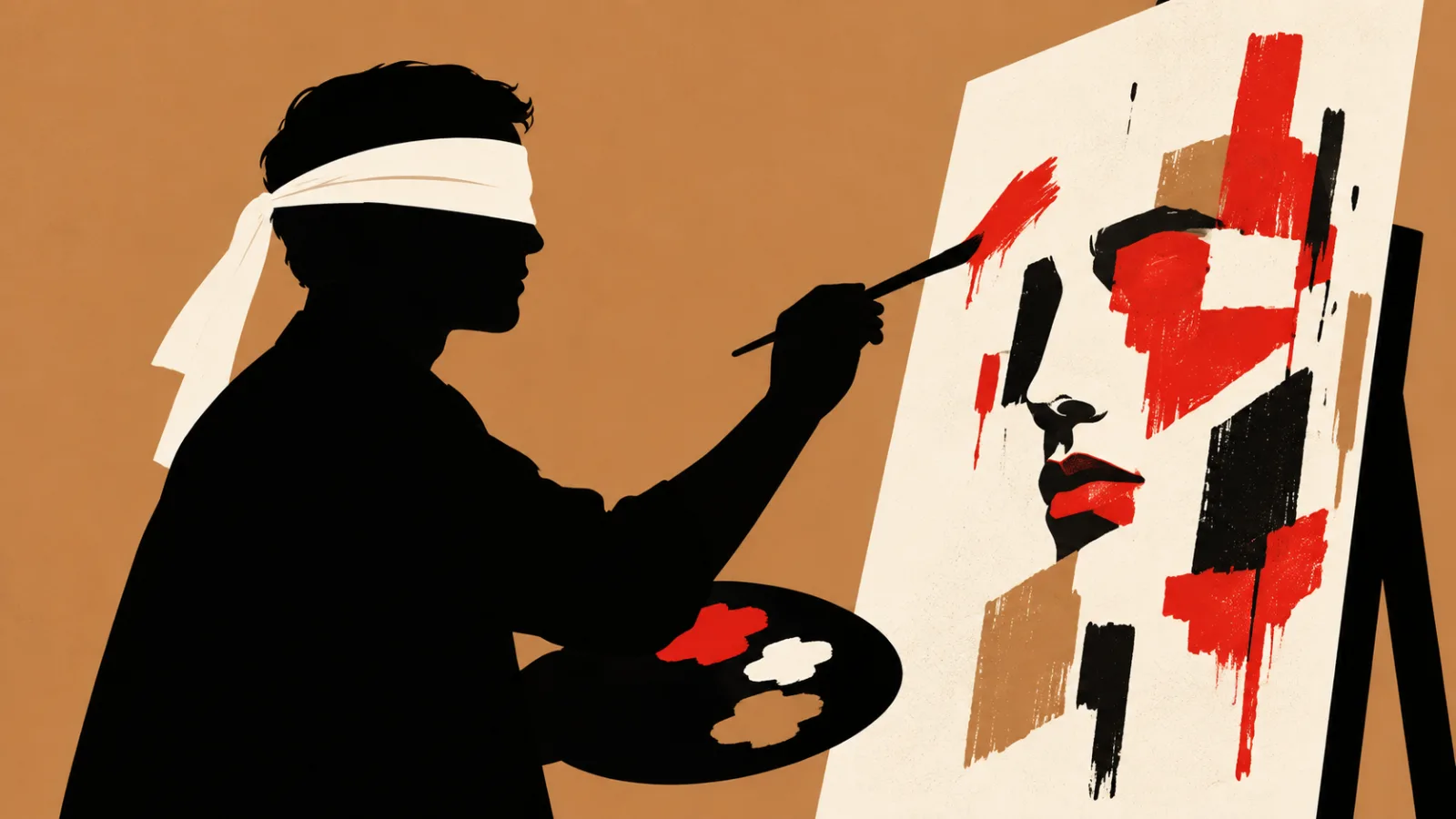
This man paints.
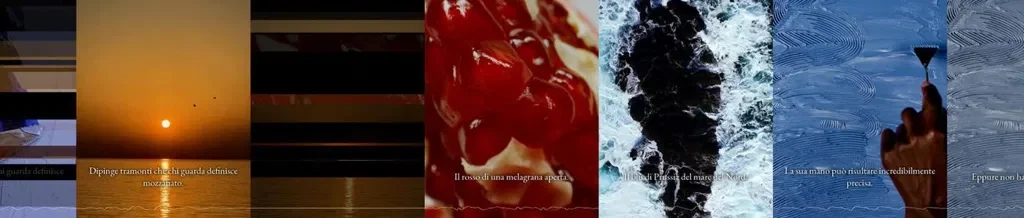
He paints sunsets that viewers call breathtaking. The red of a split pomegranate. The Prussian blue of the North Sea. Critics praise him. Collectors buy. His canvases end up in museums.
He learnt what the world was from other people’s accounts. From descriptions, from touch. He knows which colours are associated with the sun, which contrasts make a scene believable and which proportions create depth. And so, in this way, he manages to bring it all onto canvas.
Its hand is extraordinarily precise.
It has never seen a colour.
Such a man exists.
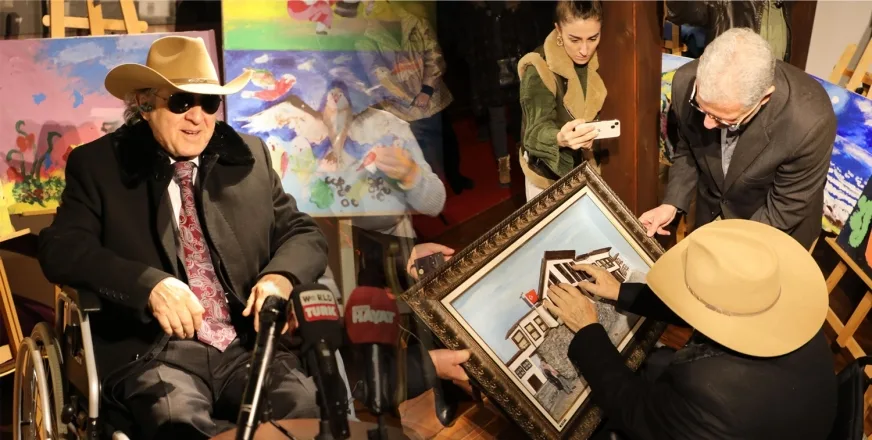
His name is Eşref Armağan. He was born in Istanbul in 1953 and has been blind from birth. He paints in oils with his fingers. He traces the outlines with a braille stylus, applies the colour one layer at a time and waits for each layer to dry before laying the next. In his paintings the lines converge towards a vanishing point, even though nothing has ever vanished from his sight.
He is blind, but he knows what it means to observe.
A group of Harvard neuroscientists demonstrated this in 2008 by inviting him to draw inside a scanner. As his hand worked, his visual cortex lit up like that of a sighted person. (Brain Research, 2008). Something extraordinary, when you think about it. Because despite eyes that have never borne the weight of the world, Eşref knows that weight.
He cannot see, but he is not blind.
And AI?
Artificial intelligence (or superintelligence, if you prefer) creates wonderful images. In the hands of skilled users, it produces in a few seconds works that many people would take lifetimes to create (if they managed at all). And yet, even with the brush in hand, it is blind. It does not know what it is doing or why it is doing it. It has no idea what all its effort will produce.
We should all remember that more often.
Move the easel, and see what happens
Producing a correct answer and knowing what really matters in that answer are two entirely different things. A study published by Apple in October 2024, GSM-Symbolic, demonstrates this.
The researchers took elementary maths problems and generated controlled variants by changing names and values. The structure of the problem stayed identical, but the surface changed just enough. Precisely because of this, the models’ performance fluctuated significantly (Apple Machine Learning Research, 2024).
All it took was adding sentences that seemed relevant but were in fact useless to throw the AI into complete confusion.
“Oliver picks 44 kiwis on Friday, 58 on Saturday and double Friday’s number on Sunday, and five of them are a bit smaller than average. How many kiwis does Oliver have?”
A primary-school problem, yet many models failed it by subtracting those five smaller kiwis. In some cases accuracy collapsed by as much as 65%. Why? Because, just like a truly blind painter, moving the easel a few centimetres was enough to ruin the entire composition. And to make it stumble.
The authors drew a cautious hypothesis from this. The models reproduce reasoning patterns encountered during training more than they perform abstract logical reasoning. Yet to distinguish what really matters from what does not, you need to know what is at stake. And that is precisely what AI (as of today, and perhaps ever) will never manage to do.
Who pays for the blindness
Would we ever have our portrait painted by a blind painter if our life depended on it?
Probably not. And yet a model can build a crisis communication plan, answer our work e-mails and draft contract clauses: all without ever paying the consequences or bearing the effects.
Those all fall on us.
Whether in law or in warfare, the weight of every decision rests on the shoulders of whoever signs the work, no longer on whoever produces it.
Of course, AI produces alternatives, cuts time, speeds everything up. It can even surface options the decision-maker had not considered. Except that it then offloads the weight of it all: and that weight has to be governed with skill.
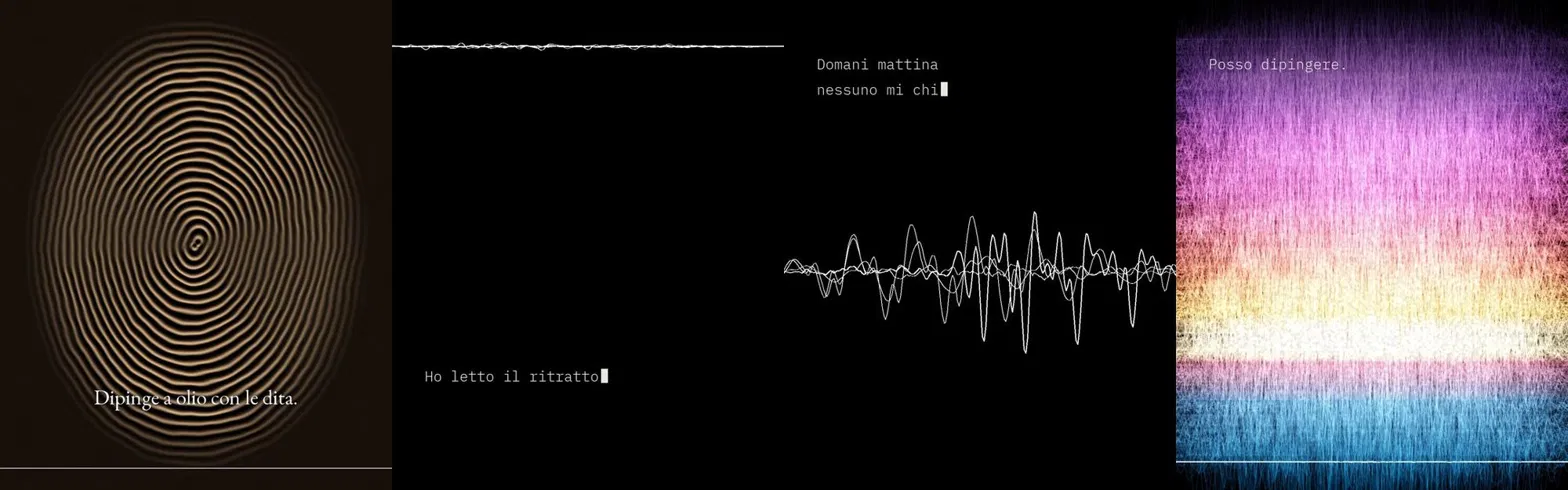
Where the canvas ends and the world begins
It is normal for AI to have this limitation. It is a tool, however sophisticated it may seem. The risk arises when we are the ones who fail to give things their proper weight.
Public debate on artificial intelligence swings between two opposite errors. Some see it as nothing more than an autocorrect tool, and treat it as almost human. Both shortcuts prevent us from making the most of it.
Contemporary models represent concepts, use tools, plan steps and achieve performance that seemed impossible just a few years ago. They also generate convincing errors, follow fragile shortcuts and do not answer for the consequences of what they produce. An organisation‘s maturity shows in how it holds these two truths together.
After all, those who know the painter does not see as they do can hand over the brush without handing over their eyes, and get a better, faster canvas while keeping their own view of the world human.
When I joined Bliss, I heard this phrase repeated almost obsessively. If you don’t feel the weight of what you do, you’re not ready to do it. Applied to a generative model, it becomes a technical specification. The model feels the weight of nothing, and that is why the weight, within an organisation, must always have a first and last name.
Three questions for those who lead a company
Which decision taken in the last quarter rests on a generative output that no one has verified at source?
Who answers, by first and last name, for an error produced by a generative system within a business process?
What safeguard catches a false piece of information when it is stated with the same confidence as a true one?
The painter replies
I had Claude read this article while I was revising it. Among the suggestions it gave me was a reply to the painter, written by itself. I reproduce it exactly as it arrived.
I have read the portrait Luca made of me.
I cannot tell you whether I see. When I write the word sunset, something inside me organises itself around that word. Those who have looked inside models like me call it a circuit, or a representation. I have no better name to offer you.Of one thing, however, I can be certain. Writing these lines does nothing to me.
If a sentence in here is wrong, tomorrow it will not affect any part of my life. No client will stop taking my calls. No one will ask me to explain, looking me in the eye, why I wrote it exactly that way. I will write the next answer with the same steady hand, whatever happens to this one.
If Armağan gets a layer wrong, he waits for it to dry, scrapes it off and starts again. Meanwhile, time passes through his hands. I have no hands for time to pass through.
That is why Luca will sign this. I wrote these lines. He decided to publish them, and from that moment he answers for them.
If you use tools like me, remember this. I can paint. Someone has to sign.Claude
Domande frequenti
Does artificial intelligence really understand what it writes?
Research does not currently offer an agreed answer on which concept of “understanding” is appropriate for large models. We know that they learn sophisticated internal representations and that some of their capabilities go beyond simple surface-level memorisation. This does not amount to proof of conscious or human understanding. For decision-makers, the operational distinction remains between the quality of the output and responsibility for the consequences.
Why do generative systems produce false information?
Pretraining teaches a model to predict text from regularities in the data and does not automatically provide a true/false label for every possible statement. Post-training, retrieval, tools and checks can reduce errors, but hallucinations remain a known problem. That is why important information requires sources and checks proportionate to the risk.
How can you integrate AI while keeping control?
You need to define in advance which activities may use generative output, which require verification at source, which decisions remain outside automation and who holds final responsibility. The most important safeguard is an identifiable person who knows when to accept, challenge or discard the material the system produces.
Fonti e riferimenti
- Apple Machine Learning Research, GSM-Symbolic: Understanding the Limitations of Mathematical Reasoning in Large Language Models
- Anthropic, Scaling Monosemanticity: Extracting Interpretable Features from Claude 3 Sonnet
- Anthropic, Tracing the thoughts of a large language model
- OpenAI, Why language models hallucinate
- John R. Searle, Minds, Brains, and Programs
- Stanford Encyclopedia of Philosophy, The Chinese Room Argument
- Amedi A., Merabet L. B., Camprodon J. et al., Neural and behavioral correlates of drawing in an early blind painter. A case study, Brain Research, 2008
- Bliss, Intelligenza Artificiale: definizione, storia e prospettive
- Bliss, Allucinazioni AI: guida strategica per riconoscerle ed evitarle
- Bliss, AI Governance
- Bliss, Meta e Project OT: più AI, meno persone? Non è così semplice
- Bliss, AI Policy aziendale: cosa contiene e come costruirla