


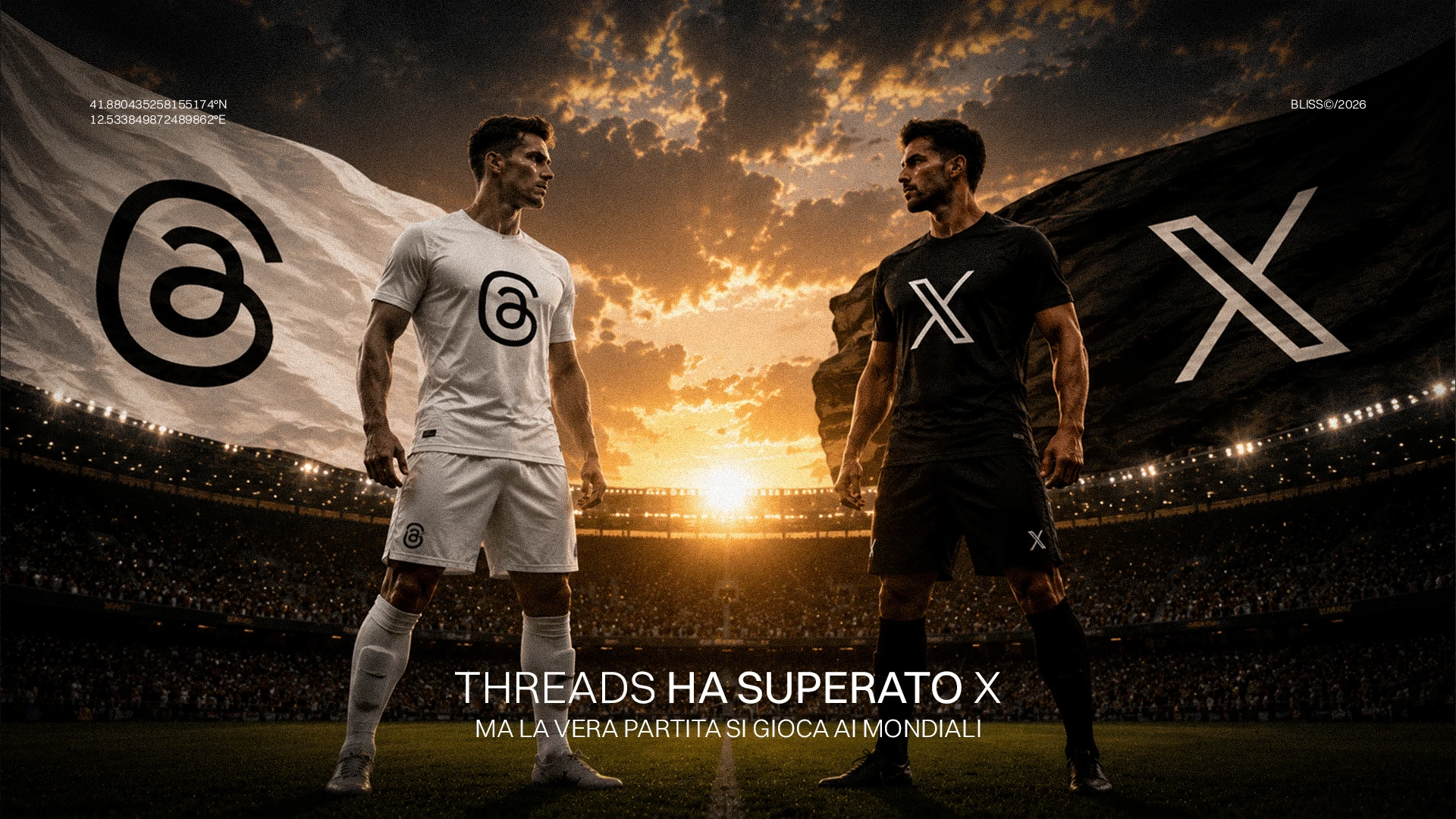
A gennaio 2026 la piattaforma di Meta ha superato X negli utenti attivi giornalieri su mobile.
On 3 January 2026 Mark Zuckerberg announced that Threads had reached 320 million active users, overtaking X.
According to Similarweb data, on mobile Threads reached 141.5 million daily active users against X’s 125 million. In December 2025 alone, more than 30 million new users had signed up to Meta’s platform.
Projections indicate that Threads will add around 50 million users every four months in 2026: a pace that, if sustained, would give it a decisive lead over X by the end of the year.
This is a significant figure, and more than just news: for brands, what matters is not so much who is winning today, but where it will be best to position themselves once the overtaking becomes irreversible.
And the time to do so, it seems, is not all that long.
The overtaking is real, but only halfway
To be honest, the numbers do not tell the whole story.
Or rather: Zuckerberg is not lying, but the victory is not yet complete.
On desktop, X remains dominant with around 145-150 million daily visits, against just 8-9 million for Threads. For a professional audience (journalists, analysts, institutional figures), X is still the place where breaking news erupts first.
The overtaking, then, is a mobile one. And this changes how brands should read the news: no, it is not yet time to abandon X. But it is time to work out which audience to address.
Why brands are migrating early
Before proceeding with our analysis, let us take a step back and ask why this shift is happening.
Looking not just at the numbers but at the words, the real reason for the flow from X to Threads lies in the deterioration of the environment on what was once Twitter.
Memes, controversies, increasingly polarised dialogue. Bots, above all. Companies are distancing themselves from Musk’s platform because of growing unease over poor content moderation and the controversies surrounding Grok.
It should go without saying, but let us remember that for an organisation that advertises, the environment around its message matters as much as the message itself. No brand wants its logo to appear next to content that triggers regulatory investigations in the United Kingdom and the European Union, however large the available audience may be.
X vs Threads is decided at the World Cup
Analysts agree on this point: the real test is now, during the World Cup. Live events have always been Twitter’s strong suit, and X is known for the wit with which it accompanies major events. If this World Cup sees Threads win, it could be game over. If instead, as has always been the case, people go to X to comment, the coexistence of the two platforms could last longer than January’s headlines suggested.
What brands should choose
A word of caution: the choice is not between abandoning one platform and adopting another. That is always a mistake, barring serious issues.
The point in this dispute is to choose between remaining passive on both platforms and understanding, methodically, where your audience really is today, and where it is likely to be over the next twelve months.
Being present on Threads before the advertising wave becomes massive means building a recognisable voice in a less saturated environment, with a real competitive advantage over those who arrive after the market has already set the price of attention. Waiting for absolute certainty about the overtaking will almost certainly mean moving when the first-mover advantage has already been taken by others. Perhaps for good.
New Connections (FAQ)
Should we move our advertising budget from X to Threads straight away?
Not clearly. The right choice depends on the specific audience you want to reach. If the target is professional, institutional or tied to real-time news, X still holds a structural advantage on desktop. If the target is broader and mobile-first, Threads currently offers a growing environment that is less saturated with advertisers. The most prudent approach is to test both platforms with modest budgets and observe where your specific audience responds best, before shifting significant resources.
If our brand has never been on X, does it make sense to open a Threads profile now rather than one on X?
For a brand starting from scratch, Threads offers a concrete advantage: a growing environment, less crowded with advertisers than X, with a user base that is still taking shape. Opening a profile on a saturated platform means competing for attention against thousands of established voices. Opening a profile on a growing platform means building a position before the market gets crowded. This does not rule out a presence on X as well, but for those starting from scratch, the investment priority today has a fairly clear answer.
How do you decide whether Threads’ overtaking is permanent or temporary?
By watching three concrete signals over the coming months: whether the general public moves to Threads for real-time news events too (not just for entertainment), whether advertising investment from major brands becomes structural rather than experimental, and whether X manages to stabilise its user base after the recent controversies. The current World Cup is the first of these concrete tests, and the results will be visible in the coming weeks, not the coming years.