


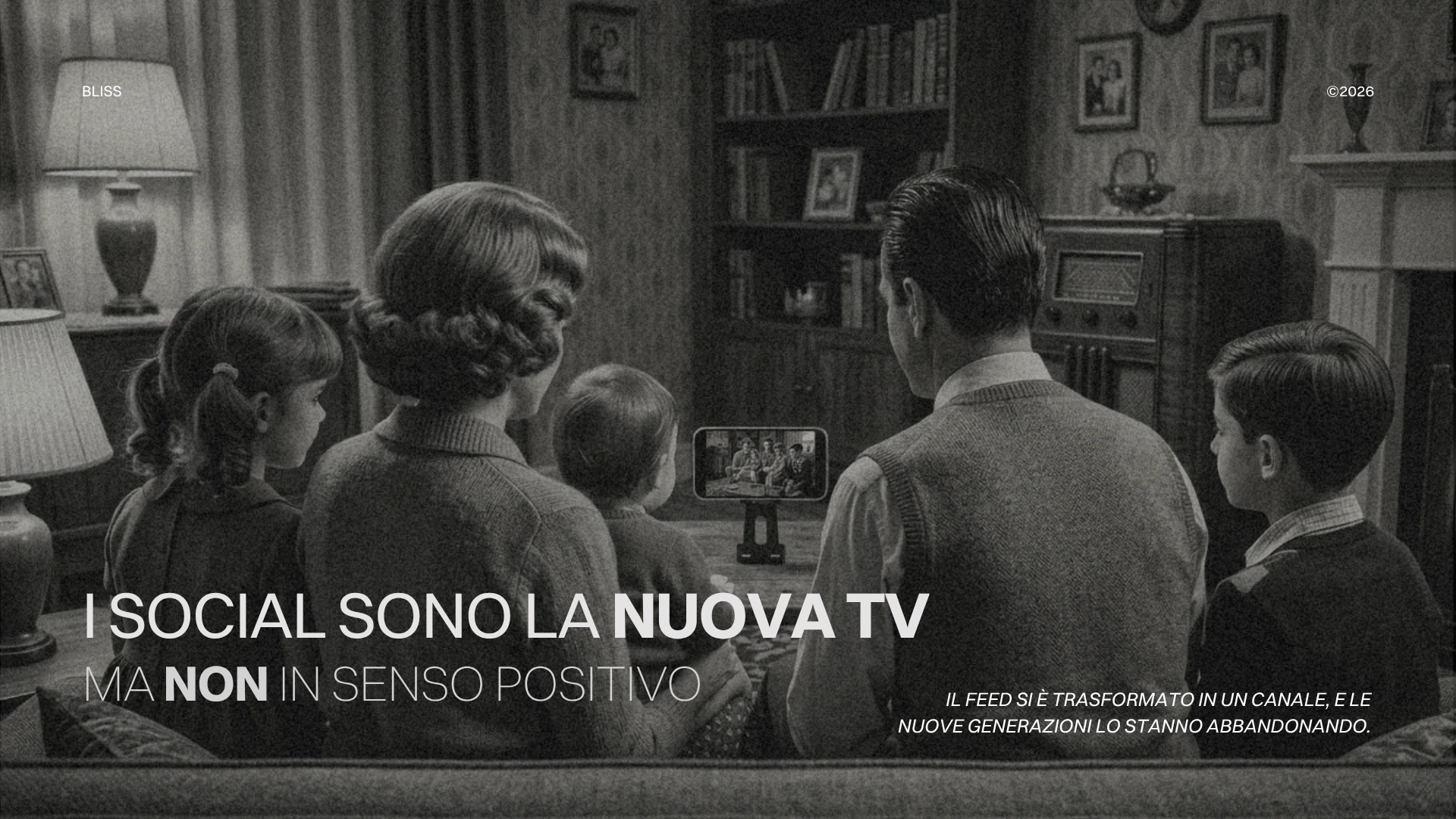
Il feed si è trasformato in un canale, che le nuove generazioni stanno spegnendo.In 2024, for the first time in the history of the internet, traffic generated by bots overtook traffic generated by humans. And by no small margin. Automated traffic now accounts for roughly half of everything that moves online. What does this mean? That every time you open a social platform, half of what you see, read or react to may have been produced by something that is not human. By an account that is not a person, but was built to look real. All this has consequences, clearly: disaffection, disorientation. Social media today is a more passive tool than ever, one that, despite its persuasive dynamics, creates detachment among the younger generations. Shares are falling, profiles are ever less human. Social media has become the new TV, to be endured passively. And this is why it happened. For a communications agency it means no longer measuring content like advertising spots and going back to asking what it leaves behind for the brand.
From feed to channel
Television has a precise structure. Someone produces. Someone schedules. You watch. Except for specific programmes designed for it, interaction is absent by definition. You can change the channel, you can switch off. But you cannot reply. Social media was born as the opposite. Its value lay in symmetry: I write, you reply, and we both change our minds, or at least our perspective. It was a promise of horizontal, distributed conversation, without precedent in the history of media. That promise wore away slowly, without anyone deciding to break it. Perhaps, yes: TikTok accelerated it. Its model, the For You Page, is designed exactly like television programming: a continuous stream worthy of the best American TV, with the algorithm serving content non-stop while you watch. You don’t need to follow anyone to see something. You don’t need to know anyone. The feed is a schedule built to keep you in place. Instagram copied this format with Reels. YouTube did the same with Shorts, followed by X and LinkedIn. The format that has won everywhere is short, passive video, optimised for scrolling. The format, in other words, that most resembles television. For anyone communicating, the consequence is that building a social media editorial plan around the format of the moment means redesigning everything each time the platform changes its mind. The data confirm the trajectory. The average comment rate per post fell by 24% on TikTok and 16% on Instagram in 2025. People watch more and write less. Passive behaviour has already overtaken participation, and this makes engagement an increasingly unreliable indicator: a piece of content can rack up views without anyone doing anything that resembles a response.
The cardboard audience
YouTube has given an internal name to the phenomenon its engineers fear most: “the Inversion”. That is, the moment when bot-detection systems begin treating fake views as the default and real views as the exception. The machine that studies the audience is so used to the fake audience that it no longer recognises the real one. On X, 64% of accounts may be automated, accounting for 76% of traffic at peak hours. On Instagram, 95 million out of a billion accounts may be fake or automated. On Reddit, between 15 and 40% of comments are generated by AI. What we call “conversation” on social media is in fact, to a growing degree, a monologue performed before an audience of cardboard cut-outs. The likes do not come from people who felt something as they read you. They come from systems designed to simulate approval. From this point of view, television was at least honest. Today, simulated response is part of the product.What happens to the brain
The mind’s default space, the default mode network, activates during reflection, autobiographical memory and social thinking. It activates, in other words, when we process our relationship with others and with ourselves. Passive consumption of short videos optimised for retention, however, activates different circuits: the response to novelty, the anticipation of reward, the release of dopamine. Mechanisms that traditional television already triggered. The difference is that scrolling is faster, more variable, more unpredictable, and therefore more effective at sustaining that activation. It is a more powerful television, one that has lost its original “social” function. The brain that comments, replies, argues and builds relationships is doing something qualitatively different from the brain that scrolls. It is building social memory, identity, belonging. These are precisely the things social media promised to amplify, and in their early years delivered. All things the algorithmic model has progressively eroded.
The generation to come
55% of Gen Z have done at least one “social media detox” in the past year. 91% of young women aged 16 to 24 say social media has a negative effect on their mental health. Hashtags related to digital wellbeing grew by 21% in 2025. This is the generation born inside these systems, and the first to learn to look at them from a certain distance. It is no coincidence that the fastest-growing platform among young people over the past five years is Reddit: a 101.2% increase between 2020 and 2025. Reddit is text-based, slow, built on threads, full of real conversations and genuine disputes. Despite its bots, it is the opposite of the algorithmic schedule. It is what social media was before it became television. Discord, BeReal, private groups on Instagram, Telegram channels. The movement is towards smaller, more verifiable, more human spaces. Nostalgia? How could it be, when this generation never knew what came before? No, it is the rational response of those who have understood that the big square has become a television set full of synthetic extras.The problem is not AI on social media
It would be convenient to conclude that the problem is bots, generative AI or algorithms. They are all symptoms of something simpler: social networks have optimised for the wrong metric. Viewing time instead of quality of interaction. Retention instead of connection. Scale instead of authenticity. Television dominated for decades on the same logic: maximise time in front of the screen. When the internet offered something different, something two-way, audiences poured in with unprecedented enthusiasm. Then that promise was slowly reabsorbed by the very logic it sought to replace. The social platforms that survive the next ten years will be those that manage to convince people there is still someone at the other end. A real person. Waiting for a human reply.New Connections (FAQ)
Has social media really become as passive as television?
The trend is documented. Comment rates are falling across all the major platforms. Passive video consumption is rising. The For You Page algorithmic model, born with TikTok and adopted by every competitor, is structurally closer to a television schedule than to a public square for exchange. It is not yet a complete transformation, but the direction is clear and the data confirm it.Will Gen Z really leave social media, or is this just another wave of moral panic?
Probably neither. Gen Z will not abandon social media, but it is already using it differently: less public broadcasting, more private and verifiable spaces. The growth of Reddit, Discord and closed groups is a structural signal, not a generational one. People move to where they perceive real interaction. When the large platforms stop offering it, the demand does not disappear: it moves.What changes for those communicating a brand in this scenario?
The relative value of authenticity is changing. In a feed increasingly saturated with synthetic, algorithmically optimised communication, what stands out as distinctive is what seems made by a real person with a real perspective. The paradox is that the most effective communication strategy in an AI-driven ecosystem is the simplest: have something to say. And say it in your own voice. The point is not to abandon the channels but to place them. Social media management remains a necessary function: what changes is the level it belongs to, and who decides what passes through it. When the feed stops being a square and becomes a schedule, the question of what to publish matters less than the question of what the brand has to say that is worth hearing.BLISS®© 2026. ALL RIGHTS RESERVED
Scritto il · Aggiornato il