


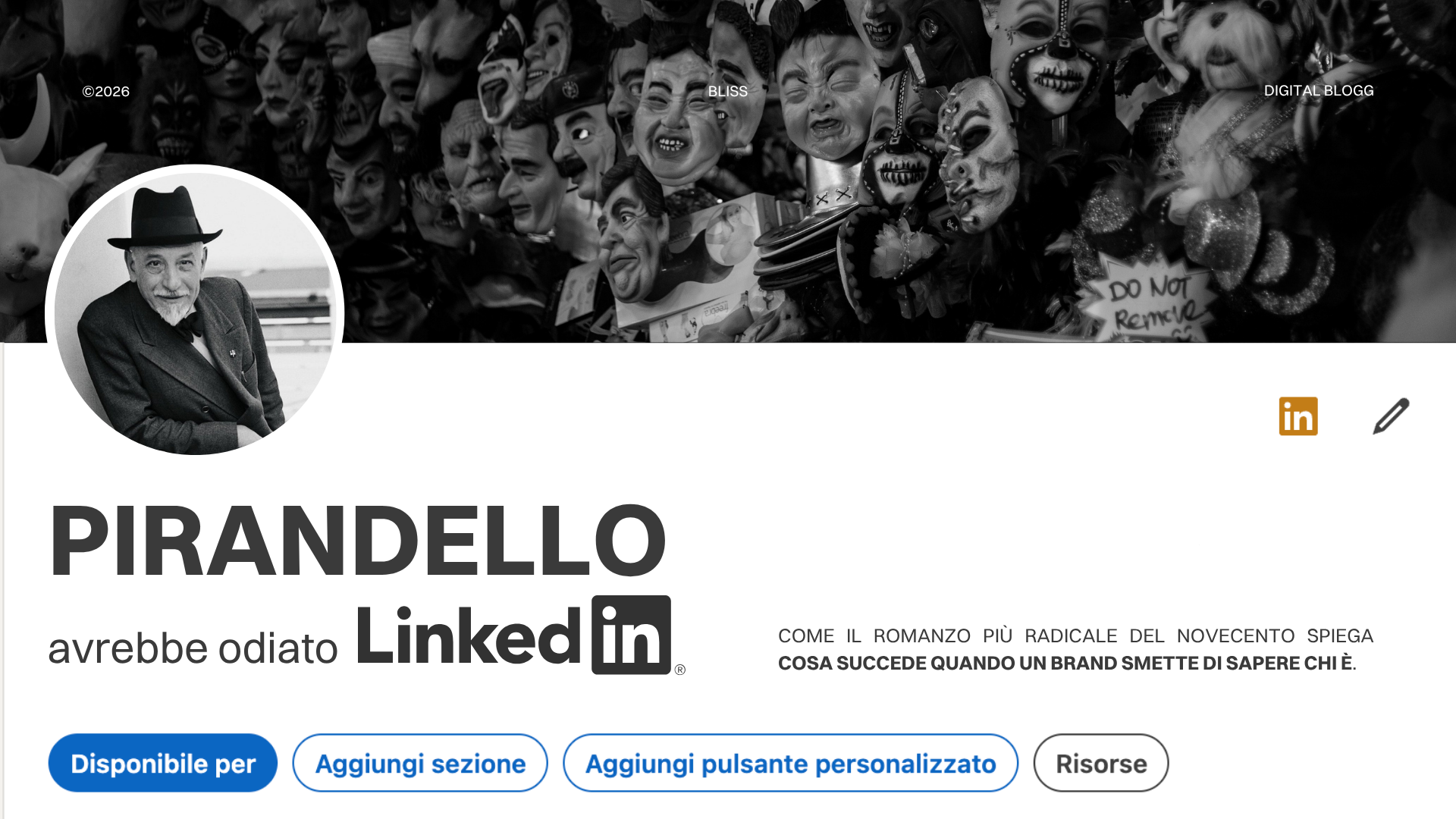
Come il romanzo più radicale del Novecento spiega cosa succede quando un brand smette di sapere chi è.
With Instagram filters, it is hard to imagine any of us still has a nose that tilts.
But let’s suppose that’s the case. Let’s imagine, one morning before leaving for work, looking at ourselves in the mirror and managing to truly see ourselves.
OK, perhaps we are not Vitangelo Moscarda, and what we see ourselves reflected in is not the bathroom mirror but our phone screen. The concept, however, is the same.
Understanding ourselves is difficult, because there are many versions of us: those we show others to please them; those we unconsciously adapt to, in order to survive; those through which others see us and, above all, those in which we recognise ourselves when alone.
You might think that a crowd so large could never fit into a mirror. Yet it fits into a smartphone, and quite comfortably too.
At the time of One, No One and One Hundred Thousand, the idea that identity was a fragmented entity shook the world. Years later (partly for this, partly for his plays) Pirandello even won the Nobel Prize in Literature, crowned as one of the greats of the Italian language.
His most famous work opens with a scene much like the one we have described: an ordinary man’s wife points out to her husband that his nose is crooked – something he had never noticed before. But if in that moment something breaks in his psyche, for us inhabitants of the web today the idea that we can be several people at once, depending on the context, is hardly a great discovery.
Between social media, websites and chats of every kind, we have grown used to the idea that we can be one, no one and one hundred thousand at the click of a button.
And yet this habit has consequences. They are so deeply ingrained in us that they radiate in every direction: brands included.
And so, in this column devoted to art and literature, today Bliss brings Pirandello to Linkedin, to see what he would make of it and how alienating he would find the way we communicate.
The problem is not the mask
A clarification is in order.
Contrary to what many believe, Pirandello did not condemn masks. Rightly, he considered them inevitable. If every relationship produces a version of ourselves and every context demands a different register, it is inevitable that who we are branches out. It is how human beings exist in social life.
Moscarda’s problem in the novel was never that others saw him differently. The problem is that, as soon as he found out, the protagonist immediately stopped knowing who he was.
In a desperate attempt to destroy every image others had of him, he ends up committing incomprehensible acts, giving away his possessions, behaving in ways no one could read. And all of this, until he became unrecognisable to everyone.
Even to itself.
Platforms as multiple mirrors
And so, we cannot condemn the multiplicity of online communication in itself either.
Every platform, after all, has its own logic, a different algorithm and native content. It follows, then, that on LinkedIn we come across as authoritative, measured, reflective; on Instagram as human, present; on TikTok as energetic, creative. Every social network is a container and we are the water that fills it.
All of this, then, makes sense. Adapting register is communicative intelligence, not hypocrisy. A managing director speaks differently in the boardroom and at dinner with the partners.
This, too, is a skill.
The problem arises when the versions being shared share nothing. When the LinkedIn professional, the Instagram human being and the TikTok explainer look like people who have never met, that is when identity fragments to please each channel’s algorithm, instead of adapting while remaining recognisable.
What happens to brands
The same mechanism operates within organisations. With more measurable consequences.
A brand that builds a different voice on every platform, without an identity operating system to provide its structure, ends up ceding control of its own narrative to each context separately.
Adapting register is an act of governance. Fragmenting identity is a lack of governance.
The distinction is not as trivial as it seems.
WeWork embodies this precisely. In pitches to venture capitalists it was a tech company reinventing the future of work. On Instagram it was a community lifestyle brand, defined by bright spaces and people smiling in front of a MacBook. In sales materials for businesses it was a flexible workspace solution. Three identities, three audiences, no common structure holding them together.
In 2019 WeWork was valued at 47 billion dollars. When the IPO documents put the three versions on the same page for the first time, that valuation collapsed to less than 8 billion within a few weeks. The IPO was withdrawn. The founder removed.
The market did not punish a financial result: it punished the discovery that beneath the masks there was no face.
Moscarda, IPO edition.
Learning from Pirandello
Every brand today competes on the market’s perception of its product, its company, its values. And since perception lives across different channels, with different audiences and different metrics, the temptation is to chase it everywhere. An authoritative tone for senior decision-makers. An empathetic register for millennials. Irony to reach Gen Z. Institutional restraint for industry portals.
The result is a brand with an answer for every audience and an identity for none.
One. No One. One Hundred Thousand followers.
Moscarda at least had a philosophical reason for doing so. Brands today do it for fear of losing market share. The outcome is identical. The more you chase every version of yourself the audience demands, the more you lose the thread connecting all those versions to something real. And when that thread snaps, what remains is not a brand that is everything to everyone.
What remains is a brand that is nothing to anyone.
So what?
So, nothing: this.
Forgive me, I couldn’t resist.
Book One of the novel ends with this sentence, and with a section I love because it summarises the protagonist’s reflections in schematic form. Just this once, let us allow ourselves to do the same.
1st – that every profile is a mask built for a specific audience.
2nd – that this is true and it is not a problem.
3rd – that without an identity operating system the masks multiply until not a single face remains. 4th – that every algorithm builds a version of you for every audience, without you having decided it. 5th – that the difference between adapting your register and losing your identity is not visible straight away, but is measured when the market, or those who know you, stop knowing for certain who you are.
6th – that the right question a brand should ask itself is: looking at my content from the past year, would a potential client understand who I am?
7th – and finally, that Pirandello would have hated LinkedIn, because it made the mask compulsory and called it a personal brand.
New Connections (FAQ)
Why do brands communicate poorly online?
Because when they post, they consider every single decision reasonable. A more accessible tone here. A shorter format there. A collaboration to reach a new audience. The problem is none of these choices. It is the absence of a system that assesses them against a stable reference identity. Without that system, every reasonable adaptation contributes to fragmentation.
How can I tell whether I am communicating well on social media?
When those who see your posts can tell unambiguously who you are and what you do. If the answer changes depending on who answers internally, the market has already received different versions. Moscarda is already on stage.
What is the difference between adapting register and fragmenting identity?
Direction. Those who adapt their register start from a defined identity and translate it into different languages. Those who fragment start from the channel and build the identity around it. In the first case the brand leads. In the second, the context decides.