

Every era has had its dominant language. And each time that language emerged, it carried with it a multitude of people convinced that speaking it was enough to call themselves artists.
In the Renaissance, a brush was enough. All of Europe filled with workshops, apprentices, copyists and enlightened amateurs touched by the same light that fell on Caravaggio’s canvases. Not everyone was Caravaggio, of course, but the age granted anyone who held a brush the right to call themselves a painter. The primary art was painting, and the world organised itself around that gravitational pull. Then came photography, and with it the first great crisis of the handmade image. Then digital, and the media of that era were flooded: anyone with a computer and a pirated copy of Photoshop could call themselves a designer. Today we are here, with generative artificial intelligence. History repeats itself; only the tool changes. But this time there is something different. Something worth stopping to look at.
The method, not the role
AI has not replaced designers. It has not replaced photographers, creative directors or copywriters. It has replaced their way of working. And that is a distinction almost nobody makes, because it is easier to tell the story of the machine stealing the human’s job.
The reality is less cinematic and more interesting. People who were never especially gifted can now express themselves at a level that used to be out of their reach. AI has become a translator between intention and execution, a bridge that shortens the distance between what you have in your head and what you are able to produce. And that is objectively a good thing. On the other side, those who have always had the hand (that talent built through years of practice, of mistakes, of nights in front of a blank page) have increased their output. They produce more, faster, with less friction.
But this is where it is worth pausing.
The question we don’t ask
Why do we need to produce more?
We rarely ask ourselves, because the answer seems obvious: the world demands it. Communication channels are multiplying, social media has become an unbroken stream of visual stimuli, every brand needs daily content, every platform has its format, every format has its frequency. The human brain is flooded with inputs that it receives as stimuli and processes as noise. And within this noise, art (the real kind, the kind that asks you to stop) loses its voice.
It is not the fault of artificial intelligence. It is the knock-on effect that follows from it. When everything can be generated in a few seconds, everything is consumed in a few seconds. We appreciate less. We stop less. The details, the ones through which you glimpse the innermost soul of whoever created the work, become invisible.
John Berger wrote:
“Seeing comes before words. The child looks and recognises before it can speak.”
And yet we are building a world in which we are always looking, but seeing less and less.
Judgement and the threshold
I often find myself receiving opinions on my work. It happens to anyone who does design, to anyone who makes art in any of its forms. Design polarises: it creates factions, it divides those who say it’s beautiful from those who say it’s ugly. But on what basis?
Let us define beautiful and ugly. What is beautiful to you? The style? The image? The font? The colour palette? The message behind every choice? The coherence between intention and result? Those who pass judgement rarely ask themselves these questions. Judgement comes before analysis, before understanding and respect.
Entering a world we do not know should always be done on tiptoe.
It is a thought I have always had. Perhaps it stems from a protectiveness towards what I do, but it grew stronger the day I saw – and I mean truly saw – the work behind a photograph. People carrying equipment, getting up at five in the morning to capture a sunrise that will never return, cutting the light with a reflector panel to immortalise a moment that can never be replicated. Hours of physical and mental work for a single frame.
Then the verdict will be: I don’t think it’s beautiful.
Five words. Not one of them contains a question.
The invisible journey
There is a clear difference between those who work with AI and those who create entirely with their own hands, and it does not lie in the result. It lies in the journey.
Because when you create a work, what nobody sees, what perhaps only the most perceptive can sense between the lines, is how you felt while making it. How many times you started again from scratch. How many dead ends you went down before finding the right direction. How much frustration you went through and turned into choices. And then that precise moment when you hand over the finished work and feel something that has no exact name. It is not pride, it is not relief; it is a kind of fulfilment that comes from having gone through something, not around it.
That journey leaves traces inside the work. Perhaps precisely because it leaves traces inside the soul. A careful eye recognises these traces: a tension in the composition, a harmony that is felt, a balance that exists because someone fought against it. They are the invisible scars of the process, and they are exactly what makes human work distinguishable from generated work. Not because AI produces ugly results (on the contrary, they are often flawless), but because flawlessness without a journey is a surface without depth.
The real problem: regeneration
Perhaps the most dangerous lesson we are instilling in our brains with the advent of generative AI is this: when we don’t like something, we don’t stop to look at it. We regenerate it.
With the same €24.99-a-month paid plan, the same slightly tweaked prompt, the same expectation that the next result will be the right one. We don’t confront imperfection, we don’t try to understand what isn’t working and why. We delete and start again, endlessly, until we get something that seems acceptable. But acceptable is never memorable. And memorable is what art, at any level, should aspire to be.
Susan Sontag observed that:
“To have an experience becomes identical with taking a photograph of it.”
Were she alive today, she would probably add that having an idea has become identical with generating it.
A letter to those just starting out
I am constantly in conversation with young people. Those who were born with AI and do not know the alternative – or rather: some lecturer may well have explained the alternative at university, but they have never practised it. And I do not blame them. It would be like blaming someone born in the digital age for never having developed a roll of film in a darkroom. Evolution is the context you grow up in, and context shapes habits.
But technological evolution is a weapon, and like any weapon it can be used actively or passively.
Active means using the tool to amplify who you are, what you know and what you have struggled to learn. It means AI accelerates a process you already understand in its entirety, and that you could, given more time, complete with your own hands.
Passive means delegating not only the execution, but the thinking too. It means the tool amplifies nothing, because there is nothing to amplify. And there is nothing to amplify because there were none of those nights in front of the blank page, that stroke repeated a hundred times until it became instinct, that sacred frustration which is the price of the craft.
If you are born into a context that never shakes you, that never pushes you to the limit, you will never know the importance of sacrifice. And those who do not know sacrifice will never appreciate the smallest details. And it is the details that separate those who use a tool from those who are the tool.
The eye before the prompt
This article is not meant to be a manifesto against artificial intelligence.
I have no interest in the rhetoric of the good old days that were never that good. AI is here, it is powerful, it is useful, and in many ways it is extraordinary.
But every powerful tool deserves an equally powerful question: what am I losing while I gain speed?
The answer is the eye. The eye that rests on a detail and recognises it as intentional.
The one that enters an unknown world on tiptoe, before judging.
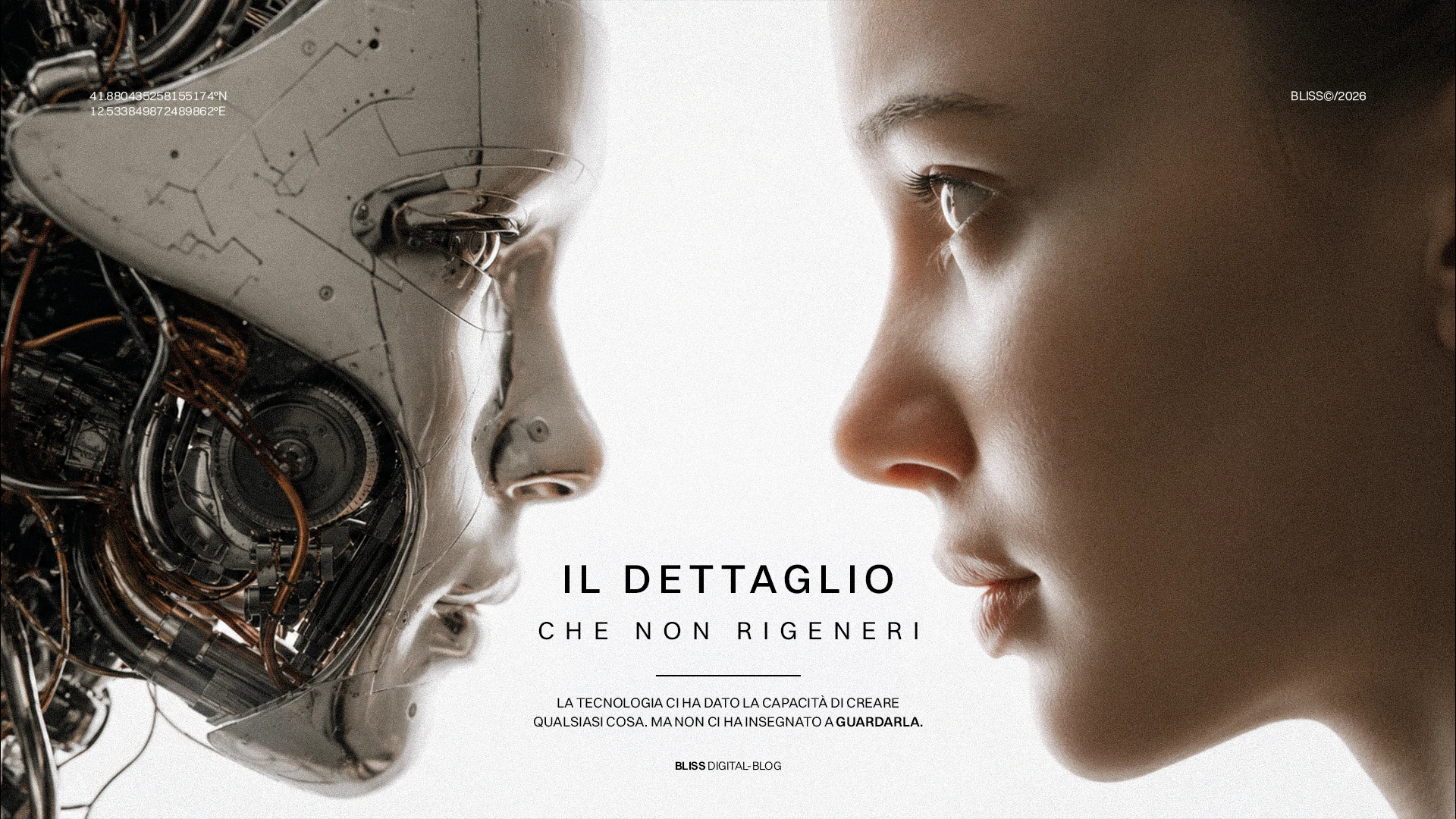
Technology has given us the ability to create anything. But it has not taught us how to look at it. And perhaps that is where we should start again: not from the next prompt, but from the next gaze.
New Connections (FAQ)
Is AI really taking work away from designers and creatives?
AI has replaced the working method, not the role. Those who had never developed a hand of their own now produce at a level that was previously out of reach. Those who had built that hand through years of practice produce more, faster, with less friction. The structure of the creative market has reorganised itself around this distinction. The problem is not the loss of work. It is the loss of process, and with it the loss of everything the process leaves in the work.
Is it still worth learning the basics of design if AI does everything?
AI amplifies what already exists. When there is nothing to amplify, the tool adds nothing. The nights in front of the blank page, the frustration gone through and turned into choices, the stroke repeated until it becomes instinct. They are the price of the craft. Those who do not pay it do not recognise the details. And it is the details that separate those who use a tool from those who are the tool.
What do we really lose when we always use AI to create?
When something does not work, the tendency is to regenerate. Tweak the prompt, start again, until you get something acceptable. Acceptable is not memorable. And memorable is what every act of communication, at any scale, should build. It is a distinction that governs every project at Bliss. Technology gives the capacity to produce anything. The eye, the one that rests on a detail and recognises it as intentional, cannot be delegated.
BLISS®
© 2026. ALL RIGHTS RESERVED