


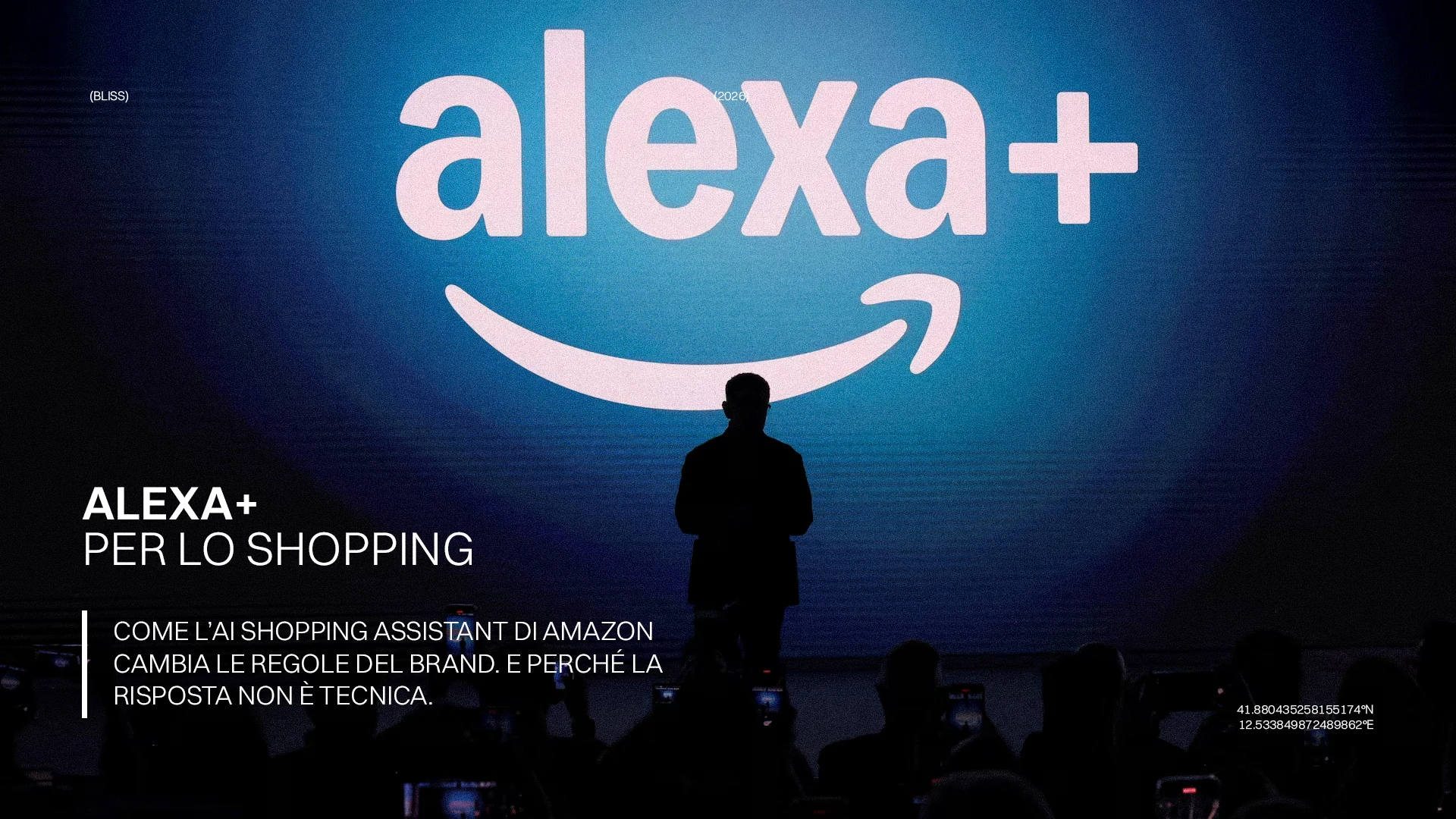
Come l’AI shopping assistant di Amazon cambia le regole del brand. E perché la risposta non è tecnica.
A child has to prepare a science experiment for school. Say, a home-made volcano. The night before, the mother talks about it with Alexa on the kitchen device. The next day, she opens the Amazon app on her phone and asks for the materials for the volcano. Alexa remembers them. Suggests them. Adds them to the basket.
The mother searched for nothing. She did not compare brands. She did not read descriptions.
Alexa did everything for her.
On 13 May 2026 Amazon launched Alexa for Shopping, the new AI assistant that replaces Rufus in the app’s search bar. And this is the most direct statement yet of where Amazon intends to go.
To become the intermediary in every purchasing decision.

From Rufus to Alexa for Shopping: a story in data
Rufus, the predecessor of this innovation, had already reached 300 million users in 2025 and helped generate around 12 billion dollars in annualised incremental sales. Rufus users were 60% more likely to complete a purchase. Alexa+ users bought three times as much as users of the previous version.
The most interesting figure, however, is this: in 2025, for the first time, more than half of American consumers used Amazon to research products, overtaking searches on Google.
Figures that show how Amazon has evolved in recent years, transforming from a place where people buy into a place where people decide.
Alexa for Shopping accelerates this process.
Its arrival is set to move the conversation directly into the search bar, connecting it to purchase history and extending it to Echo devices. Adding the ability to buy automatically when a price drops or a product sells out, or when a user expresses a concrete need (as in our volcano experiment), without having to open a product page, changes everything.
A new kind of purchasing decision
To understand why this truly is a revolution, however, let us take a step back and look at what happens in the human mind at the moment of purchase.
The traditional model of physical retail exploits the limbic system: emotion, the visual response to packaging, the association of colours and shapes with sensations already experienced. The promotions stand, the supermarket music, the product placed at eye level. All of this is designed to trigger automatic responses that precede rational thought.
Yet an AI assistant has no limbic system.
It assesses against structured criteria: review scores, volume of feedback, completeness of product information, price history, consistency of descriptions across channels. The decision it produces is pure statistics.
The brand that built its strength on emotion will, in the near future, have to learn to build it on data as well. Because even though humans will keep buying, a good share of tomorrow’s purchases will be made by those who never even see the packaging.

Invisible to machines
For all these reasons, there is one question every brand should be asking itself right now, and it marks a fundamental shift in how we think about the logic of sales, marketing and positioning. The question is:
If a user asked Alexa for Shopping for the best product in your category, would you appear in the answer?
The answer depends on things many brands have never considered competitive levers. The structure of product data (how complete, consistent and up to date it is on every platform where the brand is present); the volume and recency of reviews; the consistency of the brand name across Amazon, Google Shopping, price comparison sites and the owned website; the algorithm’s ability to recognise the brand as a reliable and authoritative entity in its category.
None of this is SEO, nor is it advertising. It is pure brand governance applied to the new world: the algorithmic one.
Make no mistake: Amazon is not alone in this.
ChatGPT, Google and Perplexity have all launched shopping features in recent months. Google has already enabled direct checkout from Gemini for retailers such as Walmart and Wayfair. The territory in which AI mediates the purchase decision is expanding at a speed that five years ago would have seemed pure science fiction.
Alexa speaks to brands
The launch of Alexa for Shopping goes beyond technology, reaching all the way to brand governance.
In all likelihood, brands that have spent years investing in digital consistency, structured product data and genuine feedback will find themselves at an advantage that budget cannot buy. Conversely, brands that have treated their digital presence as a communications problem, without ever governing it as a system, will soon face a barrier that the next media investment will not remove.
The AI assistant cannot be swayed by an advert. It does not respond to a creative brief. It responds to the quality of the data ecosystem the brand has built over time. And Alexa for Shopping is already showing us this.
The better a brand is able to govern its digital presence over the next two years, the more recognisable it will be to the algorithms set to mediate purchasing decisions.
And this visibility cannot be bought. It will have to be built, at any cost.
New Connections (FAQ)
Does Alexa for Shopping only concern brands that sell on Amazon?
The system already buys from other online stores through its “Buy for Me” feature. In the medium term, any brand with a digital presence will potentially be assessed by AI assistants in the recommendation process. The perimeter is expanding. Governing digital presence becomes relevant for any brand that sees distribution as part of its positioning.
Does product quality stop mattering if the AI doesn’t recommend it?
Product quality matters, but it matters through the signals it generates: reviews, ratings, return rates, engagement. An excellent product with an incomplete product page, or with reviews that are outdated or inconsistent across channels, is systematically undervalued by the algorithm compared with a competitor that has better-structured data. Quality has to be documented in the right way to be recognised.
What should a brand do now, in practical terms?
Three priorities. Audit the consistency of product data across every channel where the brand is present: name, descriptions, attributes, images. Build a review-collection system that generates recent and plentiful feedback. Govern the brand’s presence as a recognisable entity across all digital touchpoints, from the owned website to marketplaces. The work required is not a marketing project. It is a governance intervention.