


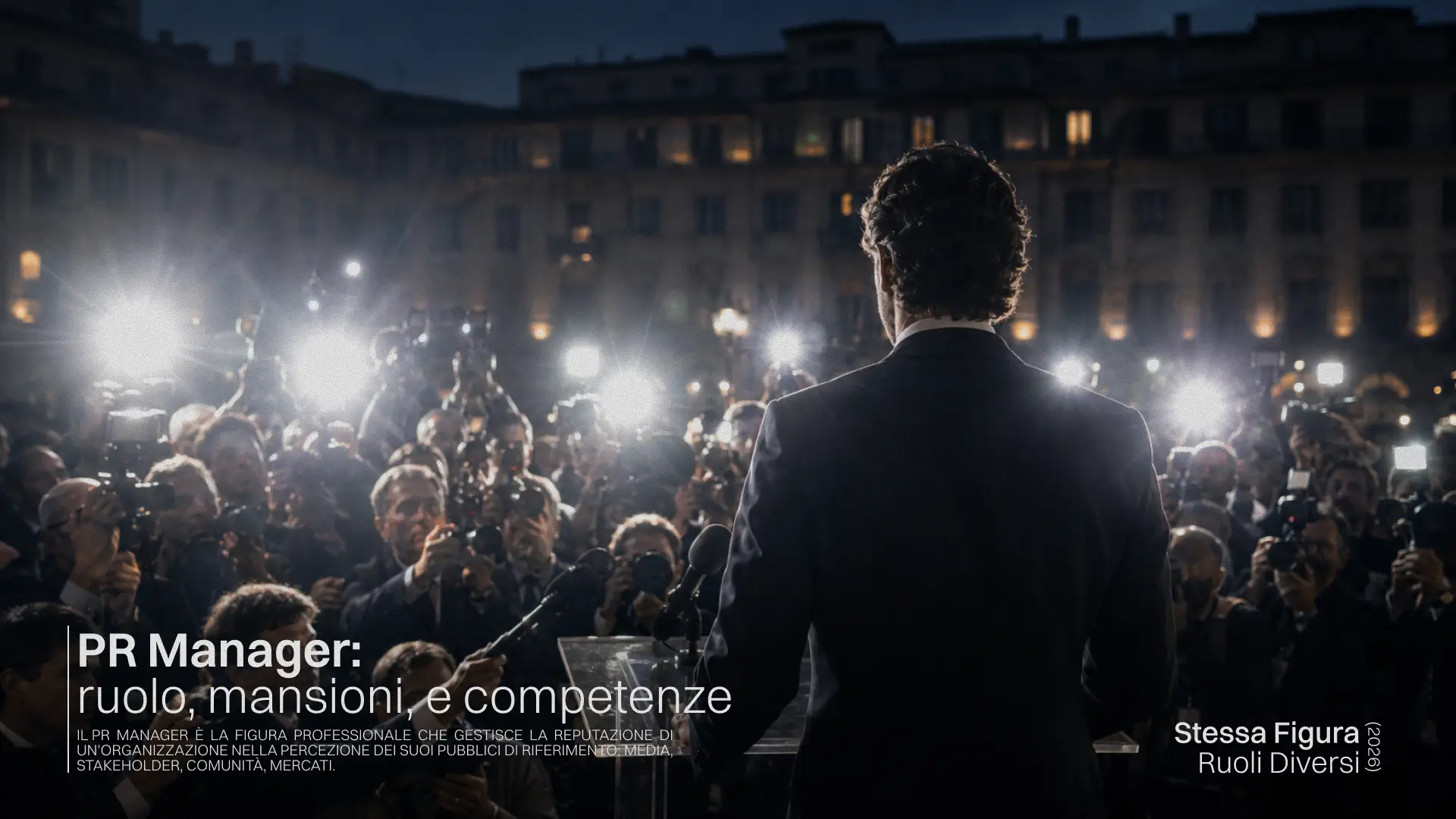
The PR Manager, or Head of Communications, is the professional who manages an organisation’s reputation as perceived by its key audiences: media, stakeholders, communities and markets. This is not simply the person who talks to journalists, but the one who strategically defines what is said, to whom, when, through which channels and with what narrative, coordinating the flow of communication between the organisation and the outside world. The distinction between a PR Manager and a traditional Press Office runs deep: the latter manages media relations; the former manages reputation as a strategic asset. In 2026, the PR Manager’s remit has expanded further. It now includes managing reputation in AI Search (the answers from ChatGPT, Perplexity and Google AI Overview that describe the company), crisis communications accelerated by social media, and building authority in a fragmented information landscape where traditional media are no longer the only gatekeepers.
PR Manager vs Head of Communications: the same professional, different roles
The market uses the two terms interchangeably, but there are nuances that affect the operational scope. The PR Manager (Public Relations Manager) has a predominantly external responsibility: they manage relations with the media, influencers, institutions and stakeholders, and build and safeguard the brand’s reputation in the outside world. The Communications Manager often has a broader remit that also includes internal communication, employees, management, shareholders, and the institutional communication of the organisation as a whole.
In larger, structured companies, the two roles coexist with distinct remits. In SMEs and mid-sized organisations, the vast majority of Italian companies, the same person covers both roles, often adding responsibility for marketing, branded content and social media management as well. This article treats the role in its broadest sense, which is also the most common in the Italian market.
What a PR Manager does: the 7 core responsibilities
1. Communication strategy and reputation management
The PR Manager defines the organisation’s communications plan: which messages to convey, to which audiences, through which channels, how often and in what order. A communications strategy is not a list of activities: it is a map linking the organisation’s identity (who we are, what we do, why we are credible) with the expectations of its different audiences. Coherence between communications strategy and brand identity is the PR Manager’s highest responsibility, and the one that demands the closest alignment with senior management.
2. Media relations and press office
The PR Manager builds and maintains ongoing relationships with journalists, editors, bloggers and sector content creators. It is not about sending out press releases: it is about understanding what is newsworthy for each publication, how to position the company’s information so that it has editorial value for the journalist, and how to build, over time, a credibility that means the media call the company, not the other way round. The quality of a PR Manager’s journalist network is one of the hardest professional assets to build and the most valuable of all.
3. Communications crisis management
Crisis management is the toughest test for any PR Manager. A communications crisis, whether a defective product, a corporate scandal, a statement taken out of context or an online reputational attack, can destroy in hours what a brand has built over years. A PR Manager who has built a preventive Crisis Communication Framework, with pre-approved key messages, response procedures by type of crisis and a decision-making chain of command, structurally reduces the damage compared with one who improvises. According to Forbes (2024), brand reputation takes an average of 3.7 years to rebuild after a major reputational crisis, with an average loss of brand value of 22%.
4. Corporate communications and stakeholder management
The PR Manager handles communication with stakeholders who are neither media nor end consumers: public institutions, trade associations, investors, business partners and local communities. This communication, often referred to as institutional affairs or public affairs, calls for an entirely different register from consumer communication: more formal, more focused on building long-term trust and less focused on immediate media impact.
5. Internal communication
In more structured organisations, the Head of Communications also manages internal communications: newsletters, intranet, organisation-wide announcements, internal events, and management communication to employees. Internal communications are the least visible but often the most critical for brand coherence: employees who do not understand the organisation’s values and messages are the first to create inconsistencies externally.
6. Corporate events and PR management
The PR Manager organises or oversees events that build reputation: press conferences, product launches, round tables, industry conferences, corporate dinners. Events are not merely moments of visibility: they are opportunities to build relationships with the media, stakeholders and the market in a physical, memorable way. In 2026, the digital component of events, streaming, content produced during the event, social media amplification, has become an integral part of planning.
7. Reputation monitoring and media analysis
The PR Manager continuously monitors the organisation’s reputation: press cuttings, social listening, sentiment analysis, tracking of mentions in traditional and digital media. In 2026, this includes monitoring the brand’s presence in AI Search answers, a new territory that no traditional media monitoring tool yet fully covers. The reputation that AI systems build around the organisation is increasingly relevant for audiences who use ChatGPT, Perplexity or Google AI Overview as their primary source of information.
PR Manager skills in 2026
| Family | Specific skills | Relevance in 2026 |
|---|---|---|
| Strategic and relational | Communication strategy, stakeholder mapping, media relations, crisis communication, institutional affairs, corporate storytelling | High — essential core |
| Writing and editorial | Press releases, corporate copywriting, speechwriting, institutional white papers, tone of voice management, editorial content strategy | High — differentiating |
| Digital and social | Social media management, community management, influencer relations, digital PR, basic SEO, corporate LinkedIn | High — prerequisite |
| Analytics and monitoring | Media monitoring, social listening, sentiment analysis, brand tracking, share of voice, media value measurement | Medium-high — growing |
| AI and new skills for 2026 | GEO/AEO Strategy (reputation management in AI Search), AI for real-time crisis monitoring, prompt engineering for press release drafts, AI for media research | Emerging — strategic |
| Crisis management | Crisis Communication Framework, dark site management, media training, multichannel crisis communications, issue management | High — essential at senior level |
The critical skill that separates an excellent PR Manager from an average one in 2026 is the ability to manage reputation in fast-changing information environments — where a crisis can erupt on Twitter at 3 a.m., spread across TikTok within hours and reach traditional media before the office opens. The PR Manager with a real-time monitoring system and a pre-built response Framework has a structural advantage over one who improvises.
PR Manager and Communications Manager salaries in Italy: 2026 data
| Profile | Average gross salary, Italy | Upper range / premium sectors | Source |
|---|---|---|---|
| Marketing and Communications Manager (average) | €47,500/year | Up to €71,600 (90th percentile) | Glassdoor, 110 salaries, March 2026 |
| Junior PR Manager (0–3 years) | €25.000–35.000 | — | Jobiri, 2026 |
| Mid-level PR Manager (4–7 years) | €36.000–50.000 | €45,000–55,000 (tech, fashion, finance) | Jobiri, 2026 |
| Senior PR Manager (8+ years) | €55.000–75.000 | €70,000–90,000 (multinationals) | Jobiri, 2026 |
| Communications Director / Head of Comms | €75.000–100.000 | €100,000–140,000 (large companies) | JobPricing Observatory / Michael Page, 2025 |
| Communications functions — mid-level manager | Mid range (between operational and executive) | Varies by sector | JobPricing Observatory, 2025 |
The sectors offering the highest salaries for PR Managers and Heads of Communications in 2026 are technology, fashion, finance and tourism, fields in which investment in communications to maintain a strong, competitive image is structurally higher (Il Tabloid, November 2025). Foreign language skills and experience in international markets are decisive factors for higher pay and roles with greater responsibility. Salaries in communications functions generally sit in the middle band of the management landscape (JobPricing Observatory, 2025): below revenue-generating roles (sales, digital marketing), above purely support functions.
Crisis management: the ultimate test for a PR Manager
Crisis communication management is the moment when the value of an experienced PR Manager becomes immediately quantifiable. A poorly managed crisis causes reputational damage that takes years and significant resources to repair, when it can be repaired at all. A PR Manager who has built a preventive crisis communication system operates with a structural advantage over those who improvise.
The 5 phases of a professionally managed communications crisis
- Immediate acknowledgement: the first public response must come within 1–2 hours of the crisis breaking, not to say everything, but to signal that the organisation is present, aware and managing the situation. Silence in the first hours is the worst signal a PR Manager can send to the market.
- Activating the Crisis Team: who decides what, with what authority, in what sequence. Without a predefined chain of command, in a crisis people argue over approving the statement instead of communicating.
- Consistent communication across all channels: the same core message, adapted to the register of each platform (formal tone for a press release, human tone for social media). Inconsistencies between channels amplify the crisis.
- Continuous updates: the market tolerates a crisis; it does not tolerate silence. Regular updates, even brief ones, demonstrate control of the situation and respect for the audiences involved.
- Post-crisis learning: a documented analysis of what worked and what did not, and an update of the Framework for the next crisis. A crisis that produces no learning is a wasted resource.
The 5Ws of the PR Manager and Head of Communications
- Who: A professional with a background in communications, journalism, humanities, political science or international relations, and with the ability to build credible relationships with media and stakeholders over time. It is not a role for those seeking visibility: it is a role for those who know how to build credibility for others.
- What: Strategically manages the organisation’s reputation, media relations, institutional communication, crisis management, stakeholder management, internal communication, events, reputation monitoring. It is the connecting point between what the organisation is and what its audiences perceive.
- When: At every stage of a company’s life, but with particularly high value at moments of discontinuity: a new product launch, a reputational crisis, generational succession, M&A transactions, entry into new markets. In normal times, the PR Manager builds the reputational capital that allows the company to weather crises without capitulating.
- Where: In any organisation with a reputation to build and protect. The role exists in private companies, public institutions, trade associations, NGOs and professional firms. Companies operating in sectors with high public visibility (food, pharma, finance, energy) have a structurally more urgent need for a dedicated PR Manager.
- Why: Because reputation is the most valuable asset of any organisation, and the most fragile. It can be built over decades and destroyed in hours. A PR Manager with a preventive crisis communication system and an established network of media relationships is the difference between a crisis that is managed and a crisis that becomes a reputational disaster.
The PR Manager in Italian SMEs: specific challenges and operating model
In Italian SMEs, which account for 67.2% of companies with a turnover above 20 million euros (AUB Observatory, 2025), the PR and communications function has its own characteristics. A dedicated PR Manager is often absent or folded into a hybrid role that also handles marketing, social media and sometimes sales. The main risk is a reactive approach: the company communicates when there is news to share, rather than building a continuous narrative that establishes authority over time.
Italian SMEs do, however, have a structural advantage in communication that they often fail to exploit: family history, deep local roots, the authenticity of the artisanal product, generational continuity. These are all narrative elements of great value to the media and to the market, but they require a PR Manager (in-house or external) capable of turning them into a story, not merely listing them in a press release.
At Bliss, our corporate communications and brand advisory work for Italian SMEs starts from exactly this premise. The Consorzio Parmigiano Reggiano case, one of the most recognisable collective brands in the world among Italian PDOs, shows how communication centred on authenticity and the value of the territory turns a traditional product into an international communication asset. The La Rustichella Truffles case, a business with 11 million in turnover in premium truffles, shows how the story of Italian artisanal excellence reaches international markets through an integrated communication system. For details: Bliss case studies.
2026 trends: how the PR Manager role is evolving
Managing reputation in AI Search: the new frontier
In 2026, an organisation’s reputation is no longer built solely in traditional media and on social media. It is also built, and increasingly so, in the answers that AI Search systems (ChatGPT, Perplexity, Google AI Overview) give to users seeking information about the company. ChatGPT accounts for 84% of web traffic generated by AI platforms (TEAM LEWIS, Digital 2026): a growing audience that forms its perception of the company through AI answers, not by reading the website or press articles directly.
For the PR Manager, this introduces a new scope of responsibility: GEO Strategy applied to reputation. Ensuring that the information about the company held in the datasets used by AI models is accurate, up to date and consistent with the desired positioning. Producing structured content (press releases, articles, white papers, a presence on Wikipedia and authoritative sources) that AI systems select as reliable sources. Monitoring how AI describes the company in its answers to users, and stepping in when the description is inaccurate or damaging to its reputation.
The speed of crises in the social media era
The life cycle of a reputational crisis has shrunk dramatically. A crisis that took days to go mainstream in 2010 now takes hours, often minutes. The 2026 PR Manager must be operational around the clock during a crisis: not necessarily in person, but through alert systems, clear escalation processes and pre-built response Frameworks that enable a rapid response without endless approval meetings before a statement goes out.
The PR Manager as strategic storyteller
In the most competitive sectors of 2026, tech, fashion, luxury, food, the line between editorial communication and PR has grown progressively thinner. The PR Manager no longer just sends out press releases: they produce branded content of editorial quality, build thematic narratives that position the company as a thought leader in its sector, and coordinate corporate podcasts, industry newsletters and podcast interviews with key media. Strategic storytelling, turning company news into stories the media want to tell, has become the skill that most sets an excellent PR Manager apart from a good one.
FAQ: PR Manager and Head of Communications
What does a PR Manager do?
The PR Manager strategically manages an organisation’s reputation: they build and maintain media relations, define the communication strategy towards all relevant audiences (media, stakeholders, institutions, employees), manage communication crises, organise corporate events and continuously monitor the brand’s reputation across traditional and digital media and, in 2026, in AI Search. They are not the person who “does press office work”: they are the one who safeguards reputation as a long-term strategic asset.
How much does a PR Manager earn in Italy in 2026?
Pay varies significantly by seniority and sector. The average for a Marketing and Communications Manager is €47,500 gross per year (Glassdoor, 110 salaries, March 2026), with a range of €38,250 to €53,500 (25th–75th percentile) and a 90th percentile of €71,600. By seniority: junior (0–3 years) €25,000–35,000; mid-level (4–7 years) €36,000–50,000; senior (8+ years) €55,000–75,000; Communications Director €75,000–100,000+ (Jobiri, 2026). The tech, fashion, finance and tourism sectors pay on average 15–25% more.
What is the difference between a PR Manager and a Press Office?
The Press Office has a specific operational scope: it manages media relations, produces press releases, organises press conferences and monitors press coverage. The PR Manager has a broader, more strategic remit: they manage reputation as an asset in all its dimensions, media, stakeholders, institutions, communities, internal communication, crisis management, events. In SMEs the same person often covers both roles; in large organisations they are distinct figures with complementary remits.
How do you manage a communication crisis?
A communications crisis is managed in five stages: immediate acknowledgement (a first public response within 1–2 hours, not to say everything, but to signal presence and control of the situation), activation of the Crisis Team with a predefined chain of command, coherent communication across all channels with a consistent core message, regular updates to signal control, and documented post-crisis learning. A PR Manager who has built a Crisis Communication Framework in advance structurally reduces reputational damage compared with one who improvises, and according to Forbes (2024), brand reputation takes on average 3.7 years to rebuild after a major crisis.
What qualifications do you need to become a PR Manager?
The most suitable degrees are Communication Studies, Humanities, Journalism, Political Science, International Relations and Economics. A STEM background is not required. The typical path involves a degree in the humanities or communications, an internship at a PR agency or corporate communications office, the progressive building of a network of journalists, and the development of digital skills (social media, digital PR, social listening). In 2026, familiarity with AI tools for communications (monitoring, supervised content generation, GEO Strategy) has become a significant salary differentiator for the most competitive profiles.