



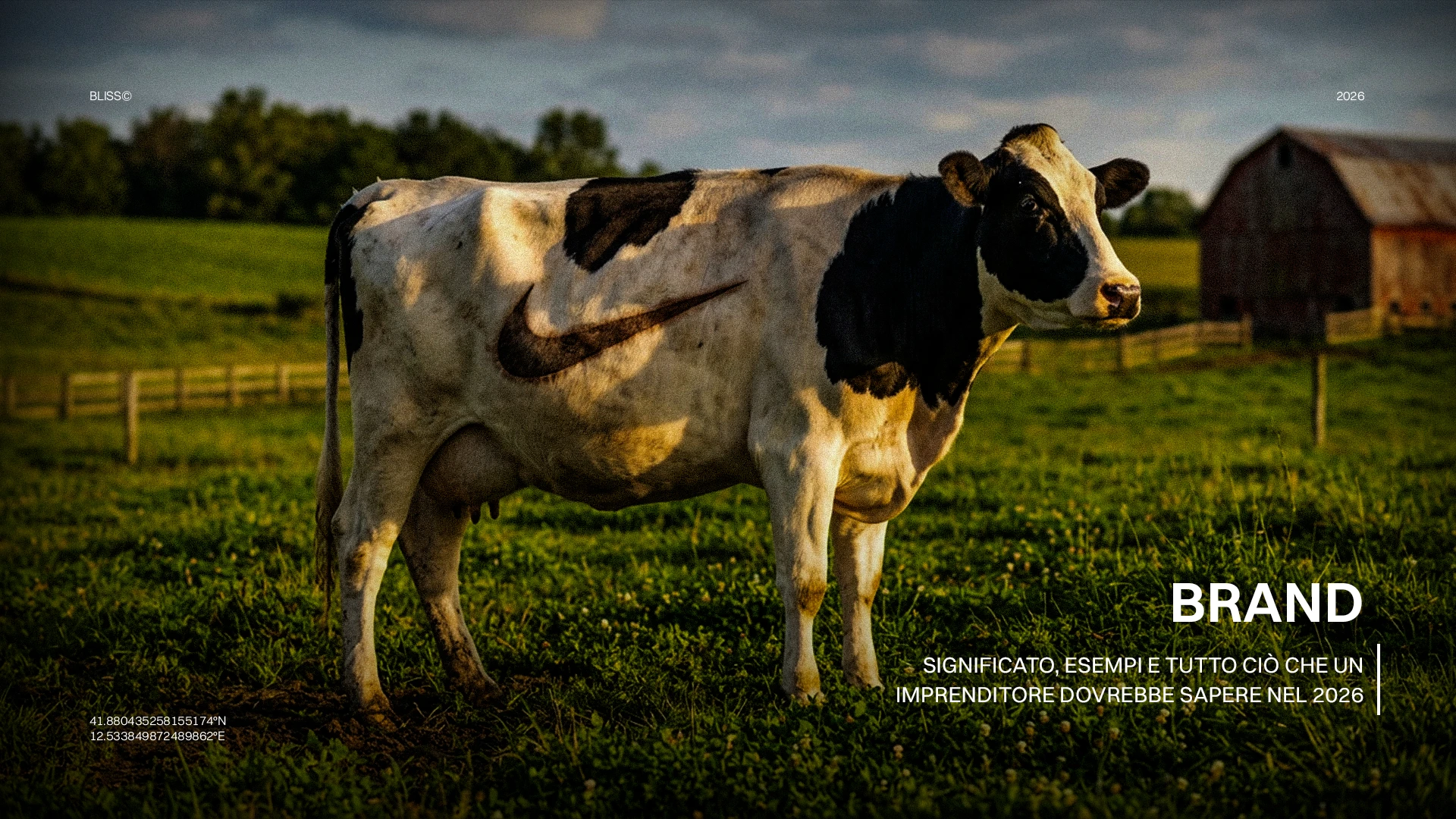
The term brand derives from the Old Norse brandr, literally “to burn”.
It referred to the branding iron used to mark livestock: a sign that made ownership unmistakable.
On reflection, this interesting etymology already contains the fundamental logic of the concept.
What is a brand? A mark that distinguishes, that makes something recognisable. Something that asserts ownership of a symbolic space in the market.
And so, more than a thousand years later, the American Marketing Association defined a brand as
“A name, term, symbol, design, or a combination of these elements, that identifies one producer’s product or service as distinct from those of others”.
Kotler and Armstrong, in Principles of Marketing, sought to broaden the perspective, stating that the brand is “everything a product or service represents to consumers” and constitutes “the company’s most enduring asset, outliving individual products and facilities”.
All correct definitions, but partial ones.
They describe the brand as an object. They do not describe the brand as a system.
Let us explore why, and how to overcome this limitation.
Who, what, where, when and why: the 5 Ws of the brand
Who builds a brand?
Technically, everyone. A manufacturing company, a digital start-up, a public institution, a professional.
The brand is not the preserve of large corporations: it is the identity structure of any entity operating in a competitive market. As the cases Bliss Agency has developed for the Repubblica di San Marino and Courmayeur Mont Blanc show, brand governance applies with the same logic to a private company as to a territory.
What is a brand, more precisely?
It is the set of expectations a market has built around an organisation. Expectations of quality, consistency, positioning, values.
The brand lives in the minds of the people who encounter it, not in the logo. And so it lives on consistency across every touchpoint.
Where is a brand built?
Precisely at every touchpoint where the organisation comes into contact with its audience.
Advertising, website, packaging, after-sales service, social media communication, conduct in a crisis. Every interaction is a contribution, positive or negative, to the structure of expectations that makes up the brand.
When does a brand create value?
At the moment of choice. When consumers face two equivalent products and choose one because they know it, expect it, trust it. That moment of automatic preference is the return on years of brand building.
Why is the brand still relevant in 2026?
According to Statista, the combined value of the world’s 100 strongest brands exceeded 9 trillion dollars in 2025. The figure describes not the creative talent of those who built them, but the structural competitive advantage a strong brand produces: a sustainable price premium, lower customer acquisition costs, resilience in crises, loyalty that does not depend on price.

Brand, marque, trademark, logo: the distinctions that matter
The terminology debate is not academic.
Confusing these terms in fact leads to concrete strategic errors.
The trademark is a legal concept.
It is the registered sign that protects intellectual property: it prevents others from using the same name or symbol. It is filed, renewed and defended in court. The trademark protects the form. It does not create the value.
The marque is the economic and managerial concept.
It is the intangible asset that accumulates over time, measurable as brand equity: the difference in value a consumer is willing to pay for a branded product compared with a generic equivalent.
The logo is one of the visual elements of the brand.
It is necessary but not sufficient. A beautiful logo for a brand without substance does not create loyalty. A mediocre logo for a brand with a strong story and strong consistency works better than any graphic restyling.
The brand is the system.
It contains trademark, marque and logo, but goes beyond them. It includes reputation, narrative, positioning and the internal culture that generates consistency across every touchpoint. It is the company’s symbolic organism.
| Term | Nature | Purpose | Who manages it |
| Trademark | Legal | Legal protection | Legal / IP department |
| Marque | Economic | Intangible asset | Management / Marketing |
| Logo | Visual | Instant recognition | Design / Brand |
| Brand | Systemic | Competitive advantage | Governance / Advisory |
How the brain builds value
Neuroscience has sought to explain the mechanism by which a brand generates economic value over time.
The human brain builds trust through the accumulation of consistent expectations over time. Each time a brand keeps a promise, the pattern is reinforced. This process, studied by the neuroscientist Robert Zajonc as early as 1968 through the mere exposure effect, shows that simple repeated exposure to a consistent stimulus increases favourable response, even independently of conscious processing.
The dopaminergic system responds to familiarity as a reduction in risk. A recognised brand lowers the cognitive cost of the purchase decision. It requires no analysis. It is chosen automatically, before the consumer even begins to weigh the alternatives. This is the brand recall that Aaker formalised as a higher objective than mere brand awareness: it is not enough for consumers to know you exist. They must think of you first when the need arises.
From identity to governance
A structured brand consists of overlapping layers, each of which requires specific decisions.
Brand Identity
What the brand decides to be: values, mission, vision, personality, tone of voice. It is the internal declaration, the starting point of every communication choice.
Brand Image
What the market perceives. The gap between identity and image is one of the main sources of inefficiency in brand management: a company that sees itself as innovative but is experienced as conservative by the market has a problem that no communications exercise can solve without structural intervention.
Brand Equity
According to Interbrand, the world’s strongest brands generate a return on invested capital structurally higher than competitors with weak brands in the same category. Brand equity is measured as a sustainable price premium, lower CAC, higher customer lifetime value and a multiplier in M&A valuations.
Brand Governance
The system that sustains all of this over time. It is not a document. It is an architecture of processes, decision-making frameworks and operating criteria that make brand consistency independent of the people managing it at any given moment. It is the difference between a brand that works because someone is good at holding it together, and a brand that works as a system.

Brand management in 2026: the trends reshaping the field
Three trends are structurally changing the way brands build and defend their positioning.
The first is the fragmentation of touchpoints. With the proliferation of channels, brand consistency across increasingly diverse surfaces has become the main operational challenge. According to Statista, the average consumer interacts with a brand across 6-8 different touchpoints before making a purchase. Every point of contact is an opportunity to confirm or contradict the identity.
The second is AI as the new mediator between brand and consumer. Language models answer questions about products, make recommendations and synthesise reputations. A brand that does not control its own narrative in automated answer systems progressively loses control over how it is perceived. Bliss has developed specific expertise in this area through its GEO & AIO service, which builds semantic architectures capable of guiding AI systems in how they represent the brand.
The third is the acceleration of the reputational cycle. A crisis that once took weeks to spread now unfolds in hours. Brands without structured governance find themselves making high-impact decisions under information stress, without predefined decision-making frameworks.
How Bliss builds brands that last
A brand that lasts is not the result of an isolated insight, however brilliant. It is the result of a method applied consistently, even when circumstances change and the temptation to deviate grows strong.
Bliss applied this principle in building the positioning of Miele in an Italian market that required defending the authority of the German brand. In governing the consistency of Coca-Cola HBC‘s communications across distinct local markets. In building for Pandora a narrative able to remain recognisable across a global audience and an extensive distribution network.
In each of these cases, the challenge was not creative. It was structural: keeping the same identity while everything around it changed in scale.
New Connections (FAQ)
What is the difference between brand and branding?
The brand is the asset: the set of perceptions, expectations and values that a market associates with an entity. Branding is the process through which that asset is built and maintained. The brand is the result of branding over time.
Does a small company need a brand?
Every company competing in a market where customers have alternatives needs a brand. Size determines the resources available to invest, not the need. A weak brand in a small company translates into price competition, difficulty retaining customers and an inability to grow without constant commercial pressure.
What happens to a brand when management changes?
It depends on governance. A brand governed by a system of principles and processes survives changes in management with continuity. A brand that depends on the vision of a single person risks identity drift at every transition.