




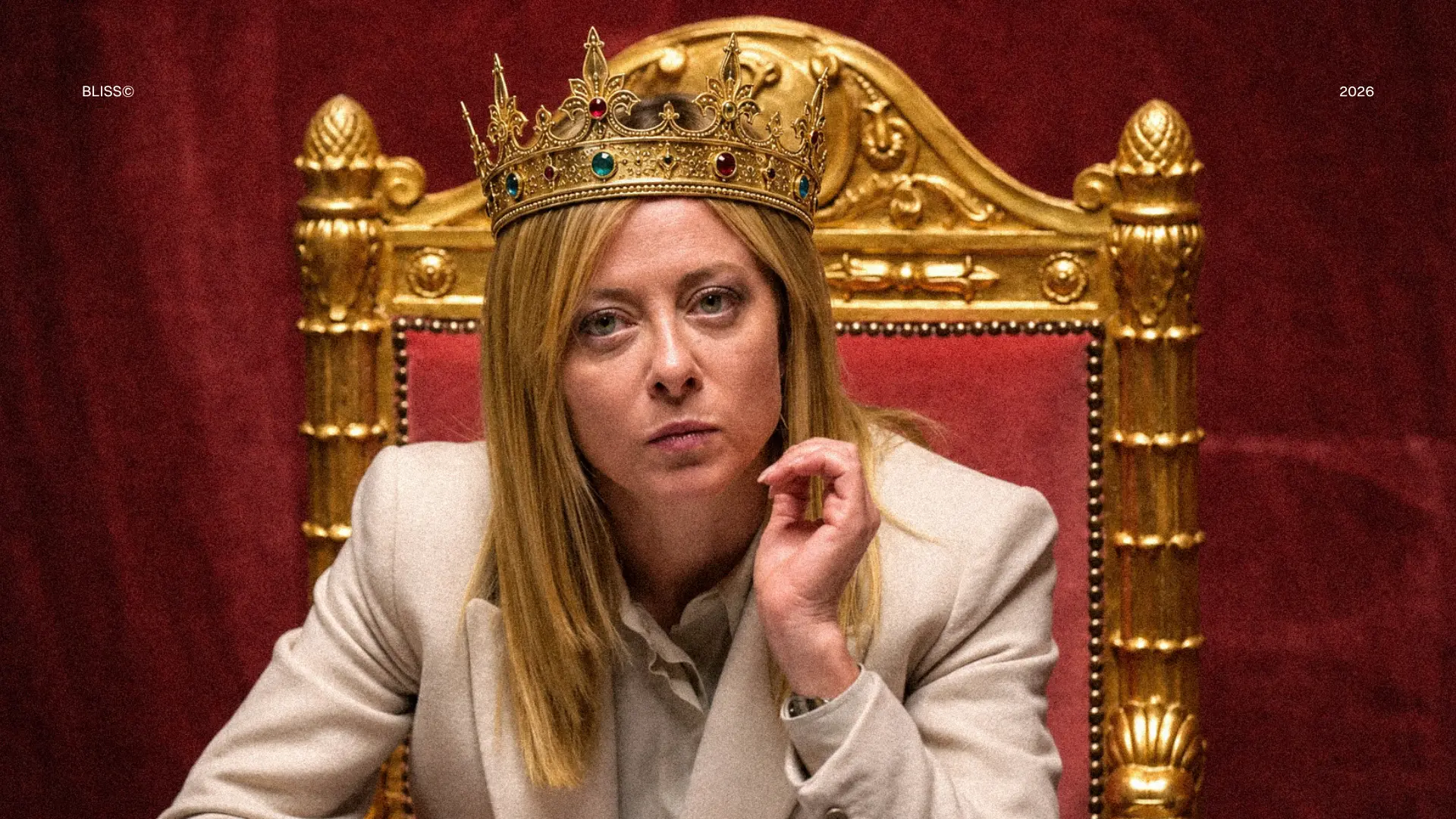
The average lifespan of an Italian government is just over a year.
Since 1946, in fact, 68 governments have come and gone. Many of them lasted only a few months.
And yet tomorrow something remarkable will happen in the history of the Republic: the Meloni government will surpass the 1,412 days of Berlusconi II and become the longest-serving government in our country’s history. The milestone is expected on 4 September 2026.
Whatever one thinks of Meloni and this government, the numbers matter, and this record prompts an interesting reflection that concerns not only countries but every decision-making system: does stability, on its own, create value?
Because continuity has an effect on investors, businesses and institutions: at least on the way they read risk.
And for better or worse, this government has shown it.
Let us look together at what Italy’s recent political stability has brought, and what it can teach every board.
Duration in days since taking office.
Stability and results: what the data say
Political sentiment is one thing, but the data are another. And the data tell us that in the same years in which Italy’s political continuity increased, some indicators of the country’s international perception improved.
Granted, the causes are many and include public finances, monetary policy, the European context, reforms and economic performance. Within this picture, however, the rating agencies have also explicitly cited greater political stability. So, in plain terms: international investors have welcomed the country’s stability.
In November 2025 Moody’s raised Italy’s sovereign rating from Baa3 to Baa2, its first upgrade in 23 years. Reuters linked the improved perception of the country to fiscal discipline, reforms and (indeed) consolidated political stability.
Fitch had also improved Italy’s outlook, citing fiscal performance, compliance with the European framework and political stability (Reuters).
The bond market, too, now paints a very different picture from the start of the legislature. The BTP-Bund spread, which hovered around 220 basis points in 2022, was moving around 80 in August 2026. ANSA recorded 80.1 points on 26 August 2026. A figure that sums up a shift in how risk in Italy is perceived.
10-year BTP-Bund spread, in basis points
Point values recorded on the dates indicated, not monthly averages. Sources: MEF, ANSA, Deutsche Bank, Il Sole 24 Ore, Borsa Italiana.
What an investor buys when buying stability
Above all, an investor buys a time horizon. If I am to invest 500 million in a plant meant to stand for twenty years, I want to be able to estimate who decides, which rules govern the system, how much they can change and how recognisable the context will remain in which the project must reach full operation.
No investor asks for certainty. Legibility is enough.
A system in which counterparts change very rapidly generates an uncertainty cost. That cost feeds into expectations, required returns and capital allocation decisions.
That is why, even though for decades Italy managed to get by despite marked political discontinuity, investors’ view was far less optimistic. A generational turning point.
Stability is not just a political weapon
The same problem exists inside any organisation. A company may have an excellent CEO, a brilliant strategy and a strong brand. But if the CEO, CMO, positioning, agency and priorities change every eighteen months, the organisation still pays a cost. More often than not, an invisible one.
That cost includes lost time, strategies abandoned before they could take effect, dispersed expertise, suppliers to be realigned, a confused market and people who start reading every new direction as provisional.
Useful continuity means keeping the direction recognisable, while leaving the organisation free to adjust tools, people and tactical choices.
Financial investors, employees, commercial partners and clients form expectations when they know who decides, by what criteria and within what horizon. This legibility is one of the most tangible effects of governance.
It is the same principle behind Executive Advisory: keeping the direction legible while decisions, investments and scenarios keep changing.
Whether or not one is a fan of Meloni’s record, it is undeniable that Italy is currently offering us a case that is rare in its history. Only time will tell how much political continuity will have affected the country’s performance. The question, however, is already useful for any board.
Because there is always value in stability.
If nothing else, in the outward image it gives of one’s work.
Domande frequenti
Does political stability really make a country more attractive to investors?
It can help, especially when it makes counterparts, policies and the decision-making horizon more predictable. Investors, however, weigh a much broader set of factors: public finances, growth, institutions, regulation, productivity and the ability to honour commitments. Political stability reduces one component of uncertainty, but it acquires economic value when it is accompanied by the quality of decisions.
Can too much stability become a problem for an organisation?
Yes, when continuity means stagnation. A stable CEO or management team can accumulate knowledge, make the direction legible and allow strategies to deliver results over time. If, however, permanence reduces debate, slows the renewal of ideas or protects decisions that ought to be corrected, the same advantage can turn into inertia.
What can a corporate board learn from a government’s stability?
That predictability has a value of its own. Employees, investors, clients and partners need to understand who decides, by what criteria, and which direction will hold long enough to guide their own choices. Constantly changing leadership, priorities, positioning or organisation, by contrast, raises the cost of uncertainty. It is one of the principles behind Bliss’s work in its Brand Governance and Executive Advisory programmes: building systems in which strategic direction survives the constant turnover of people and initiatives. Useful stability does not mean leaving everything unchanged, but making recognisable what must continue while the rest evolves.