


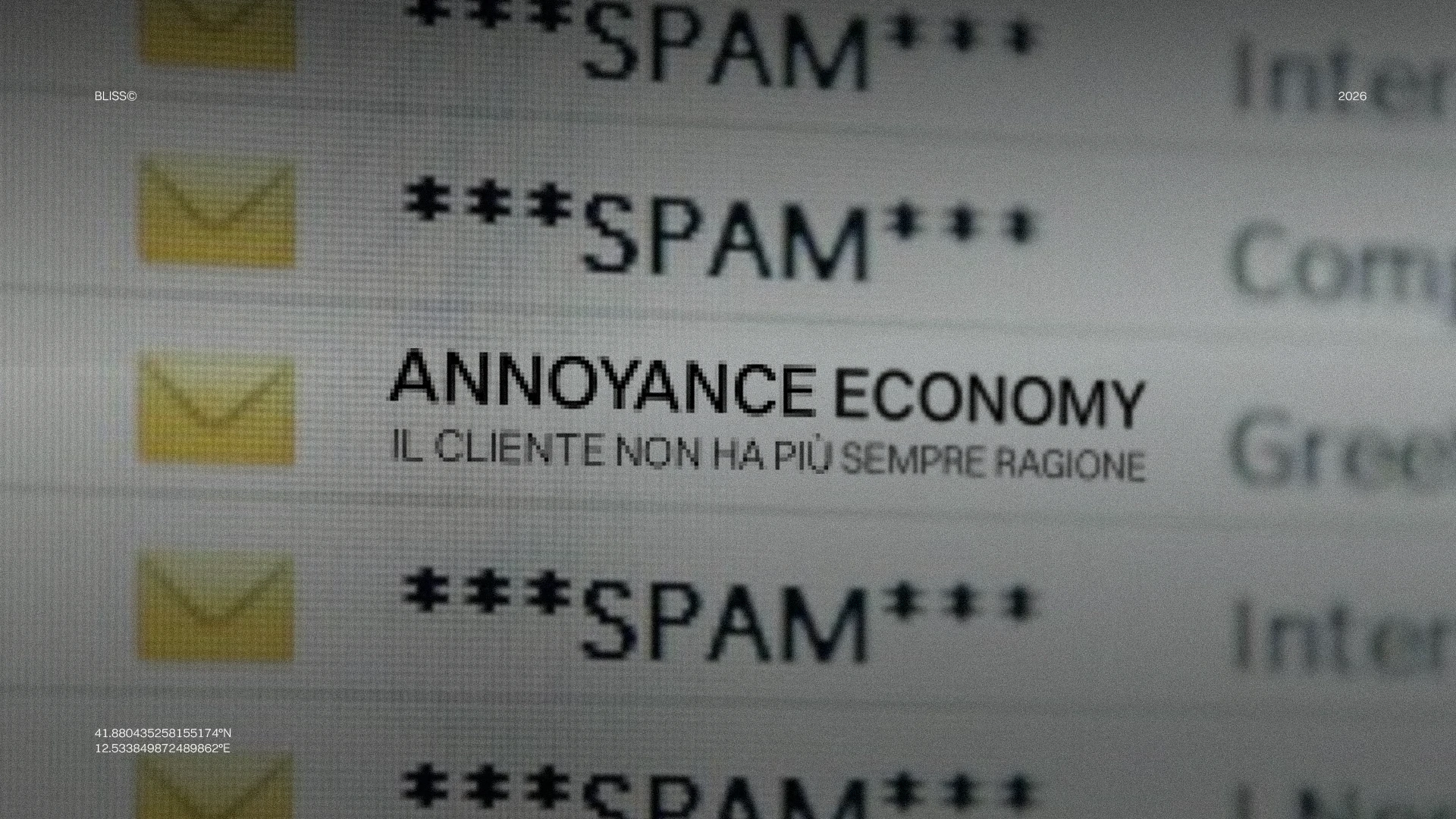
On 7 July 2026, NPR published an article on Project 2029: the policy blueprint the US Democratic Party is building in response to Project 2025. The war on the annoyance economy is one of the document’s pillars; the term, coined by Adam Maisel and Stanford economist Neale Mahoney, describes the set of frustrating commercial practices that, day after day, drain consumers’ time and money.
The estimate it produces is the most striking part: the annoyance economy costs American households at least $165 billion a year. All of this is down to hidden fees that appear only at checkout, and subscriptions that are impossible to cancel except through endless waits on the phone or AI agents answering in place of human beings, leaving you nostalgic for even the grumpiest flesh-and-blood operator.
The problem with these practices is that someone deliberately designed them.
The logic behind the problem
The annoyance economy is the result of decisions made rationally, in isolation, by people who were not looking at the full picture.
The reasoning that produced these systems works like this. A human call centre costs X a month, whereas an automated system costs X divided by five. The difference goes straight to margin. The same logic applies to hidden fees: a fee that appears only at checkout converts less, but those who get that far convert anyway, and average revenue per transaction rises. Cancelling a subscription takes seven steps instead of one: the cancellation rate falls while retention rises, so the quarterly figures improve.
Every single decision, assessed in isolation against its own short-term metric, looks rational. Taken together, these decisions produce a system that erodes the customer relationship faster than any marketing initiative can rebuild it.
Why the market does not correct itself
The obvious question is: why don’t customers simply leave?
The classical economists’ answer is that competition should punish companies that adopt frustrating practices, not reward them. And in theory, it does.
In practice, however, the mechanism breaks down for three structural reasons. The first is switching cost: in sectors such as telecommunications, energy, financial services and insurance, moving from one provider to another takes time, paperwork and uncertainty. The perceived cost of switching often outweighs the inconvenience of staying. The second is information asymmetry: hidden fees and obscure terms are designed precisely not to be discovered until it is too late. The third is market concentration: in many sectors the alternatives are few and behave identically, because they have optimised on the same logic.
When every alternative on the market has the same frustrating practices, the customer has no real choice. They can only put up with it or give up the service. That is why the phenomenon has become significant enough to feature in a national policy document.
The cost beyond the bill
From a brand perspective, the most interesting aspect of the annoyance economy is that its real cost is not visible in the short term. The 165 billion estimated by Maisel and Mahoney measures the harm to consumers. The harm to the brands that generate that frustration is even harder to quantify and structurally more dangerous.
Every unresolved wait on the phone, every fee discovered only at checkout, every attempt to cancel turned into a bureaucratic maze produces something more lasting: a customer who leaves and tells others.
Research on loyalty dynamics shows that negative experiences are shared three times as often as positive ones. Acquiring a new customer costs between five and seven times as much as retaining an existing one. Every point of friction that accelerates churn multiplies the acquisition cost needed to keep the customer base stable.
None of these numbers appears in the P&L line that measures the call-centre saving. They appear months or years later, diluted in churn and NPS metrics that are too often read as market data rather than as feedback on specific operational decisions.
A governance problem
The most common response when an organisation recognises it has a customer experience problem is an intervention on customer service: more training for agents, new scripts, a better chatbot, a loyalty programme. These are last-mile interventions.
The problem is that the frustrations documented in the annoyance economy originate less in individual events than in the decisions that shaped the system upstream: pricing with hidden fees, cancellation flows designed to discourage, automated systems chosen to replace human beings. Those decisions belong to brand governance.
Every point of friction in a customer’s experience is the result of a choice made at a decision-making table. Someone decided that the operational saving was worth more than the quality of that touchpoint. That choice is a brand choice, even if whoever made it did not think of it in those terms.
Organisations that govern their brand with method assess the impact of every operational decision on the customer’s perceived experience. The question missing from most corporate decision-making processes is the simplest one: what does the customer feel when they encounter this system? If that question is not asked before the system is implemented, the customer will ask it later. With consequences measured in churn, in reputation and in 165 billion dollars of value burned every year.
New Connections (FAQ)
Is the annoyance economy an American problem, or does it affect Italian companies too?
The phenomenon is structural and cuts across every market where sector concentration is high and switching costs are steep. In Italy, telecommunications, energy, insurance and banking show similar dynamics. Hidden fees, obstructive cancellation flows and automated support systems that loop back on themselves are common practice. The difference from the United States is that in Italy the regulatory response has come partly through the AGCM, which has opened proceedings on unfair commercial practices in specific sectors, though without yet building a coherent framework comparable to the proposals in Project 2029.
How do we measure, in concrete terms, whether our company is creating unnecessary friction?
The starting point is to map the customer’s real experience at every critical touchpoint: from purchase to cancellation, from complaint to support. Not through internal surveys, but through sessions of direct observation of actual behaviour. There are three signals to look for: the time a customer actually takes to complete an action compared with the time it should take; the abandonment rate in key flows (checkout, cancellation, renewal); and the qualitative content of negative reviews, which almost always names the specific points of friction before anything else.
If frustrating practices generate operational savings in the short term, how do you persuade management to change them?
By building the full economic model rather than the partial one. The operational saving from the automated call centre shows up in the current month’s costs. The cost of accelerated churn shows up in acquisition costs over the next twelve months. The loss of NPS shows up in the following year’s retention figures. Putting the two numbers on the same sheet, in the same unit of measurement, almost always produces a different result from the one that justified the original decision. The friction is simply accounted for elsewhere and later, where it is invisible to those who created it.