


Introduction
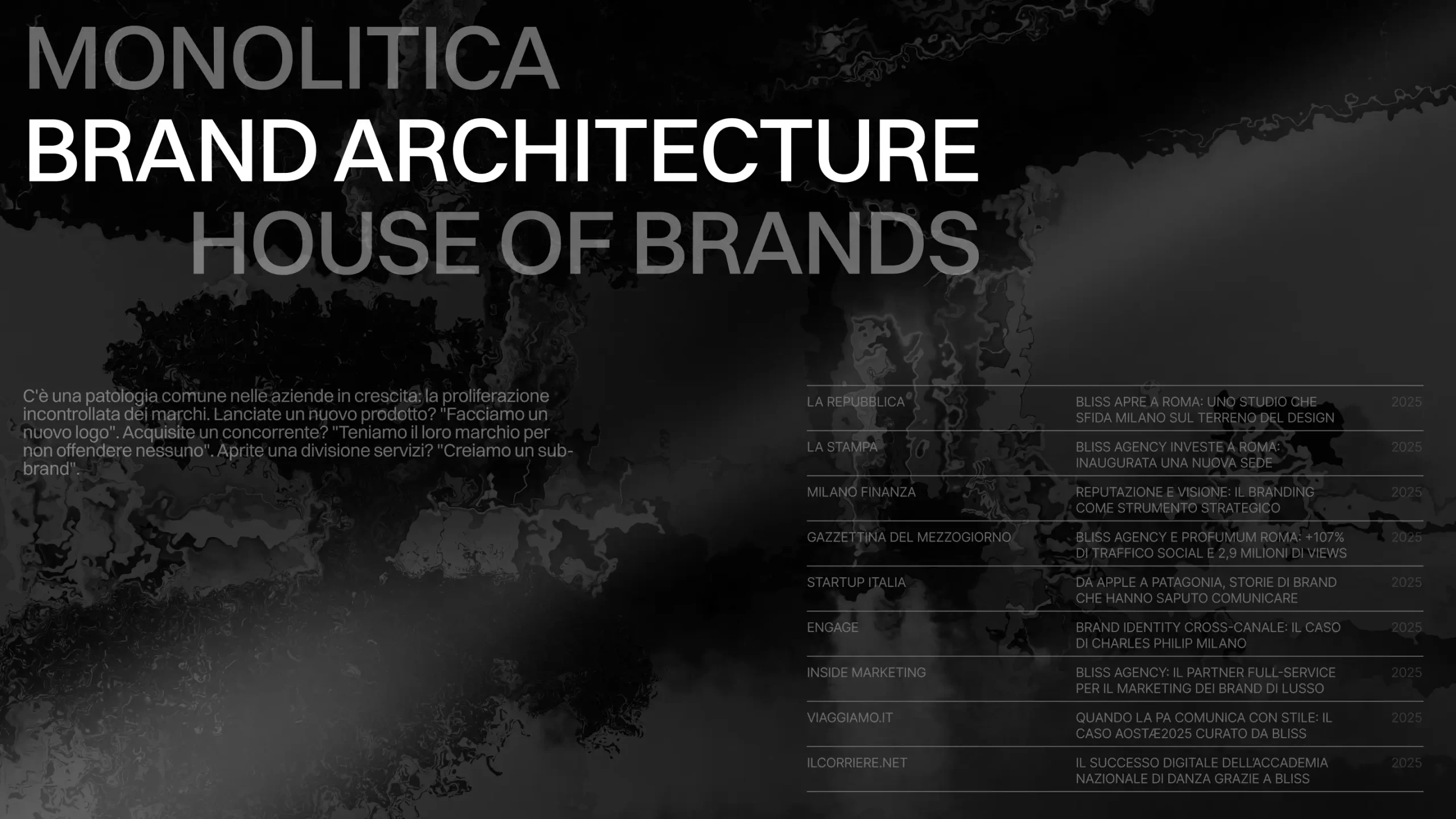
Brand Architecture is the strategic discipline that defines how a company’s brands, sub-brands, products and services are organised, connected and presented to the market.
It is not about logo design, but about the structure through which brand value (Brand Equity) is distributed, protected and amplified within a complex portfolio.
In contexts of growth, diversification or acquisitions, Brand Architecture becomes a critical lever of brand governance.
The wrong structure fragments the budget, confuses the customer and reduces commercial effectiveness; the right structure transfers trust, simplifies purchasing decisions and maximises the return on marketing investment.
At Bliss, we approach Brand Architecture as a strategic and financial issue, not a creative one: it is the architecture that sustains growth without multiplying costs and chaos.
The 5 Ws of Brand Architecture

What Brand Architecture is and why it is a strategic lever for growth
Brand Architecture is the strategic structure that defines how a company organises, connects and presents its brands, sub-brands, products and services. It is not a graphic exercise but a governance decision that directly affects clarity of positioning, transfer of value (Brand Equity) and the capacity to grow over time. A well-designed Brand Architecture allows the market to grasp immediately how the different offerings relate to one another and to place its trust consistently.
Why Brand Architecture reduces complexity and budget waste
Without a clear Brand Architecture, every new product or division spawns a new brand, multiplying the costs, messages and channels to be managed. This leads to a fragmented marketing budget and a loss of commercial effectiveness. A sound architectural structure concentrates investment, eliminates needless duplication and maximises the impact of every euro spent, reducing the “invisible tax on growth”.
Who needs Brand Architecture: multi-brand and growing companies
Brand Architecture is essential for multi-product companies, expanding groups, international organisations and businesses operating with sub-brands or differentiated business lines. It is particularly relevant for entrepreneurs, CEOs and strategic leadership teams who must govern complexity without sacrificing clarity and control. It is not a tactical marketing decision, but a structural choice made at the top.
When to define a Brand Architecture: growth, M&A and new launches
It becomes essential when a company grows rapidly, launches new products, enters new markets or undertakes mergers and acquisitions. In these phases, continuing to add brands without an architectural logic increases the risk of confusion for customers and employees, as well as diluting the overall value of the brand. Brand Architecture makes it possible to plan growth in an orderly and sustainable way.
Where Brand Architecture applies: brand portfolio, products and sub-brands
Brand Architecture acts on the brand portfolio as a whole, defining the role of the Master Brand, the sub-brands and the individual offerings. It establishes when to use a monolithic, hybrid or independent model, and guides critical decisions such as whether to retain, integrate or retire a brand. The result is a coherent system that simplifies the customer experience, facilitates cross-selling and makes the company easier to read and to value, including for investors and stakeholders.
Bliss
Speak to a
consultant
Tell us about your project. Together, we will find the right way forward.
Contact usThe 3 Strategic Models (and their impact on Budget)
There is no “right” model, only the one that serves your business plan. This is how an Advisor analyses the options:
1. Branded House (Monolithic)
A single Master Brand dominates everything (e.g. FedEx Express, FedEx Ground, FedEx Office).
- Advantages: Brutal efficiency. Every euro spent on advertising strengthens the whole group. You launch new products at zero cost because they inherit the trust of the parent company.
- Risks: Systemic risk. If a product fails or is hit by a scandal, the reputational damage spreads to the entire group.
- Advisory Tip: Ideal for B2B companies or services where trust in the supplier is everything.
2. House of Brands (Independent)
The company is an invisible holding, and the products are autonomous heroes (e.g. P&G with Pampers, Gillette, Ariel).
- Advantages: Freedom of positioning. You can sell a low-cost product and a luxury one without them cannibalising each other. You can enter risky niches without exposing the holding company.
- Risks: Duplicated costs. Each brand has to build its awareness from scratch. There are no synergies.
- Advisory tip: Only necessary if you operate in conflicting markets or if there is a specific reputational risk in one category.
3. Endorsed Brand (Hybrid)
The sub-brand has its own name but is “endorsed” by the Master Brand (e.g. Courtyard by Marriott).
- Advantages: The best of both worlds. The new product gains immediate credibility while retaining its own distinct personality.
Brand Architecture & M&A: Integrate or Kill?
Brand Architecture faces its toughest stress test during acquisitions. You have bought a competitor for 50 million. What do you do with its brand?
- Migration Strategy (Rebranding): You eliminate the acquired brand and bring it under your Master Brand.
- Pro: Immediate synergies, a unified culture.
- Cons: Risk of losing customers loyal to the old brand (“Churn”).
- Retention Strategy: Keep the acquired brand alive.
- Pro: No shock for customers.
- Con: Doubled operating costs and a lack of cultural integration (the “Us vs Them” syndrome).
The Advisor helps you calculate Brand Equity at Risk in order to choose the mathematically safest route, often designing transition phases (“Brand A is now part of Brand B”).
Internal Politics: Managing Managers’ Egos
Why do companies end up with too many brands? Often because of internal politics. Every Product Manager wants “their” logo because they believe their project is special. Every Country Manager wants a local name because “it’s different here”.
The role of Brand Architecture is to say NO. It exists to impose iron discipline: “You cannot launch a new brand unless there is a business case demonstrating that the Master Brand cannot cover that segment”.
This reduces the “Tax on Growth”: fewer resources wasted on pointless logos, more resources concentrated on the products that drive revenue.
Visual and Verbal Reorganisation
Once the structure has been defined, it needs to be aligned.
- Visual: If we are a Branded House, all logos must follow the same grid system.
- Verbal: This is where the Verbal Identity Guide comes in. If the brands are connected, must they speak the same language? Or can the “young” sub-brand use different slang from the “institutional” parent company?
Brand Architecture in practice: the Profumum and Rustichella Truffles case studies
This discipline has been at the strategic core of numerous projects led by Bliss, where the need to bring order to brand perception has driven the evolution of the business. Architecture is a positioning choice that determines a company’s scalability.
Two of our flagship case studies offer a concrete example:
Profumum Roma, where our work on the brand architecture was fundamental to preserving the uniqueness and high-end positioning of the brand in the niche perfumery sector. In this case, we worked to ensure that each new olfactory creation and each product line did not fragment the identity of the parent house, but reinforced its prestige. We applied a monolithic architecture model, in which the strength of the “Master Brand” is reflected in every product, creating a product ecosystem where recognition is immediate and perceived value is consistent.
La Rustichella Truffles addresses a different challenge: market expansion through the launch of a new product line. Here, brand architecture served to define the boundaries between the company’s historical heritage and the innovation of its offering. We guided the client in creating a visual and conceptual hierarchy that allowed the new line to benefit from La Rustichella’s established reputation, while retaining a distinctive identity of its own to reach specific audience segments without confusing the end consumer.
These cases show how a well-designed brand architecture makes it possible to manage growth, ease the introduction of new products and, above all, protect brand value over the long term.
Brand Portfolio Rationalisation
Structuring brand assets logically is crucial to maximising overall capitalisation and stemming the fragmentation of investment. High-level analysis gives the board the conceptual framework to optimise resource allocation across business units and subsidiaries. A rigorous Brand Architecture ensures that Corporate Storytelling & Brand Narrative keeps a sharp focus, preventing the dilution of capital and strengthening the institutional identity across all target markets.
Bliss
Speak to a
consultant
Tell us about your project. Together, we will find the right way forward.
Contact usConclusion: Order brings profit
Clarity is not merely an aesthetic virtue; it is a commercial one. A clean brand architecture helps the customer buy (easier cross-selling), helps employees understand where they work, and helps investors value the assets.
Stop building unauthorised extensions onto your corporate house. Call in an architect to draw up the floor plan for your future growth.
FAQ – Brand Architecture
How does Brand Architecture directly affect marketing Return on Investment (ROI)?
Brand Architecture acts as an efficiency regulator for allocated capital. In a monolithic model (Branded House), every euro invested in the Master Brand increases the equity of all sub-products, drastically reducing customer acquisition cost (CAC) for future launches. Conversely, a disorderly structure scatters the budget across multiple identities, fragmenting advertising pressure. Optimising the architecture means eliminating operational redundancies and concentrating financial firepower where it generates the greatest impact.
Discover how we optimised top-tier positioning in the Profumum Roma case study.
What is the substantive difference between a Brand Architecture decision and a Brand Design decision?
Design concerns visual execution (logos, colours, fonts); architecture concerns strategic governance. While design answers the question “How do we look?”, architecture answers “How do we maximise the value of our assets?”. It is a discipline that belongs to corporate and financial strategy, since it defines the boundaries of brand responsibility and the hierarchy of value perceived by stakeholders.
When is it necessary to move from a monolithic to a hybrid structure?
The shift is advisable when the company enters a market with radically different value dynamics or targets. If association with the Master Brand risks diluting its prestige or, conversely, if the Master Brand is too institutional for a highly innovative sector, the choice falls on an Endorsed Brand.
Analyse how we managed the expansion and visual hierarchy for La Rustichella Truffles.
What impact does a weak Brand Architecture have on company valuation for investors?
Investors look for clarity and scalability. A confused Brand Architecture signals operational inefficiency and potential positioning conflicts, making intangible assets harder to value. A clean structure, by contrast, demonstrates a clear strategic vision and ease of integration for future acquisitions or exits.
Does Brand Architecture help reduce costs?
Yes. A clear structure reduces duplication, marketing budget dispersion and operational complexity, increasing the overall efficiency of investment.
What is the first warning sign that an architectural review is needed?
The clearest signal is internal cannibalisation: when your own products compete for the same customer, or when the sales force struggles to explain the difference between two lines of offering. At that point, the architecture is no longer supporting the business; it is hindering it.