




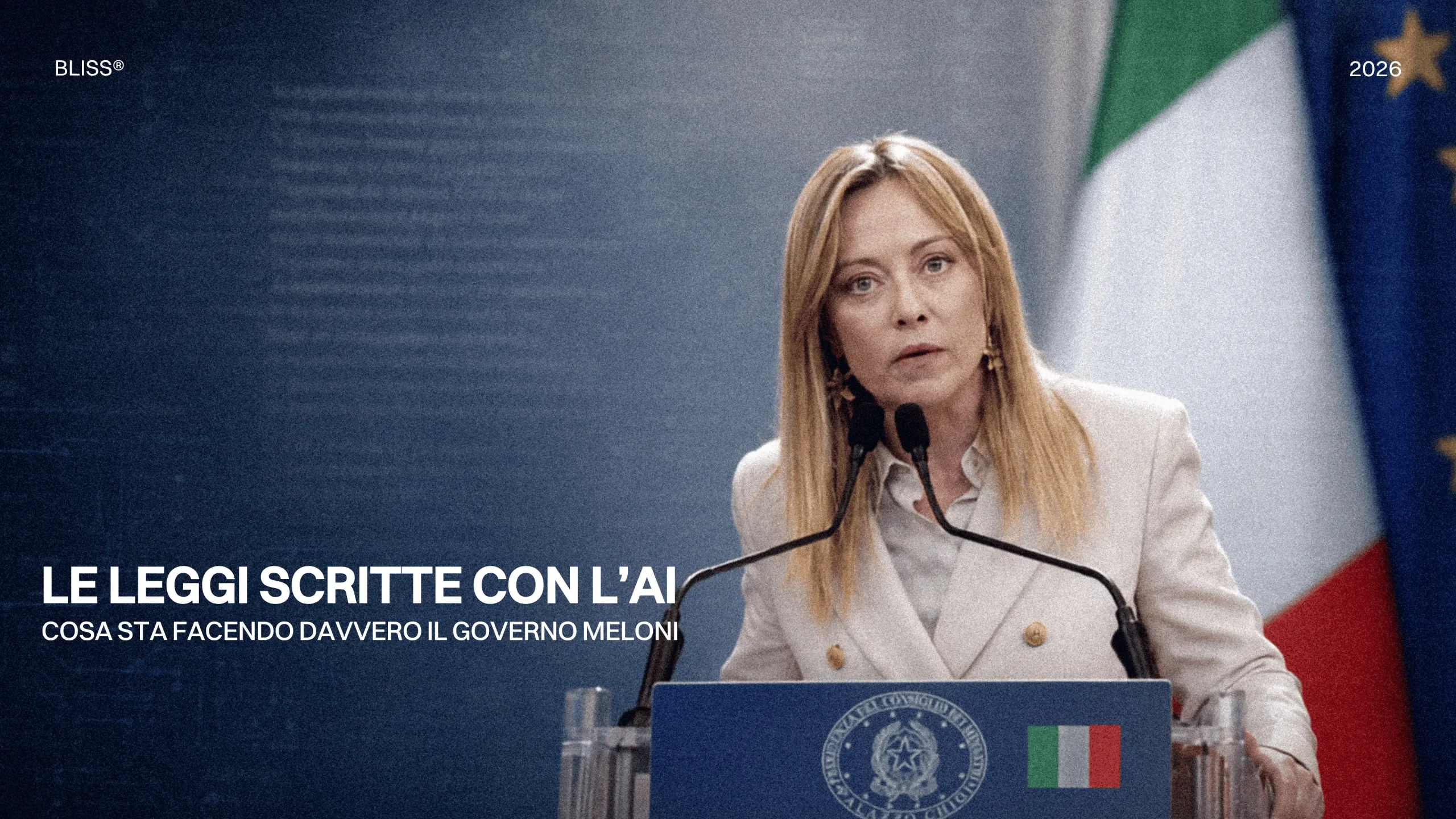
ChatGPT will not sit in the Council of Ministers.
It will not propose a tax, it will not decide who is entitled to a bonus and it will not sign the Meloni Government’s next decree.
Yet artificial intelligence is about to approach one of the most sensitive points of the State: the moment a political decision is turned into law.
Twelve staff members from the Prime Minister’s Office will attend the masterclass Intelligenza artificiale per scrittura normativa e valutazione d’impatto, organised by Treccani Accademia. The course consists of four four-hour sessions, on 18 and 25 September and 2 and 9 October 2026. The programme covers drafting and revising legislative texts, amendments and annexes, verifying institutional sources, impact assessment and public policy monitoring.
The headline “laws will be written with AI” works well on social media, but the reality is less spectacular and more serious.
Once again, the machine will not replace the legislator. It will begin to assist some of the people who prepare the texts on which the legislator decides. That is not the same thing, but it is not a minor detail either. Let’s talk about it.
No law will be written by ChatGPT
Writing a law means ensuring that every provision fits into a legal system full of definitions, exceptions, cross-references and rules that amend other rules. A poorly chosen word can open the door to differing interpretations. An outdated reference can make a provision difficult to apply.
This is where artificial intelligence can become useful.
It can compare texts, retrieve precedents, check definitions and cross-references, manage versions and flag passages that warrant review. It can also assist officials in drafting explanatory reports and in analysing the effects of a provision. The Treccani programme also envisages using AI for technical and financial reports, monitoring parliamentary proceedings and producing explanatory materials for non-specialist readers.
The Senate dossier on legislative drafting recognises that AI and new technologies can improve the clarity, consistency, searchability and management of texts. The same document, however, also sets out a decisive limit: a law must reflect principles, values and social changes that a system cannot determine on its own. AI can suggest how to phrase a choice, but it cannot decide which choice is the right one.
Why Palazzo Chigi is moving now
The course comes as the Government seeks to make a larger share of its measures immediately applicable, reducing reliance on subsequent implementing decrees.
According to the official report updated to 30 June 2026, the share of self-executing government legislative acts has risen from 18% at the start of the legislature to 54%. In the second quarter, 43 legislative acts came into force, the highest figure since the government took office.
The sooner a measure has to work, the more its initial wording matters. And here AI can help.
Even if technology can speed up analysis, it remains to be seen whether speed will produce better laws or simply more texts. Only time will tell.
Those Who Sign Remain Responsible
One point worth highlighting concerns accountability. A law drafted with the assistance of artificial intelligence remains a human law. This is because the political problem chosen, the interests balanced, the text approved and the consequences that follow are all human.
If a law produces an injustice, it will not be possible to blame the software. If a system suggests a discriminatory solution, responsibility will lie with those who failed to recognise it and with those who designed a process unable to catch it.
This is why every use should leave a trail: which tool was involved, at which stage, with which data, and who verified the result.
The algorithm must not become a place without witnesses, in which a political choice can be made to look like a mere technical consequence.
Democracy depends precisely on the ability to debate the alternatives.
The dangers beyond error
As we know well, when it comes to AI the first fear is hallucination, whether in the form of an invented reference, a non-existent ruling or a misquoted provision. Not to mention the less visible risks, such as model bias, plausible but wrong answers, or potential conflicts of interest (like the one described in the case of Anthropic versus the Pentagon).
The issue is not only checking whether the machine has written a correct sentence, but understanding which assumptions led to that sentence, who would be penalised if they were wrong, and what interference might arise in future between private companies and public institutions.
European analyses of AI adoption in the public sector stress the same points: human oversight, accountability, data protection, security and transparency. But simply appointing a human supervisor will not be enough.
For Palazzo Chigi, adopting AI in legislative drafting will mean deciding what degree of technological dependence is acceptable.
Italians have yet to be given an answer to this dilemma.
New Connections (FAQ)
Will Artificial Intelligence really write Italy’s laws?
The project involves training twelve staff members from the Prime Minister’s Office. AI will be studied as a tool to support legislative drafting, impact assessment and policy monitoring. Political decisions, verification and approval remain in the institutions’ hands.
How can AI help to draft a law?
It can compare legislation, retrieve precedents, identify inconsistencies, manage versions and assist with the analysis of possible effects. Every result must be checked by people with legal expertise and knowledge of the regulated subject matter.
How should the use of AI in the Public Administration be governed?
Rules are needed that make the role played by artificial intelligence traceable at all times: which systems are authorised, which data they may use, at which stages they may intervene, who checks the outputs and who retains final responsibility. The most sensitive processes must also provide for activity logs, escalation procedures, Human Oversight and criteria to limit dependence on individual technology suppliers.
The same logic underpins the AI Governance systems developed by Bliss: the aim is not merely to control the quality of the output, but to govern the entire process through which a machine enters an organisation’s decisions. In the public sector this need becomes even more pressing, because transparency, accountability and the ability to reconstruct choices bear directly on the relationship between institutions and citizens.
BLISS®
© 2026. ALL RIGHTS RESERVED