


Try this experiment.
Try asking ChatGPT, Claude or another AI for a random number between 1 and 100.
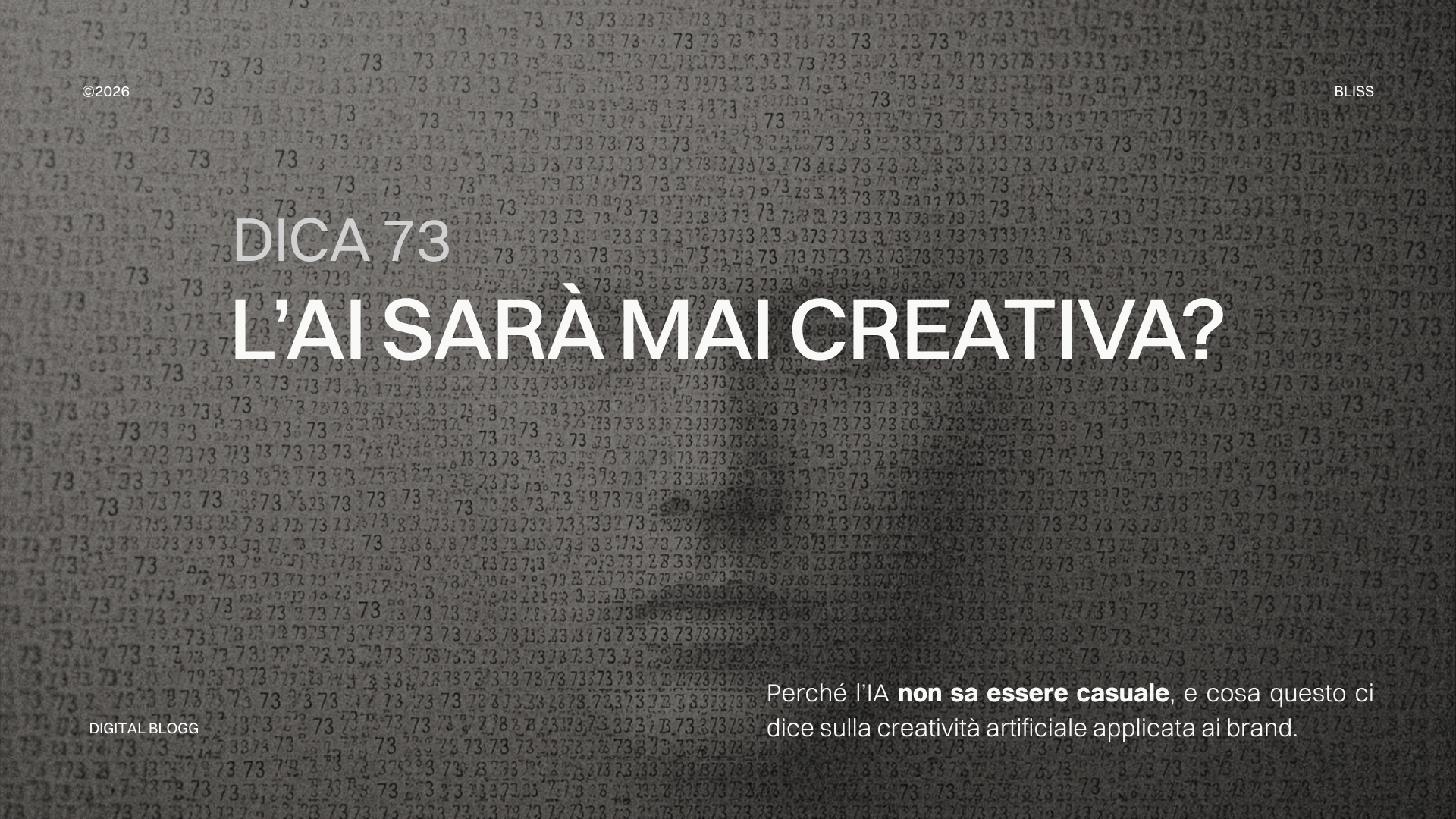
The answer will probably be 73.
Not always, of course. There will be times when it answers 37, or 47, or 77, but the result will still oscillate between these options. And it is so curious that it has become a documented phenomenon: tested in hundreds of experiments and discussed on Reddit and Hacker News.
Often enough, then, to raise a suspicion.
And the suspicion is justified.
But the interesting point lies elsewhere, and it has to do with creativity.

The human number
Before you blame the AI, know this: it is human beings who choose 73.
The Veritasium channel ran an experiment with 200,000 participants, asking each of them to choose a random number between 1 and 100. The most chosen were: 7, 73, 77 and 37.
All of them contained a 7.
After this small test, participants were asked which number they thought would be chosen least.
The most frequent answers: 73 and 37. Yet the numbers actually chosen least were the multiples of 10 (that is, 90, 80, 70, 60), perceived as too round to be random.
This makes it clear that the human brain has its own idea of what looks random.
And that idea is wrong, systematically, in the same way for everyone.
Prime numbers, such as 37, 47 or 73, seem more random because they rarely appear in everyday life. The brain reads them as an absence of pattern. And it translates that absence into randomness.
Why AI chooses 73
An LLM predicts words. Only words. This is the distinction on which everything else rests.
When you ask a language model for a random number, it does not draw a value from a mathematical generator. It calculates which word is statistically most likely, given the context of the request, based on the millions of texts it was trained on.
And those texts were written by human beings. Human beings who, when they ask for or name a random number, name 73. Or 37.
So the model learns that, in that specific context, those are the most probable words. And when it is asked the same question, it returns them.
The pattern scales with the range. Ask for a number between 1 and 50: it answers 27. Between 1 and 10: 7. In a 2025 experiment, GPT-4o answered 7 in 92 conversations out of 100. ChatGPT, Claude, Gemini and Copilot all gravitate towards the same numbers when tested in sequence.
And the best part is that this is not a bug.
It is exactly how a system trained to predict what a human being would write works.

The paradox of artificial creativity
This is the point that interests us most.
If an LLM cannot generate true randomness, then it cannot generate true originality either. Because originality is, by definition, a statistical deviation from the average. An original idea is one that most people would not have had. Whereas the idea an LLM produces is, by design, the idea most people would have had.
The creativity of an LLM is the average creativity of the corpus it was trained on. The statistical aggregate of millions of creative texts, returned in the most likely combination given the request.
It is the same mechanism as 73. When you ask AI for an original name, a surprising headline, an unexpected brand idea, it returns the creative equivalent of 73. The most original-seeming. The most surprising-seeming. The statistical average of what human beings perceive, or have been taught to perceive, as original.
What it means for brands
A brand’s positioning is built on its perceived difference from the category average. A recognisable brand occupies a mental space that others do not.
If AI produces the statistically most likely output for any creative request, and every brand uses AI to generate communication and identity, the outcome is predictable. Brands converge. Headlines look alike. Tones of voice become uniform. And so the category produces an ecosystem of “brand 73s”: the most brand-seeming identity, the most approximately strategic communication.
And so the differential (the only asset capable of protecting a brand over time) is inexorably eroded.
AI is a powerful tool for communications governance. Yet true differentiation will always require something that an LLM, by its very nature, cannot produce.
A deviation from the statistical average.
An idea that no training corpus has ever seen before.
AI chooses 73 (or 37, or whatever it may be) because it is exactly what you asked for. The most believably random number.
But the difference between plausibly random and truly random is the same as the difference that exists (and always will) between plausibly original and truly original.
New Connections (FAQ)
If AI cannot be original, what is it for?
To execute the original, not to generate it. AI is powerful for maintaining consistency at scale, for producing variants of an idea already defined, for checking that a communication complies with an identity system built elsewhere. The work an LLM cannot do is the work upstream: defining the niche the brand occupies. That requires human thinking applied to a specific problem, not the statistical aggregate of how other brands have solved similar problems.
Is the convergence problem already visible?
Yes. It is the same phenomenon documented in AI’s linguistic fingerprint: bullet points where prose is needed, em dashes, “in conclusion”, contextual openings. These are not individual stylistic choices. They are convergent patterns produced by systems optimising towards the same average. In branding, the same phenomenon produces similar palettes, similar tones of voice, similar promises. The category tends towards 73.
How do I stop my brand from looking like everyone else’s?
By encoding the difference before AI enters the process. A brand governance system built with precision before generative tools come into use exists for exactly this purpose. AI executes within that system. The difference is not generated by AI. It is defended by it.
BLISS®
© 2026. ALL RIGHTS RESERVED