


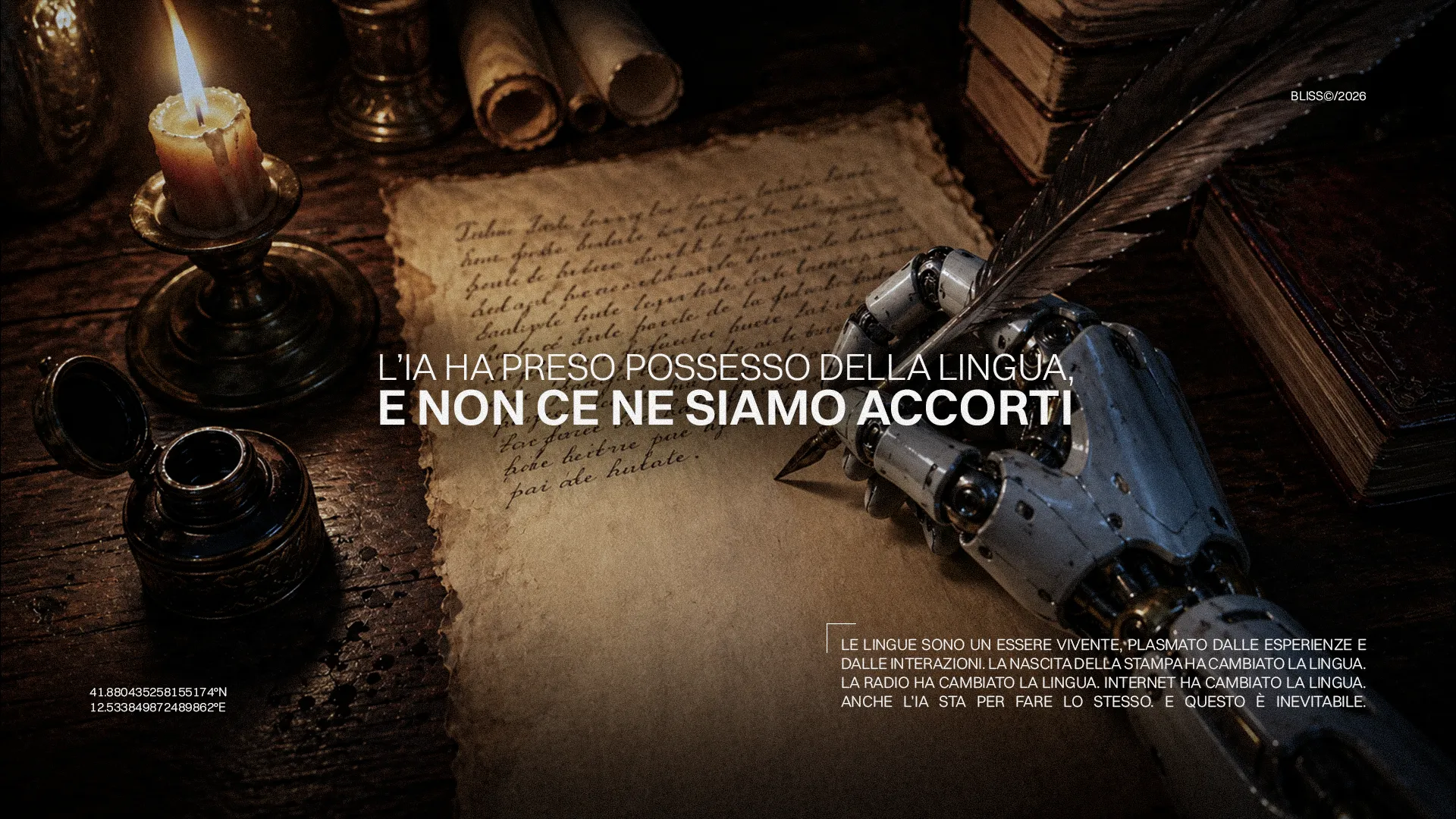
Come i modelli linguistici hanno colonizzato certi pattern comunicativi, e cosa succederà alla lingua nei prossimi anni.
The internet is now littered with AI.
Traces of Artificial Intelligence can be found in images, algorithms, articles and social media posts. And so, navigating content and finding human-made work has become increasingly complicated.
AI is everywhere, but look closely and it leaves traces that can be recognised. Even in language, which is becoming more uniform and flatter.
Whether it is the dashes, the bullet points or the sentences beginning with “In summary” or “In conclusion”, generative models now have a clear fingerprint in language too.
At Bliss we analysed this fingerprint, to understand how to recognise it, which structures it has taken root around, and how language will change in the near future.
How AI developed a style of its own
Large language models are not trained to sound artificial. They were trained on billions of human texts, with the aim of producing output that is as natural as possible. Yet, in the process, they have developed recurring patterns that now act as a signature.
The mechanism follows a precise logic. Models optimise for perceived clarity and user satisfaction: lists, as we know, are clear, opening phrases that set the context reduce ambiguity, and so on.
Every single choice AI makes is rational. Human choices, on the other hand, well… Let’s just say they rarely are.
Applied systematically and at scale, these choices therefore produce a register that no human being would use so consistently. All with a paradoxical result: appearing so human as to seem not human at all. Not because of a technical flaw, but because of excessive consistency.
Human beings create irregularly. They think discontinuously. They exist in ways that often contradict one another. There is no optimisation in our existence.
This is what makes us, in the long run, impossible to mistake for machines.
And in the short term?
To address this problem, there are now dozens of online tools designed to tell the hand of AI from the human one. Except that they do not act as we humans would, but rely (like good machines) on statistical calculations that measure the weight of the mathematical destiny that binds them.
Whereas humans write following the emotion of the moment, AI proceeds by statistical inertia, always choosing the most well-trodden path: the one, that is, that would guarantee the highest probability. Digital detectors capture this absolute predictability by analysing what is known as perplexity, namely a text’s capacity to be “surprising”.
Whether in the short or the long run, a human being is a generator of surprises. AI is not. A human being is a broken rhythm. AI, a metronome.
These tools work through a kind of digital mirror: they use language models to predict what the next word in a sentence would be. If the text they are analysing matches their predictions almost perfectly, the mask inevitably slips. It is the paradox of perfection: the tools recognise the machine not by what it says, but by what it does not say, or did not have the courage to say.
The psychology of recognition
The human brain is also a pattern machine. It loves, it craves, recognising recurring structures. The stars in the sky. The sequence of the seasons. Since the dawn of time, we have encountered patterns and given them a name.
The same is happening with AI.
The so-called “uncanny valley” lies at the heart of this process. According to researchers, there is a threshold beyond which something almost human becomes more disturbing than something clearly artificial. AI-generated text does not always cross that threshold, but when it comes close, the reader senses something at once familiar and alien.
Online, browsing social media and blogs (newspapers included), we feel this more and more often.
That is why recognising AI does not require a tool, but knowing what to look for.
It may be useful to watch out for:
1. Compulsive use of long dashes. AI loves the long dash (the em dash) and considers it the most elegant punctuation mark of all. Personally, I might even agree, but it is an Anglo-Saxon convention, or at any rate an obsolete one in Italian usage. None of the great authors of our language ever used them. They are not even taught at school. Their presence is often a sign of artificiality.
2. Lists that appear where they are not needed. When a model has to explain something, its first move is a list. Even when the content would be clearer in prose! Lists give an impression of completeness, though: and generative models optimise for the impression of completeness. Goodness, now that I think about it, this list is a list too… Does that mean I…?
3. Opening phrases that frame. “In conclusion…” “It is important to understand that…” “It is worth noting how…”. Phrases of this kind are known as landing formulas. AI uses them to create a sense of organised text. But humans rarely start from context, particularly in spontaneous writing.
4. Closing summaries that repeat everything. If a text ends with a paragraph that starts over, recapping everything from the beginning (saying things like: “In summary…”), we can always recognise a model in that signature. Granted, there are boring human beings, but the general tendency is to close by provoking; by opening towards a final perspective. AI, on the other hand, always insists on taking stock.
5. Absolute consistency. Less easy to spot yet glaring, this signal is certainly the most reliable. A text written by a human being is imperfect. If we were to compare it to a walk, it would be a hillside path, full of ups and downs. Irony, shifting rhythm, imperfect sentences. AI is a plain. AI is a field flattened by bulldozers. Flat. Perfectly level.
How boring…
Language belongs to no one
Yet one thing is worth remembering: even if AI can be recognised by these elements, these elements belong to no one.
Proust loved dashes. Eco wrote many lists. Ancient rhetoric used contextual sentences. No linguistic pattern is inherently artificial: it becomes so when used with a frequency and regularity that betray the absence of an individual.
So the question is not what you use, but how you use it. A text with long dashes written by someone with a voice of their own does not resemble (and never will) a generic text created by an anonymous, impersonal model. The difference lies in the signature – the difference lies in the soul of a text.
Writers have a responsibility to use whatever structure they need. So the concern should not be “do I sound like an AI?”, but: “am I putting my soul into these words?”.
What will happen to language
The final question we asked ourselves is perhaps the hardest.
Languages change constantly. They are, in a sense, living beings, shaped by experience and interaction. The birth of printing changed language. Radio changed language. The internet changed language.
AI is about to do the same. And this is inevitable.
Two scenarios are plausible. The first is polarisation, which would produce standardised texts on one side, and individual, deliberately inconsistent forms on the other. The second is hybridisation, in which AI will speak an ever less recognisable language. Either because Artificial Intelligences will have learned to speak like humans, or because humans will have adapted to speaking like machines (pretending to be human).
Whatever the scenario, the question is the same: namely, whether this will enrich our language or flatten it.
In conclusion, we don’t know yet.
(Only joking, it’s still me, I swear).
Only one thing is certain: machine learning will be able to learn everything, even to speak like a human. But it will never learn to communicate the way a human being does.