


What is fashion advertising: definition and strategic scope
Advertising in fashion doesn’t sell products: it builds myths. The most iconic fashion advertising campaigns have rewritten the rules of clothing advertising and luxury marketing, creating images that remain in the collective imagination for decades. From Dior with Charlize Theron to Calvin Klein with Kate Moss, from Versace advertising to Diesel’s provocations: these are the 10 famous advertising campaigns that defined the aesthetics and strategy of fashion advertising — and what every brand can learn from each of them.
Famous advertising campaigns in fashion: what makes them iconic
Famous advertising campaigns that have marked the history of fashion are never the result of chance. Behind every image that has entered the collective imagination lie three constant elements: a precise visual direction that breaks the conventions of the moment, a strategic choice of the testimonial or aesthetic code perfectly aligned with the brand’s positioning, and a system of meaning that transcends the product to touch upon the identity, aspirations, or cultural tensions of the period.
Longevity is the ultimate test of an iconic campaign: an advertising image still recognizable and cited twenty years later has achieved the status of a permanent cultural asset. This is the parameter by which we selected the ten fashion advertising campaigns analyzed here — not the budget, not the number of awards, but the ability to endure.
From a strategic point of view, the most effective campaigns in the history of fashion advertising share one characteristic: they do not communicate “buy this object” — they communicate “be this person”. The product becomes the medium; the identity is the message.
Distribution of the advertising budget in the fashion sector by channel — 2025 (market estimate)
Source: Statista Digital Advertising Report 2025, Bain Luxury Study 2025
Editorial elaboration by Bliss based on Statista 2025 and Bain & Company Luxury Study 2025 data
Every iconic advertising campaign in fashion stems from a solid brand advisory strategy: the visual is the surface, the strategic positioning is the foundation.
Bliss
Talk to a
consultant
Tell us about your project. We will find the right path together.
contact usThe 5Ws of fashion advertising
- Who: fashion, luxury, sportswear, fast fashion, and accessible luxury brands — and the communication agencies that support them.
- What: visual campaigns, TV commercials, social media campaigns, editorials, outdoor, cinematic branded content.
- When: seasonally (SS/AW pre-collections), during events (Fashion Week, trade shows), or continuously for brand building.
- Where: glossy print, OOH (Out of Home), digital (social media, display, video), physical retail, immersive events.
- Why: to build brand awareness, generate desire, position the brand in the market, defend premium pricing, attract new generations of consumers.
According to the McKinsey State of Fashion 2026, the global fashion market will continue to grow at a moderate pace in 2026, with macroeconomic volatility continuing to affect consumption. In this context, 46% of industry executives expect market conditions to worsen compared to 25% who anticipate improvements. Agile brands, capable of adapting creativity and messaging, will emerge as winners.
On the Italian market, according to Statista, the Apparel sector generated a revenue of approximately 58.3 billion dollars in 2025, with fashion e-commerce reaching 6.03 billion euros in 2024 (+16% year-on-year). Italian fashion is exported to 122 countries, confirming Italy’s positioning as a global hub for textile excellence. In this scenario, advertising is not a cost: it is the infrastructure that sustains perceived value.
The 10 most iconic fashion advertising campaigns: strategic map
Before diving into the details of each campaign, this table offers a synthetic map of the strategic mechanisms that made them immortal — a framework applicable to any fashion or luxury brand.
| Brand | Campaign | Year | Key Mechanism | Lesson |
| Dior | J’adore — Charlize Theron | 2004→today | Cinematic mythology + female icons | Evocation surpasses explanation |
| Gucci | #GucciAria | 2021 | High/low culture fused in dreamlike aesthetics | Campaign as a conceptual installation |
| Calvin Klein | Marky Mark & Kate Moss | 1992 | Visual disruption + radical casting | Controlled audacity generates pop culture |
| Prada | The Delivery Man | 2012 | Cinematic branded content | The brand as a cultural catalyst |
| Chanel | Marilyn & N°5 | 1954→today | Mythological reactivation of the testimonial | Encoding values into collective memory |
| Balenciaga | Digital dystopia | 2020→ | Intentional polarization + Gen Z language | Radical brand: not consensus, but identity |
| Versace | Donatella’s Power | ongoing | Narrative personalization: person = brand | Charismatic leadership as an asset |
| Saint Laurent | Eternal rock chic | ongoing | Aesthetic consistency over time | Repeated aesthetics become an asset |
| Dolce & Gabbana | Sicilian Dreams | ongoing | Cultural heritage as soft power | Parochialism → shared dream |
| Off-White | Urban Rebellion | 2013–2022 | Urban aesthetics → high recognizability | Speaking the community’s language |
Table: strategic summary of the 10 most iconic fashion advertising campaigns | Bliss
Clothing advertising slogans: when words matter as much as images
In clothing advertising, the verbal component is often underestimated compared to the visual one. Yet some of the most effective clothing advertising slogans in history have themselves become brand assets — cited, parodied, and reactivated by different generations of consumers. Their effectiveness does not depend on literal creativity: it depends on the ability to condense a precise strategic positioning into a few words.
Among the slogans that have defined brand identity in the fashion sector:
- Calvin Klein — “Nothing comes between me and my Calvins” (1980): erotic provocation that builds the perception of exclusivity and bodily freedom; contributes to the launch of premium denim as an aspirational category.
- Nike — “Just Do It” (1988): not a clothing slogan in the strict sense, but it redefined the relationship between sportswear and performative identity, becoming the benchmark for the entire subsequent athleisure sector.
- Diesel — “For Successful Living” (1990s): postmodern irony that subverts the language of traditional aspirational advertising; builds the loyalty of an audience that recognizes itself in the brand’s intelligence.
- Gucci (Alessandro Michele era) — absence of a verbal slogan, replaced by an aesthetic code: a strategic choice that demonstrates how positioning can be communicated exclusively through visuals and casting, without textual support.
The lesson for contemporary brands: an effective clothing slogan doesn’t describe the product — it defines the wearer. Every word must answer the question “what kind of person is this brand?” even before “what does this product do?”
Fashion advertising campaigns: the differences between luxury, premium, and fast fashion
Not all fashion advertising campaigns speak the same language. The fashion sector is structured on very distinct positioning levels, and advertising choices reflect — and build — these differences. Confusing the codes of one segment with those of another is one of the most costly mistakes a brand can make in communication.
The most relevant operational differences between the three major segments:
- Luxury fashion advertising — favors image scarcity (less frequency, more impact), narrative ambiguity, and the absence of prices and direct calls to action. The product often appears indirectly or is absent. The brand is the message. Examples: Chanel, Dior, Bottega Veneta. Budget allocated predominantly to high-end print, physical events, and cinematic content.
- Premium fashion advertising — balances aspiration and accessibility. The product is visible, the testimonial is recognizable but not unattainable, the call to action is present but not aggressive. Examples: Ralph Lauren, Tommy Hilfiger, Michael Kors. A mix of traditional and digital channels with an emphasis on the brand lifestyle.
- Fast fashion advertising — maximum frequency, rapid rotation of creatives, emphasis on price or trend relevance. The communication is tactical, not identity-driven. Examples: Zara (which paradoxically uses very little traditional advertising, focusing entirely on visual merchandising), H&M, Shein. Budget concentrated on digital performance advertising.
Growth of the digital fashion advertising market 2020–2028 (billion USD)
Source: Statista Fashion Advertising Market Report 2025
Projected estimates 2026–2028. Editorial elaboration by Bliss based on Statista 2025 data.
The distinction is not just aesthetic: it reflects precise strategic choices about where perceived value is created. In luxury, it’s created in the image; in premium, it’s created in attainable aspiration; in fast fashion, it’s created in speed and price. Understanding which segment your brand operates in — and communicating accordingly — is the first step in an effective fashion advertising strategy.
For brands that want to measure the return of their fashion advertising campaigns, performance marketing integrates the creative dimension with the measurement one: every visual has a conversion goal, every budget has a reference KPI.
Luxury is not sold, it is told: the campaigns that made history
The fashion world does not follow the rules: it dictates them. And it does so in advertising as well, through advertising campaigns that do not just sell clothes or accessories, but visions, identities, and desires. Behind every impactful visual often lies a marketing and communication agency, like Bliss, capable of translating the brand’s DNA into a universal visual language.
Advertising in fashion does not communicate a product: it builds an image, defines an era, and positions the brand in the minds and hearts of a demanding and hyper-exposed audience. Campaigns like those of Gucci by Alessandro Michele or the provocations of Diesel are not simple advertising content: they are declarations of identity.
Our work starts from a fundamental question: what does this brand want to be, culturally and visually, for its audience? Only from there can you generate communication capable of breaking the mold, leaving a lasting impression, and setting trends.
1. Dior – J’adore
The J’adore campaign, featuring Charlize Theron as an ethereal muse walking through a golden temple, represents one of the highest examples of brand elevation through cinematic language. It is not simply about promoting a perfume, but about evoking a sensory universe where femininity is regal, decisive, and timeless. The video — built on visual references to classic Hollywood (Marilyn Monroe, Grace Kelly, Marlene Dietrich) — elevates the Dior brand to a synonym for eternity.
From Bliss’s perspective, this campaign demonstrates how storytelling is not just narration, but the mythological construction of the brand. In a world saturated with stimuli, the value lies in evocation, not explanation.
2. Gucci – #GucciAria
With #GucciAria, Alessandro Michele built a multi-layered work where fashion, philosophy, and symbolism intersect in a deliberately dense narrative. The campaign draws on the dreamlike language of Fellini and Pasolini, but also Kanye West and mysticism: an operation that mixes high and low culture with curatorial intelligence.
Bliss recognizes a new paradigm in this work: the campaign as a conceptual installation. You don’t sell a garment, but you impose a worldview. And doing so requires art direction, cultural strategy, and an editorial vision.
3. Calvin Klein – Marky Mark & Kate Moss
When Calvin Klein launched the campaign with Mark Wahlberg and Kate Moss in the 90s, it rewrote the advertising language: minimal, but incredibly powerful. Black and white, bare background, two young, raw, sensual bodies. It is the antithesis of the artificial glamour of the time.
As a marketing agency, Bliss reads this campaign as an intentional break with the rules — one of the most effective mechanisms for gaining authentic attention. The strength lies in the casting, in the use of photography as a language of reality, and in the courage to expose the human body as narrative content. A still highly relevant example of how visual audacity, guided by a clear strategic vision, transforms a campaign into pop culture.
4. Prada – The Delivery Man
When branded content meets cinematic authorship, the result is a cultural object. With The Delivery Man, Prada signs a real short film starring Elijah Wood and Emma Roberts. The plot doesn’t revolve around the product, but the feeling the brand evokes. The logo is present, but subtle.
From Bliss’s perspective, this is the pinnacle of brand narration: when you stop talking about the product and start staging your imagery. It’s a lesson for every high-end brand: when communication abandons self-promotion and embraces entertainment, the brand elevates into a cultural catalyst.
5. Chanel – Marilyn & N°5
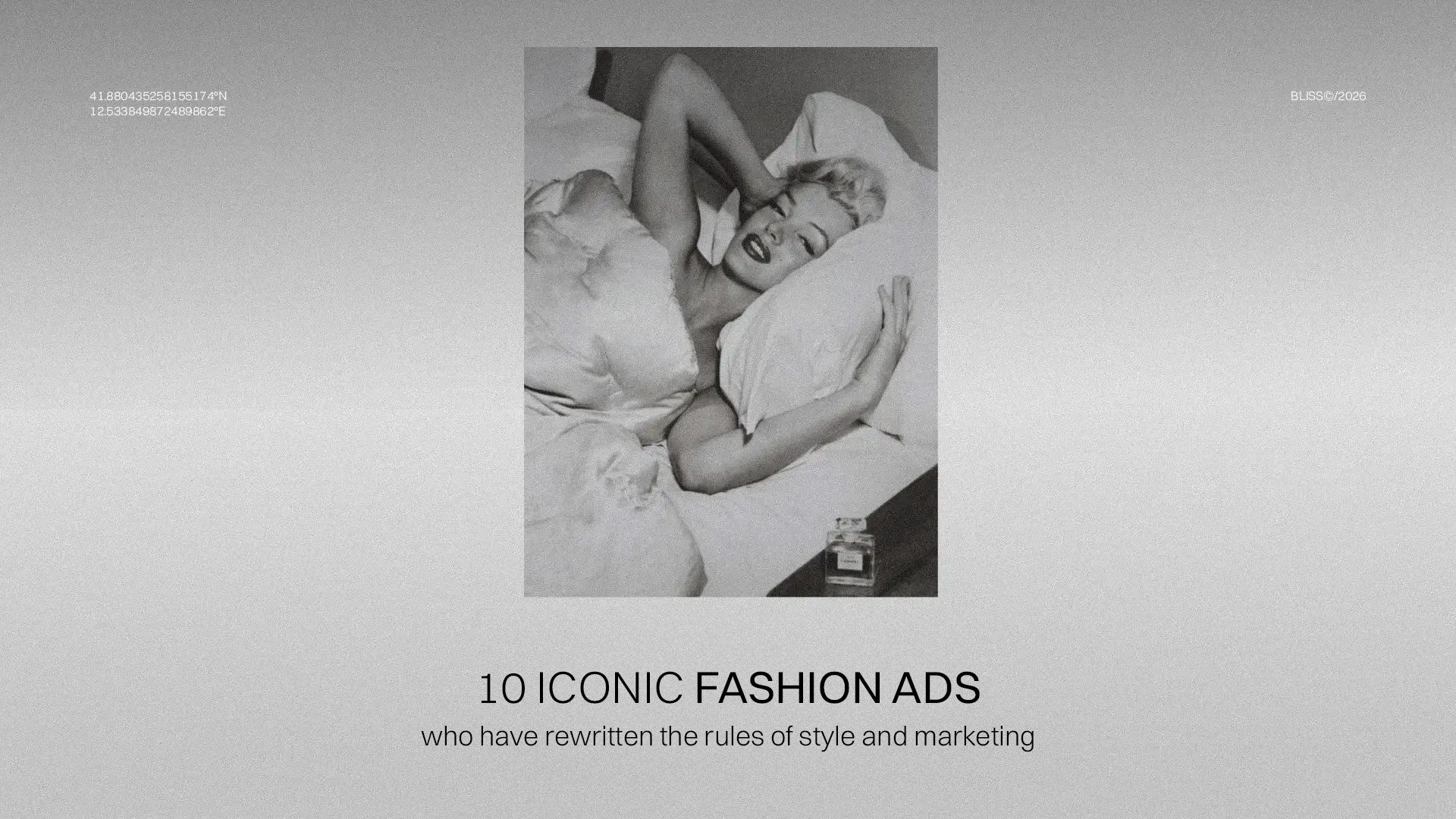
Chanel turned a legendary phrase — “What do I wear in bed? Chanel N°5” — into an eternal narrative asset. It is not just a posthumous testimonial, but a mythological reactivation: the brand does not exploit the icon; it celebrates and recontextualizes it in the present. Chanel doesn’t sell a perfume, but an iconic identity — a brand that manages to encode values and memories earns a place in the collective imagination.
6. Balenciaga – Digital Dystopia
Balenciaga is perhaps the most emblematic case of how a brand can redefine the boundaries of luxury marketing. Campaigns inspired by the gaming world, CGI videos, and dystopian settings are not designed to please everyone, but to colonize new languages. The brand speaks Gen Z’s language with extreme visual and conceptual consistency.
This approach is risky but highly memorable: an effective strategy for brands that want to create a strong, identity-driven community that recognizes itself not only in the product but in the value and symbolic system it represents.
7. Versace – Donatella’s Power
Few brands manage to merge advertising image and creative identity as intimately as Versace does. Donatella Versace is not just the creative director: she is the face, the voice, and the essence of the brand. For a branding agency like Bliss, this is a perfect example of narrative personalization: the brand becomes a person, and the person becomes the brand.
8. Saint Laurent – Eternal rock chic
Glossy black and white, metropolitan settings, androgynous and sharp protagonists: everything speaks a precise and recognizable language. Saint Laurent’s campaigns are veritable art short films, often directed by internationally renowned filmmakers. The brand doesn’t promote a product, but a visual lifestyle crystallized in the collective imagination. A consistent, repeated, and refined aesthetic over time can become one of the most powerful branding assets.
9. Dolce & Gabbana – Sicilian Dreams
D&G built its advertising storytelling as a journey into Italian cultural memory. Campaigns set in Sicilian villages, among markets, churches, and popular festivals, are much more than commercials: they are cinematic frescoes that exalt the brand’s Mediterranean roots. This approach transformed advertising into a form of cultural soft power. To stand out in the global market, sometimes you have to start from your own backyard — provided you know how to turn it into a shared dream.
10. Off-White – Urban Rebellion
The campaigns created under Virgil Abloh’s direction represent a lucid break with the glossy communication of traditional fashion: deconstructed backgrounds, texts that look like scribbles, shots that reject perfection in favor of expressive urgency. It’s a visual language born from the grassroots that evolves into a recognizable aesthetic, designed to be shared, discussed, and remixed.
This approach is anything but random: it’s an identity statement, a precise positioning in a market where new generations reject quiet luxury and demand brands capable of speaking their language.
Fashion advertising in the digital age: what changes in 2026
The 10 campaigns just analyzed belong in part to an era where fashion advertising was played out in print and television. In 2026, the playing field has radically changed. According to Project Aeon (2025) data, 75% of purchasing decisions in fashion are today influenced by what users see on social media. Firework (2025) adds that 46% of buyers prefer to watch a video of the product before making a purchase. This does not mean that grand cinematic commercials are dead: it means they must coexist with a new ecology of attention.
The paradox of fashion advertising in 2026
Fashion today faces a structural paradox: brands have more channels than ever to communicate, but less available attention. The McKinsey State of Fashion 2026 confirms that winning brands are those capable of “creative vision” — not just media coverage. Creative direction matters more than budget: a wrong idea distributed with massive investments burns resources; a right idea, even with a limited budget, generates culture.
The 5 emerging trends in fashion advertising 2026
| Trend | Strategic implication for fashion brands |
| Video-first advertising | 46% of buyers want to see videos before purchasing. Campaigns must be designed video-first, not adapted to video as an afterthought. |
| Social media as a battleground | 75% of purchasing decisions are influenced by social media. Quality organic content is worth as much as paid advertising, if not more. |
| AI as a creative amplifier | AI accelerates the production of variants and personalizations, but the risk is homogenization. The winner is the one who uses AI to amplify a proprietary creative direction. |
| Longevity vs. virality | Famous advertising images generate value for decades. Building campaigns with a vocation for longevity is more profitable than temporary virality. |
| Narrative sustainability | 63% of brands are behind on their 2030 decarbonization goals. Those who authentically integrate sustainability into their narrative clearly differentiate themselves. |
Source: McKinsey State of Fashion 2026, Project Aeon 2025, Firework 2025, bizplanr.ai 2025
Fashion advertising in Italy: Bliss case studies
Italy is one of the global reference markets for high-end fashion. Bliss has worked with Italian brands that have tackled top-level advertising and brand identity challenges.
Profumum Roma: +107% social traffic and 6.4 million views
Profumum Roma is an artistic Roman perfume house that has built its digital communication around a precise and recognizable visual aesthetic. The advertising and visual production project curated by Bliss produced measurable results:
- Over 2.9 million video views on TikTok from visual campaigns alone
- +380% reach on Meta (461,762 users reached)
- +107% organic social traffic, +79.3% from Instagram
- 6.4 million total views in a single campaign cycle
Video content of a purely visual nature — built on the brand’s aesthetic, not on direct product promotion — accounted for 35.3% of the entire advertising spend. This confirms that in the perfume and luxury sector, advertising that builds imagery performs better than advertising that sells.
Charles Philip Milano: accessible luxury with a strong identity
Charles Philip Milano represents a specific creative challenge: maintaining the visual codes of luxury — aesthetic rigor, rarefaction of the message, photographic quality — within an accessible price segment. The cross-channel brand identity developed by Bliss has demonstrated that consistency between digital advertising, visual production, and brand design is not an operational detail: it is the lever that differentiates a memorable brand from an interchangeable one.
For those managing an Italian fashion brand and wanting to build a brand advisory strategy that supports advertising with a solid positioning, Bliss’s approach integrates strategy, visual direction, and performance into a single system.
FAQ: the most searched questions about fashion advertising
What is fashion advertising?
It is the set of communication and promotional activities with which fashion brands build their perception in the market. Unlike traditional product advertising, fashion advertising operates on building imagery: it sells identity, desire, and cultural meaning even before physical products.
What are the most iconic fashion advertising campaigns?
The most studied famous advertising images in the fashion sector are: Dior J’adore with Charlize Theron (cinematic mythology), Calvin Klein with Marky Mark and Kate Moss (90s disruption), Chanel N°5 with Marilyn Monroe (icon reactivation), Balenciaga and digital dystopia (Gen Z polarization), Versace and Donatella (narrative personalization). All build a system of meaning that transcends the product.
How do you create an advertising campaign for a fashion brand?
An effective campaign starts from a strategic question: what does this brand want to be, culturally, for its audience? Only then are the creative brief, format, cast, and visual direction defined. Advertising that works in the long run is born from a solid brand identity — not from creative improvisation.
How much does a fashion advertising campaign cost?
Budgets vary enormously depending on the scale and channel: from 10–50,000 euros for a niche digital campaign to millions for a major fashion house’s campaign film. In 2026, thanks to performance marketing tools and social media, even brands with limited budgets can build high-impact campaigns, provided they have a brand advisory strategy guiding their creative choices.
Why do some fashion ads become iconic?
Fashion ads that become iconic operate on a cultural level, not just a commercial one. They have a precise visual direction, intentionally break conventions, and build a system of meaning that transcends the product. They don’t communicate “buy this” — they communicate “be this”. Image longevity is the ultimate test: an advertising image remembered twenty years later has achieved cultural asset status.
How does fashion advertising work on social media?
Fashion advertising on social media follows inverse rules to the mass market: less frequency, more care for each piece of content. The most effective brands use social media not to reach the maximum number of people, but to build a recognizable aesthetic and narrative code. As Profumum Roma’s results show, the visual format and narrative quality generate higher engagement than sheer quantity. According to Project Aeon (2025), 75% of fashion purchasing decisions are influenced by social media.
Visual quality is the main lever of fashion advertising on social media: every asset must respect the brand’s aesthetic code across every format. Discover how we build consistent visual systems in the brand design and visual identity section.
Does a fashion agency work differently from a generalist one?
Yes, substantially. An agency specializing in fashion advertising knows the visual and cultural codes of the sector, knows how to build imagery-oriented briefs, and manages the complexity of communicating across heterogeneous channels while maintaining identity consistency. The difference is not just technical: it is a cultural sensitivity towards an industry where every choice — from casting to music, from the palette to the format — is branding even before it is communication.
Build your fashion advertising with Bliss
Fashion advertising that works doesn’t come from a brief: it comes from a vision. And a vision, to last over time, needs a strategy to support it — from visual production to brand design, from strategic brand advisory to performance marketing.
Bliss supports fashion, luxury, and lifestyle brands in building advertising campaigns that speak their audience’s language, dominate the right channels with the right message, and build measurable brand equity over time.