



Over the past decade, the vocabulary of tech investors has been dominated by FAANG: Facebook (now Meta), Apple, Amazon, Netflix, Google. Five listed companies, with public accounts and verifiable forecasts. On 9 June 2026, however, an AI engineer posted a graphic on X featuring a new acronym.
Within 24 hours it had received over 20,000 likes. The FAANG era was over.
The future is a fruit.
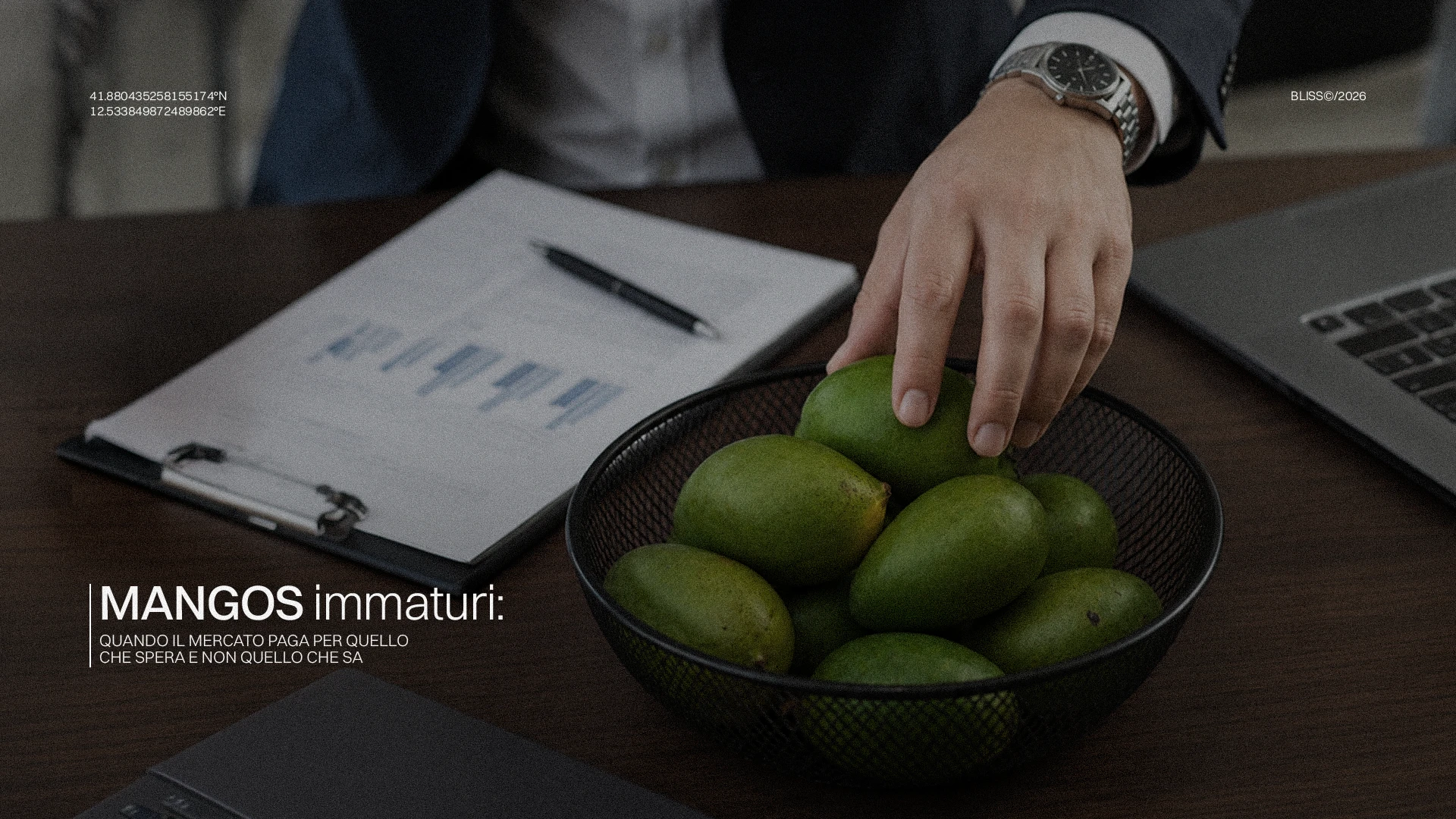
The new acronym is MANGOS: Meta, Anthropic, Nvidia, Google, OpenAI, SpaceX. In practice, the most important companies in the S&P500, and those with the highest market capitalisation in the US market. Yet the most interesting thing is not so much who is in, but who has been left out: Amazon, Netflix, Apple. Add to that the fact that two of the six components are private companies that cannot be bought through any index (a few weeks ago, it was three).
No Wall Street acronym had ever included unlisted companies. MANGOS is the first.
A signal worth analysing.

From FAANG to MANGOS: who drops out and why
If FAANG built the Internet age, MANGOS will give rise to the AI era.
That is why every exclusion says something about the paradigm shift the market is trying to name, and therefore about the way the world is changing.
Amazon is out because AWS, however dominant in the cloud, is AI distribution infrastructure, not AI creation. Netflix is out because streaming is no longer the sector that defines the future. Apple is out of the most widely used version of the acronym because the Wall Street Journal’s ranking of the companies best positioned for the future puts Nvidia first, followed by Alphabet, Microsoft and Meta. Apple does not appear near the top. Apple’s AI trajectory, compared with its peers, has been slower (and a failure).
Nvidia is in because, in just a few years, it has become the world’s most valuable company by market capitalisation, with a valuation of over $5 trillion. Once a maker of chips for video games, it now holds a de facto monopoly on the hardware that trains every frontier AI model. Anthropic and OpenAI are in because they are about to go public at valuations that defy comprehension: $965 billion and $852 billion respectively, based on their latest private rounds.
14 trillion, of which 1.8 cannot be bought
To date, MANGOS represents around 14 trillion dollars in combined market capitalisation and private valuations. Of this, the private portion (Anthropic and OpenAI) is worth around 1.8 trillion. That is almost half of France’s GDP. Yet no index fund, ETF or retail investor can access it.
And if we add SpaceX, listed only a few weeks ago, the figure rises to 3.6 trillion. An enormous sum.
This creates an effect without precedent in the history of market acronyms. FAANG was a de facto index: five listed companies, buyable through ETFs and tracked every quarter through their financial statements. MANGOS, by contrast, describes an aspiration: the “place” where the market believes value is concentrating, even if only part of that value is actually accessible.
The numbers the market would rather not look at

The public side of MANGOS holds up, at least on reported results. Meta posted revenue of 56.3 billion dollars in the first quarter of 2026, up 33% year on year. Alphabet reached 109.9 billion in the same quarter, with Google Cloud growing 63%. Nvidia continues to generate the demand that the Jevons paradox had predicted: the more efficient chips become, the more the overall volume required grows.
It is the private side, however, that tells a different story.
In 2025 OpenAI posted revenue of 13.1 billion dollars and operating costs of 22 billion, with a net loss of around 9 billion. Projected operating losses for 2026 stand at 14 billion, with a peak expected at 74 billion by 2028 before breakeven, forecast for 2029. At a valuation of 852 billion, the market is paying today for a promise of profit that, according to the company’s own projections, will arrive in four years’ time.
Anthropic is on a more disciplined trajectory. Its revenue run-rate exceeded 47 billion by June 2026, with a burn rate expected at 9% of revenue by 2027 and breakeven projected for 2028. Same sector as OpenAI, same moment in history, but different financial structures. This is also why Anthropic’s valuation (965 billion) exceeds OpenAI’s (852 billion) in the most recent round.
The price of AI tokens, meanwhile, has collapsed by 97% in three years: from 30 dollars per million tokens in March 2023 to 1-3 dollars in April 2026. Price competition between models is brutal. Private valuations are moving in the opposite direction to the market prices of the product those companies sell.
What MANGOS says about the market, and about the future
Wall Street acronyms are also, and above all, narrative constructs. For a decade FAANG steered capital, talent and market attention. MANGOS is trying to do the same at a time when two (plus one) of its most representative companies are about to go public at valuations that require a leap of faith on future revenue.
The five FAANG components still accounted for around 35% of the Nasdaq 100 and 19% of the S&P 500 in June 2026. Those positioned in the index while FAANG was taking shape enjoyed a decade of returns. Those who come to MANGOS too late will not be able to say the same.
New Connections (FAQ)
MANGO or MANGOS: which is the correct version?
It depends on whether SpaceX, recently listed on the Nasdaq, is included. The original version circulated on X on 9 June 2026 included SpaceX, producing MANGOS. Some financial analyses use MANGO to refer to the AI players alone (Meta, Anthropic, Nvidia, Google, OpenAI), excluding SpaceX because its core business is space infrastructure. In practice, the two terms are used interchangeably, and the context generally makes clear what is meant. The distinction matters for sector analysis but not for the market narrative.
If three MANGOS components are private, how can investors gain exposure today?
The public part (Meta, Nvidia, Alphabet) is accessible through ordinary channels. For the private part, until the OpenAI and Anthropic IPOs, direct access is limited to venture capital funds and secondary markets for qualified investors. SpaceX is listed, but its free float has been kept very low (under 5% of total shares). Some indirect exposure exists: Amazon has invested up to 4 billion in Anthropic, and Microsoft has invested 13 billion in OpenAI. Buying Amazon or Microsoft is not the same as buying Anthropic or OpenAI, but it creates a partial correlation. The IPOs, expected in the second half of 2026, will turn MANGOS from an aspirational narrative into a portfolio you can actually buy.
Is MANGOS the bubble, or the new structure of the market?
The honest answer is that the two are not mutually exclusive. FAANG was a bubble at certain moments and the structure of the market at others: the companies were real, the revenues were real, but valuation multiples in certain periods priced in expectations that proved excessive. MANGOS presents the same tension in a more acute form, because three of its components do not yet have verifiable public accounts. The technology is real. Anthropic’s and OpenAI’s revenues are real and growing rapidly. OpenAI’s operating losses are real and growing faster than its revenues. The market is betting that the curve will turn before the capital runs out. It is a rational bet on AI. On price, it is harder to be equally certain.