




On 27 January 2025, Nvidia’s shares suffered the steepest one-day fall in the company’s history: down 17% in a single session, with almost $600 billion of market capitalisation wiped out within hours. The trigger was an announcement from China: the startup DeepSeek had released R1, a reasoning model able to compete with the most advanced American systems, trained at a fraction of the cost.
The market’s logic seemed obvious.
If AI becomes more efficient, fewer expensive chips are needed to train and run it.
But less demand for GPUs means less revenue for Nvidia. And so the stock plunges.
Yet thirteen months later, not one hyperscaler has cut a single dollar from its AI spending plans.
If anything, they have all increased them.
Let’s look at why.

An economic principle a hundred and sixty years old
In 1865 the English economist William Stanley Jevons published The Coal Question, an analysis of coal consumption in industrial England.
His observation was counterintuitive: although steam engines were becoming ever more efficient in their use of coal, total coal consumption was rising.
Jevons wrote a sentence that sounds prophetic today:
It is wholly a confusion of ideas to suppose that the economical use of fuel is equivalent to a diminished consumption.
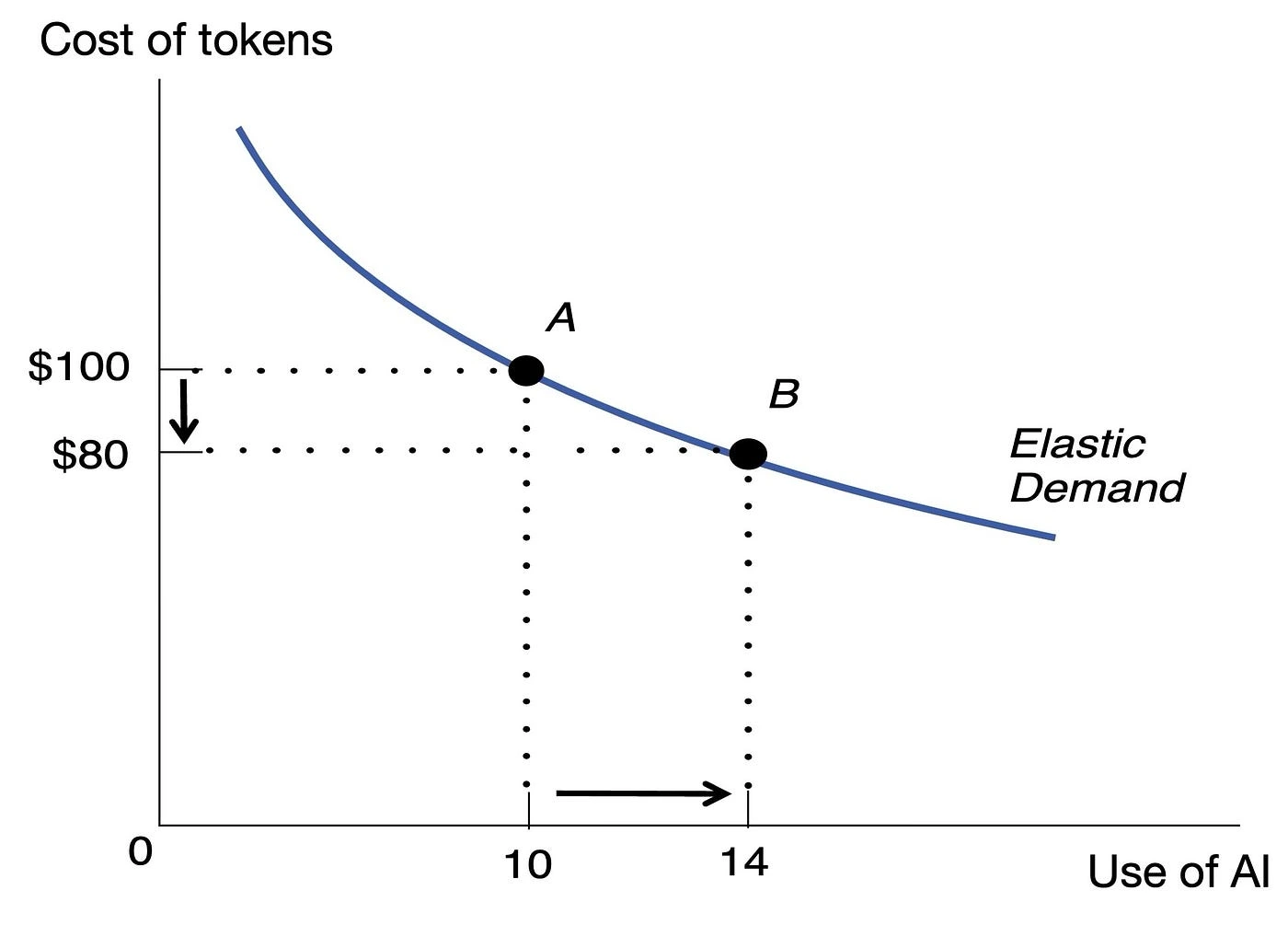
The principle that bears his name states exactly the opposite of what intuition (as we have seen) suggests: when a resource becomes more efficient to use, its overall consumption increases, rather than decreasing.
Because efficiency lowers cost, lower cost widens the range of possible uses, and the range of possible uses ends up consuming more resources than efficiency had saved.
What the market said after DeepSeek
Satya Nadella, CEO of Microsoft, responded to the DeepSeek announcement by writing publicly:
“Jevons paradox strikes again. As AI gets more efficient and accessible, we will see its use skyrocket, turning it into a commodity we just can’t get enough of.”
Several analysts shared this reading, including Hamish Low of Enders Analysis, who called the market’s reaction greatly overdone: being able to use compute far more efficiently is by no means bad for demand for compute.
Subsequent data confirmed this reading.
Over the course of 2025 the cost of achieving a comparable score on a complex AI benchmark collapsed from 4,500 dollars per task to 11.64 dollars. An efficiency gain that, according to common intuition, should reduce overall spending. Instead, AI usage has far outstripped the efficiency gains, exactly as the Jevons paradox would have predicted.
The figure that settles the debate
Had the Jevons paradox remained a purely theoretical argument, it would have stayed confined to social media. Instead, actual spending figures have confirmed it unambiguously.
The five largest cloud and AI companies in the United States — Microsoft, Alphabet, Amazon, Meta and Oracle — have planned combined infrastructure spending of between 660 and 690 billion dollars for 2026. Almost double the 2025 figure. Aggregate spending was around 380 billion in 2025: in eighteen months it has almost doubled, precisely in the period following the DeepSeek shock which, according to the market’s initial intuition, should have reduced it.
The dissenting view: why not everyone agrees
It is also worth including those who disagree with this reading, because the debate is real and unresolved.
Madhavi Venkatesan, who teaches economics at Northeastern University, raised an objection: the Jevons paradox describes rising demand for a resource, but does not guarantee that the rise is sustainable or economically justified.
A more critical analysis published on Investing.com argues that the Jevons paradox, when analysed in its proper historical context, does not support a bullish case for AI-related tech stocks: rather, it would suggest implications far more bearish than the bulls care to admit.
The critical point is this: the Jevons paradox describes what happens when aggregate demand responds to a fall in price. It does not automatically guarantee that future demand will justify the investments made today. There can be greater use of AI and, at the same time, overcapacity in infrastructure built too far ahead of that demand.
The two are not mutually exclusive.
Why this principle matters
The Jevons paradox is not just a curiosity for financial analysts. It describes a mechanism that applies to any technology that reduces the cost of a previously expensive action.
When a company introduces AI tools that reduce the cost of producing content, analysing data and providing customer service, common intuition suggests that overall spending on those activities will fall. The Jevons paradox suggests the opposite: lowering the unit cost tends to increase the total volume of that activity, because it becomes worthwhile to do much more of it.
This has consequences for brand and communications management. If AI makes the cost of producing material collapse, the volume of material each company produces increases. If it increases for everyone at once, the attention market becomes crowded. It is the same mechanism we described in relation to Instagram saturation: more output, less signal per unit of material.
Companies that understand this principle do not respond to falling costs by increasing volume indiscriminately. They respond by using the margin saved to raise the quality and distinctiveness of what they produce, knowing that the market is crowding in exactly the opposite direction.
Jevons today
DeepSeek accelerated the race to invest in AI, applying (knowingly or not) an economic principle borne out by one hundred and sixty years of industrial history.
The Jevons paradox does not guarantee that every current investment in AI infrastructure is rational. The academic dissenters are right to point this out. But it explains why the most obvious intuition (more efficiency equals less spending) is almost always the wrong one when faced with a technology that lowers the cost of something the world still wants, in growing quantities.
Those who run a company in the age of AI should apply the same principle to their own strategy. Efficiency never simply reduces costs. It redefines what becomes possible with the margin it frees up. And that possibility, almost always, ends up being used.
New Connections (FAQ)
If AI lowers the cost of our communications, shouldn’t we simply spend less on everything else?
Only if the goal is to save, not to compete. The Jevons paradox says that the margin freed up by efficiency does not sit idle: it is reinvested in more volume, by your competitors if not by you. If everyone produces more content at lower cost, the attention market becomes crowded for everyone at once. The real choice is not between spending less and spending as before. It is between using that margin to make more noise or to build more quality.
How do you tell a justified AI investment from a bubble, if even the optimists admit that future demand is uncertain?
By looking at whether the investment reduces a cost that the market still wants to pay in growing quantities, or whether it creates capacity awaiting demand that may never materialise. The difference between Nvidia in 2025 and an overbuilt infrastructure is that demand for AI compute has, so far, always exceeded supply. The real risk is not the Jevons paradox itself: it is confusing “aggregate demand will grow” with “every single current investment is correctly sized”.
Our company does not have Microsoft’s or Amazon’s budget. Does this principle make sense for an SME too?
Yes, and it applies more to the scale of content and processes than to the scale of capital. If an AI tool cuts the time needed to produce a market analysis from a week to an hour, the temptation is to produce ten times as many. The Jevons principle suggests that this is exactly what will happen, across the entire market. The question that matters for an SME is not whether to invest in AI, but what to do with the time AI gives back: produce more mediocre output, or use that time to raise the quality of what already works.