



Kantar’s Marketing Trends 2026 highlighted a phenomenon that changes the way brands need to think about their customers.
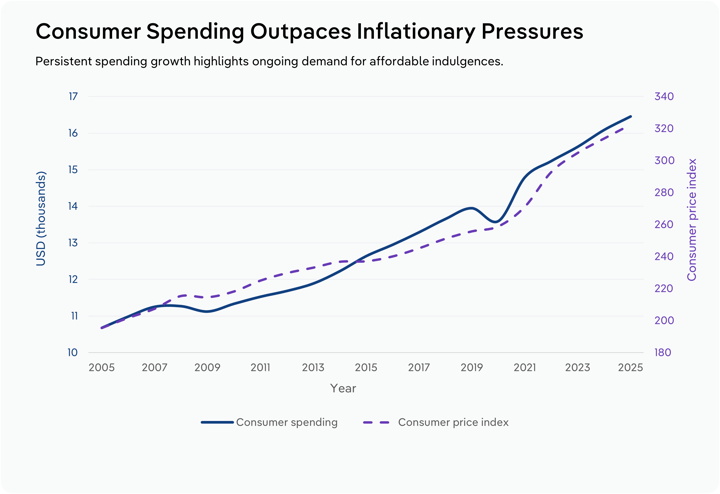
Marriage, parenthood and home ownership are becoming more distant or less desirable each year, and people are responding by shifting their search for control and optimism onto everyday gratifications. Kantar calls it treatonomics: the culture of the small pleasure.
Let’s explore what it involves.
When the big goal disappears, the small pleasure takes its place
Let’s start with the numbers. And this one is certainly the most significant of all.
36% of consumers are willing to take on short-term debt for something they love.
For generations, adult identity was built around a sequence of milestones: the home, marriage, children, stability. Yet now that this sequence has become economically out of reach, the psychological need to have something to celebrate, while still present, has changed. And it has shifted to a smaller scale.
Kantar calls these small milestones “inchstones“: a play on “inch” (the smallest unit of measurement) and “milestone”.
In 2026, people celebrate a minor promotion, a fitness goal, a divorce. What matters is not the size of the milestone but its immediate availability (at least in a world where the big milestones keep drifting further away).
Social commerce fuels this mechanism, with supply and demand having to meet within seconds, delivering instant satisfaction to every small desire.
Treatonomics for brands
Positioning built around major life milestones (the dream home, the perfect wedding, the large family) now speaks to a shrinking audience. Perhaps not for lack of desire, but certainly for lack of access.
This is a crucial insight for brands, which cannot afford to ignore it in their day-to-day operations.
Of course, a brand positioned exclusively on the small, immediate pleasure faces an equally serious problem: substitutability. If the value on offer is only instant gratification, any competitor with an equally quick and equally enjoyable product can replace it without friction.
The future of brand strategy, therefore, lies in taking treatonomics into account without simply riding it as a trend. In other words, learning to build a small pleasure that carries a recognisable identity, not just a fleeting, interchangeable satisfaction.
The difference between a speciality coffee bought for the pleasure of the moment and a speciality coffee bought because that specific brand means something in the buyer’s life is the difference between selling a product and building a brand. Treatonomics makes that difference more urgent: in a market where people buy small pleasures more often, the consistency of those who offer them is (and will increasingly be) the one, single factor that protects brands from the competition.
New Connections (FAQ)
Should a high-end brand, far removed from the idea of an “affordable small pleasure”, be concerned about this trend?
Indirectly, yes. Premium brands, too, sell smaller points of access to their world at certain moments: a capsule collection, a lower-priced limited edition, a lesser experience than the flagship product. Understanding the logic of treatonomics makes it possible to build these smaller points of access so that they strengthen the brand’s identity rather than dilute it. The worst risk is ignoring the phenomenon and letting the most accessible price tier of one’s offering be perceived as a generic product, disconnected from the premium positioning.
How do you tell a small pleasure that builds a brand from one that only builds occasional sales?
The first leaves a recognisable memory even after the purchase: distinctive packaging, a consistent tone of voice, an experience tied to that specific brand that would not be the same with a competitor. The second runs out at the moment of consumption, and the next time the customer seeks instant gratification, they will simply choose the nearest or cheapest option. The operational question is: if we removed our logo, would the customer still know it was our product?
Does this trend risk normalising unhealthy borrowing behaviour among consumers?
It is a legitimate concern, and Kantar records it as a behavioural phenomenon already under way, not as a strategy to be further encouraged. For a brand, the responsible distinction lies in building value around gratifications that customers can genuinely afford on a regular basis, rather than knowingly pushing them towards purchases they cannot sustain. A positioning built on pressure to borrow produces short-term sales and long-term reputational damage once the pattern becomes visible.