



Single-person households are now the fastest-growing household type in the Western world.
So says the US Census Bureau, which in December 2025 published its latest estimate of household composition in the United States.
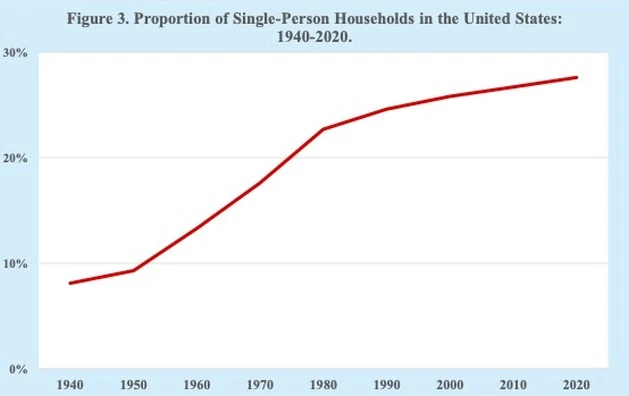
The figures surprise no one. There are 39.7 million single-person households: 29% of all households. In 1975 they were just 20%. Married couples, who accounted for 66% of American households in 1975, have fallen to 47%.
One in two American adults is unmarried. The single-person household is the second most common type of household after couples with children, and the trajectory suggests it will become the first within a decade.
Be careful, however, not to treat it as a purely American phenomenon. It is in fact a transition running through the entire highly urbanised world: even historically prolific countries such as China.
In household terms, the singles market is already larger than that of the traditional nuclear family.
And yet mainstream communication still treats single people as if they were waiting to become something else. In doing so, it misses major opportunities.
Why are there so many single people?
The answer to this question can be neither single nor obvious. Multiple causes have contributed to the phenomenon, often reinforcing one another.
The first is our lifestyle. The median age at first marriage in the United States has risen to 30.8 for men and 28.4 for women: in 1975, the same figure stood at around 23.5 for men and 21 for women. We can read in this postponement a profound transformation of the social fabric. Marriage has shifted from an event marking the start of adult life to a milestone reached after achieving financial stability and a home of one’s own. The period of single adult life has lengthened by almost a decade.
The second reason is, of course, economic. Women make up 58% of all single-person households in the US. Women’s financial independence, measured in employment rates, career progression and personal income, has made marriage less necessary as an economic structure and more akin to an emotional goal. Let us put it plainly, without beating about the bush: if women once often married for financial support, today there is no longer any need. Those who marry do so because they want to. And it is only natural that, when marriage becomes a choice, some of those who would have married for practical reasons no longer do so
The third reason we can point to (though there are many others) is generational. 35% of Gen Z homebuyers are single women. It is the highest figure of any generation. Gen Z is not waiting for a partner to buy a home, travel or build wealth. The very image of independence and self-fulfilment has changed radically. The standard life cycle that brand communication has used as its reference for fifty years has disappeared.
All that remains is a distant memory.
The single-household economy
Watch out, though, for an unexpected variable: (individual) purchasing power.
People who live alone tend to have higher disposable income per capita than those in larger households, because although they do not share fixed costs with a partner, they have fewer expenses (children and so on). Visa has documented that single people spend proportionally more on dining out, travel, technology and services than the average household. They are frequent buyers in high-margin categories.
The paradox of the singles market is that the consumer with the highest per capita disposable income, in the highest value-added categories, is addressed as if they were temporarily waiting to start a family.
Something we now need to get out of our heads.

The market’s response
Some industries adapted earlier than others, following the data rather than the narrative.
The food sector anticipated the trend. Procter & Gamble, for example, launched a version of its toilet roll designed for people living in small spaces with no storage. Arnold Bread, meanwhile, offers ten-slice loaves. Single portions, single-serve formats and packs with no price premium for the smaller size are already a measurable segment of mass retail. Appliance companies such as Bosch have reduced the size of washing machines and fridges to fit the spaces of single-occupant flats.
A consequence, in part, of the heavy property speculation of our times. But also of smaller households with fewer needs.
Yes, because the urban property market has produced the micro-unit: flats under 40 square metres with layouts optimised for one person, with coworking spaces and communal areas replacing private rooms. The solution the system has found, and one that is now rising fast.
The travel sector is the one lagging furthest behind. The single supplement, the charge a solo traveller pays to occupy a double room, is still standard practice at many hotels and on many cruises. It is a levy that explicitly penalises the fastest-growing demographic segment. Some operators have scrapped it. Most persist in this mistake.
The reference customer problem
The reason most brands have not yet addressed this market is that the reference customer embedded in the decision-making processes of almost every organisation is still the nuclear family.
What is the reference customer? An operational abstraction that steers decisions on product, packaging, pricing and communication.
Who is the reference customer? Even today, despite social change, a 35-year-old adult with a partner and children.
The single buyer is seen not as a core customer but as a special case. The product is adapted to their situation, but the communication reaches them as an exception within a system designed for someone else.
This is where the mistake comes in.
A brand that speaks to single people as if they were waiting to stop being single is misreading the single consumer’s identity as a transitional phase. For a growing and measurable share of the population, however, being single is now a structural choice, and brands should learn to respond to it with the same seriousness they bring to any other customer on whom they have built their offering.
Capturing the Single Economy means redesigning the reference customer: and with it, revisiting product formats, pricing structure, tone of communication and visual register.
In short, stop treating the cohabiting partner as the default, and living alone as an absence.
New Connections (FAQ)
Does the single market apply only to young people, or does it also concern older age segments?
It concerns both, for different reasons. Young adults live alone by choice or out of economic constraint, while waiting for marriage or in place of it. The over-65s live alone because they have outlived their spouse: this is the age group in which single-person households are growing fastest. The two populations have distinct product needs but share the same invisibility in mainstream communication. For a brand, the relevant distinction is understanding which of the two is its reference customer within the single segment, and building a specific offer for that group.
Does capturing the single market require different products, or is different communication enough?
It almost always requires both, but the sequence matters. Communication aimed at single people without adapting the product has a paradoxical effect: customers feel recognised in their identity, then frustrated by the experience. The four-portion pack, the per-couple price, the single supplement on holidays do not disappear with a more inclusive advert. Genuinely capturing the market starts with product and pricing, and only then is reflected in communication.
Does a brand that mainly targets families risk anything by not capturing the single market?
It depends on how quickly its customer base is changing in demographic composition. A brand whose core customers already include 30–40% single-person households, and which does not know it or does not address it, is already ceding share to those who do. The risk is not losing the family customer: it is becoming irrelevant to the growing segment of the market, which in the meantime is building loyalty towards brands that recognise single people as primary customers rather than as an exception.