




Capex, whose financial meaning and correct Italian translation are essential to understand, or Capital Expenditure, according to its primary accounting definition, is the expenditure an organisation incurs to acquire, improve or extend the useful life of an asset intended to generate value for more than one financial year, estimated using a specific accounting formula. Unlike operating costs, it is not fully expensed in the year it is incurred: it is capitalised on the balance sheet as a fixed asset and spread across the income statement through depreciation over the asset’s entire useful life.
Opex, or Operating Expenditure, is the set of current expenses needed to keep the organisation running day to day: salaries, rent, utilities, raw materials, service fees. It is charged in full to the income statement in the relevant financial year and directly reduces EBITDA. For any analyst, grasping the real difference between capex and opex is a key step in comparing the Capex line with the corresponding Opex component.
So far, the distinction has held steady for over a century. What has changed over the past two years is what ends up on each side. A figure that once meant concrete and machinery now also means tokens, licences and computing infrastructure, and the line separating investment from running cost has become a governance decision before it is an accounting one.
The same term.
An entirely different line item.
Understanding what Capex is, how it differs from Opex and why artificial intelligence has made this distinction more complicated than ever is now a skill required of anyone who has to read a set of accounts, assess an investment or decide how to allocate resources within an organisation.

Capex meaning: what capital expenditure is
Capex is short for Capital Expenditure, in Italian spesa in conto capitale.
It refers to the investments an organisation makes to acquire, maintain or upgrade physical or intangible assets with a useful life of several years. Machinery, property, technology infrastructure, patents, long-term licences.
Yet what defines Capex is not so much the amount spent as its accounting treatment.
Capital expenditure is not charged to the income statement in the year it is incurred. It is capitalised as an asset on the balance sheet and depreciated over several financial years, according to the asset’s estimated useful life.
In other words, a machine that costs one million euros and has a useful life of ten years generates a depreciation charge of one hundred thousand euros a year, not one million.
Capex is therefore an investment that turns into a cost over time.
An organisation with high Capex is investing in its future production capacity. The spending hits cash flow immediately, but affects the income statement gradually, through depreciation, over the entire useful life of the asset.
Investors, analysts and boards look at Capex to understand an organisation’s trajectory. Rising Capex signals expanding capacity. Falling Capex may signal financial discipline, or a risk of underinvestment that will show up in future results.
The number alone is not enough. It must be read alongside the strategy behind it.
Capex and Opex: what is the difference?
The difference between Capex and Opex lies mainly in the time horizon of the expenditure and its accounting treatment. Capex funds assets and investments intended to generate value over several financial years and is capitalised and depreciated over time; Opex, by contrast, covers the costs needed for day-to-day operations, such as salaries, rent, utilities and service fees, which are charged in full to the income statement for the year. For the classification of operating expenditure and its effects on margins, see Opex: meaning, difference from Capex and examples.
| Capex | Opex |
| Investment in assets with a multi-year useful life | Current operating expenditure |
| Capitalised on the balance sheet and depreciated over time | Expensed to the income statement in the current financial year |
| Has an immediate impact on cash flow | Hits the income statement immediately |
| Requires structured approvals and multi-year planning | Managed through shorter operating budget cycles |
| Examples: machinery, property, proprietary infrastructure | Examples: salaries, rent, software subscriptions, maintenance |
| Signals investment in future productive capacity | Indicates the organisation’s current running costs |
For decades this distinction was applied with relative clarity. The arrival of artificial intelligence as operational infrastructure has made the boundary between the two categories significantly harder to draw.
Capex and artificial intelligence: the new expenditure to watch
For decades, Capex meant machinery, property, physical infrastructure. Things you can see, touch and depreciate on the balance sheet using established criteria. Artificial intelligence has changed that logic.
The most significant costs for organisations adopting artificial intelligence models today are of a different nature. Subscriptions to language models. Tokens consumed on a usage basis. Software licences priced by number of users or volume of requests. Computing costs on cloud infrastructure, often varying with load. Working hours devoted to implementation, integration and the ongoing maintenance of systems.
Costs that build up every month, often spread across different teams.
This is the first break with traditional Capex. A machine is bought once and depreciated for years. A subscription to a language model is paid every month, for an amount that varies with usage, and often does not pass through a single business function. Marketing, product, customer service and IT can each take out separate licences, each below the threshold that would require centralised approval.
The result is expenditure that, from an accounting standpoint, behaves more like Opex than Capex, but from a strategic standpoint has a structural impact comparable to an investment in production capacity. An organisation that adopts artificial intelligence systematically is building new operational capability. It simply does so through scattered monthly spending rather than through a single, traceable investment.
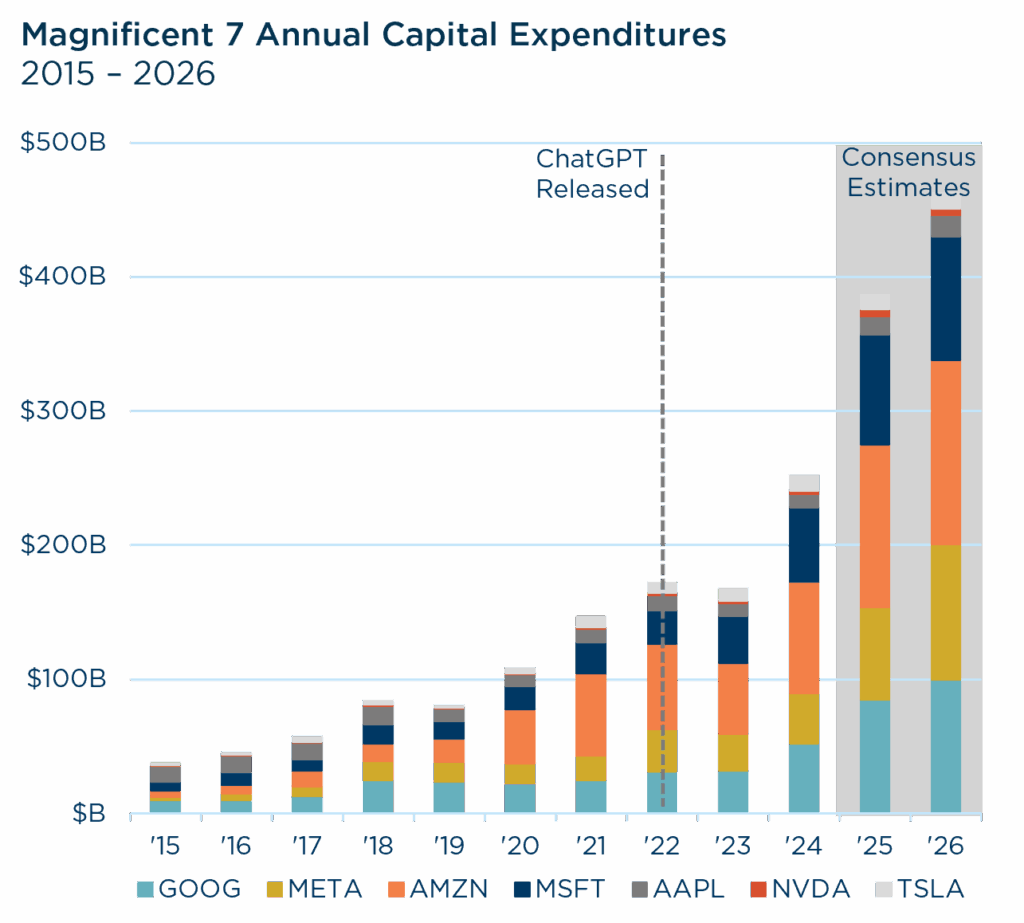
The problem with aggregate measurement
In Italy there is no aggregate, public measure of industrial Capex allocated to artificial intelligence. Large organisations are not required to report it separately in their financial statements. Small and medium-sized enterprises, in most cases, do not even track it internally in a structured way.
This creates an information gap on two distinct levels. The first is macroeconomic: without an aggregate measure, it is difficult to assess how much Italy’s productive system is actually investing in the adoption of artificial intelligence, and with what intensity compared with other countries. The second level is internal to each organisation: without precise tracking of spending spread across different teams, it becomes difficult to calculate accurately how much is being spent and what return that spending is actually producing.
Nobody knows how much is being spent. As a result, nobody knows what it actually returns.
This opacity is not a technical detail for finance departments alone. Resource allocation decisions, assessments of the return on artificial intelligence investment and future budget planning depend on figures that, in many organisations, simply do not exist in aggregate form.
How organisations are starting to adapt
Some emerging practices are beginning to fill this gap, even in the absence of a shared national accounting standard.
One initial approach is to explicitly separate, within internal management control systems, recurring AI-related spending from other general Opex items, even when the formal accounting treatment remains the same. This provides at least internal visibility of total spending, even though it does not change the external presentation in the financial statements.
A second approach involves the selective capitalisation of certain components. When the development or customisation of an artificial intelligence system produces an asset with multi-year use, some organisations are beginning to consider capitalising that specific component, separating it from current consumption costs such as tokens or usage-based licences.
A third approach, organisational rather than accounting-based, consists of centralising the monitoring of artificial intelligence spending under a single governance function, even when individual subscriptions are still taken out by different teams. This does not change the accounting nature of the expenditure, but it restores overall visibility to those who must decide how to allocate resources.
What really matters in this distinction
The distinction between Capex and Opex has always been a matter of visibility over investment decisions. Clearly tracked Capex allows those who govern an organisation to know how much they are investing, in what, and over what return horizon.
Artificial intelligence has introduced a category of expenditure that does not follow the established rules. It accumulates as Opex, yet produces structural effects comparable to a long-term investment. Until this category is tracked with the same discipline historically applied to traditional Capex, organisations will keep investing in capabilities they cannot measure with precision.
Governing the adoption of artificial intelligence requires, first and foremost, clarity on this number. Without that clarity, every decision on how much to invest, where to invest and when to halt an investment that is not generating a return is taken without the data needed to take it well.
New Connections (FAQ)
What is Capex?
Capex, or Capital Expenditure, is the spending a company incurs to acquire, improve or extend the useful life of assets intended to generate value for more than one financial year: plant, machinery, property, vehicles, proprietary software, patents. It is capitalised on the balance sheet as fixed assets and spread across the income statement through depreciation.
What is the difference between Capex and Opex?
The difference lies in accounting treatment and time horizon. Capex is investment in durable assets, capitalised on the balance sheet and depreciated over several years. Opex is current spending, charged in full to the income statement in the year it is incurred. A machine is Capex; the energy that powers it is Opex.
Where does Capex appear in the financial statements?
In the cash flow statement, under cash flows from investing activities. The figure should be cross-checked against the balance sheet, where tangible and intangible fixed assets appear, to distinguish actual investment from depreciation charges for previous periods.
Are Capex and depreciation the same thing?
No. Capex is the cash outlay at the moment the investment is made. Depreciation is the accounting charge that spreads that cost over subsequent financial years. A company can therefore have high Capex in one year and an income statement impact spread over ten.
Is a software subscription Capex or Opex?
A subscription is Opex: it is a recurring fee consumed within the financial year. It becomes Capex only if the organisation develops or acquires proprietary software, which is then recorded under intangible assets. This is the distinction that made the move to the cloud a choice of financial structure, not merely of technology.
How is spending on artificial intelligence classified?
It depends on the nature of the arrangement. Access to models via API, with variable pay-per-use costs, is Opex. Purchasing or building proprietary computing infrastructure is Capex. Many organisations now find themselves with hybrid items, where part of the investment can be capitalised and part cannot, and classification requires an explicit decision by the finance function.
Is high Capex a positive or a negative signal?
On its own it is neither. Rising Capex signals expanding production capacity, but it absorbs cash and produces no immediate benefit. Falling Capex can signal financial discipline or underinvestment, with effects that emerge in subsequent financial years. The figure must be read alongside the strategy behind it.
Does Capex affect EBITDA?
No, not directly. EBITDA is calculated before depreciation, amortisation and impairment, so Capex does not reduce it in the year it is incurred. This is why companies with the same EBITDA but very different investment profiles should not be valued at the same multiple.
BLISS®
© 2026. ALL RIGHTS RESERVED