


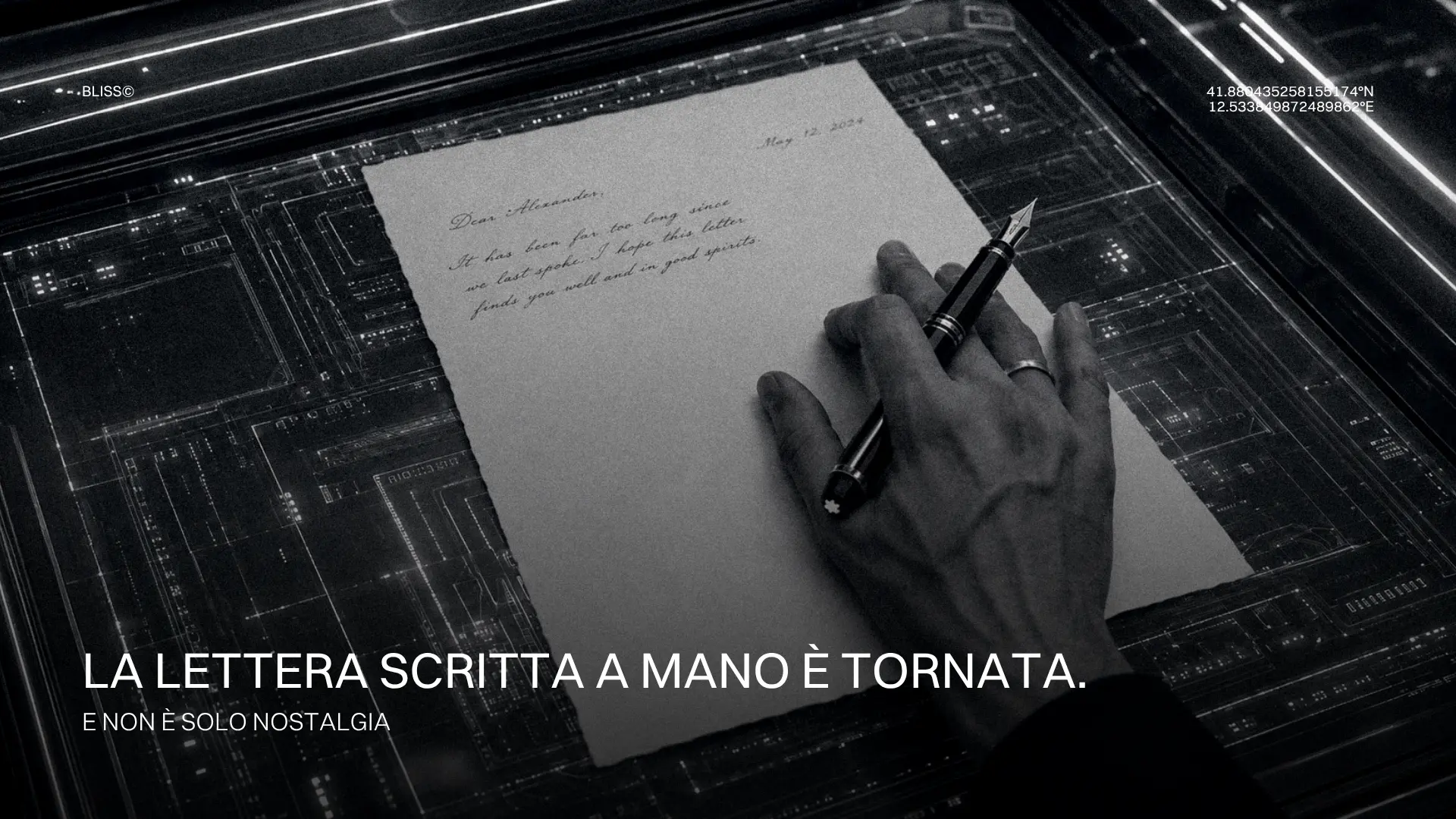
Receiving an instant message costs the sender nothing.
Zero seconds of reflection. Zero euros of paper. Zero minutes of writing.
Receiving a handwritten letter, on the other hand, implies real time spent: and with that time, attention, physical effort, commitment.
This cost asymmetry has never been as visible as it is now, at a time when digital production has become free and unlimited.
This is also why the handwritten letter is back in fashion. Searches for “cute stamps” have risen by 105%, those for “snail mail gifts” by 110%. Gen Z and Millennials are rediscovering physical post at a time when receiving something that demands time and attention is rarer than any digital gift.
Digital has not failed: precisely because it has won, something different is needed.
The neuroscience of the physical gesture
Modern research on episodic memory has documented how physical objects produce more vivid and lasting memories than their digital equivalents. Holding a letter, feeling its weight, recognising the other person’s handwriting: these are all multisensory stimuli that activate different memory circuits from reading on a screen.
In short, a physical letter carries more than the message: it carries physical proof that someone chose to devote time to it.
So let no one say that Gen Z writing letters by hand are aping their grandparents. What is under way is an optimisation for rarity: in an ecosystem where everything arrives instantly, whatever takes time gains value. It is the same logic as vinyl, photographic film and the printed book.
The handwritten letter is not merely a vintage object: seeing it as such would be limiting. It is, in reality, a high-attention medium in a communications market saturated with low intensity.
What changes for brands that manage physical touchpoints
The same logic that makes a handwritten letter precious applies to any physical touchpoint a brand chooses to invest in. In a predominantly digital communications ecosystem, every physical object that reaches a customer’s home carries an implicit message: this brand chose to use real paper, print, weight and volume to tell you something.
It was not a given, but it was done. And that has value.
Packaging, a handwritten card included in a shipment, a personal note attached to a premium product: all these elements work on the same principle. They require invested attention and, for that very reason, they generate it.
Brands that have grasped this dynamic are not going “against the tide” of digitalisation. They are using digitalisation as a context that increases the value of the physical. The more automated digital becomes, the more distinctive whatever requires a human being becomes.
So, welcome back, pen and paper.
New Connections (FAQ)
Does the handwritten letter work as a touchpoint for any type of brand, or only in certain sectors?
It works wherever there is an individual relationship between brand and customer that is worth strengthening. In luxury, premium, craftsmanship, direct-to-consumer: any context in which the customer is treated as a specific person rather than an order number. It works less well where volumes are so high that any degree of real personalisation becomes impossible. The principle is not the letter itself: it is the investment of attention it signals. Any physical object that requires human care produces the same effect, provided it is authentic.
How do you scale a personalised physical touchpoint without losing authenticity?
It does not scale completely, and that is the right answer. Scarcity of attention is the source of the value. A brand that sends handwritten cards to a hundred selected customers produces a very different effect from one that prints cards in calligraphic fonts across fifteen thousand shipments. The second is cheaper and delivers worse results, because it is recognisable as automation imitating a human gesture. The right answer is to choose when and for whom: the most loyal customers, the most relevant moments, the occasions on which the physical gesture has the greatest impact.
When does it make sense to include a handwritten card in the customer experience?
The gesture works best at moments when the brand wants to recognise a specific person: a first significant purchase, an anniversary, entry into an exclusive programme, the resolution of a problem or a thank-you to a particularly loyal customer. Using it indiscriminately in every shipment, by contrast, risks turning it into a procedure and diminishing its perceived value. The decision should start from mapping the touchpoints and identifying the moments of greatest emotional intensity. Bliss can integrate letters, packaging, invitations and other physical elements into the customer experience, defining recipients, occasions and execution criteria consistent with the brand’s positioning. The value does not come from the paper itself, but from the gesture’s ability to make genuine attention visible.
BLISS®
© 2026. ALL RIGHTS RESERVED