


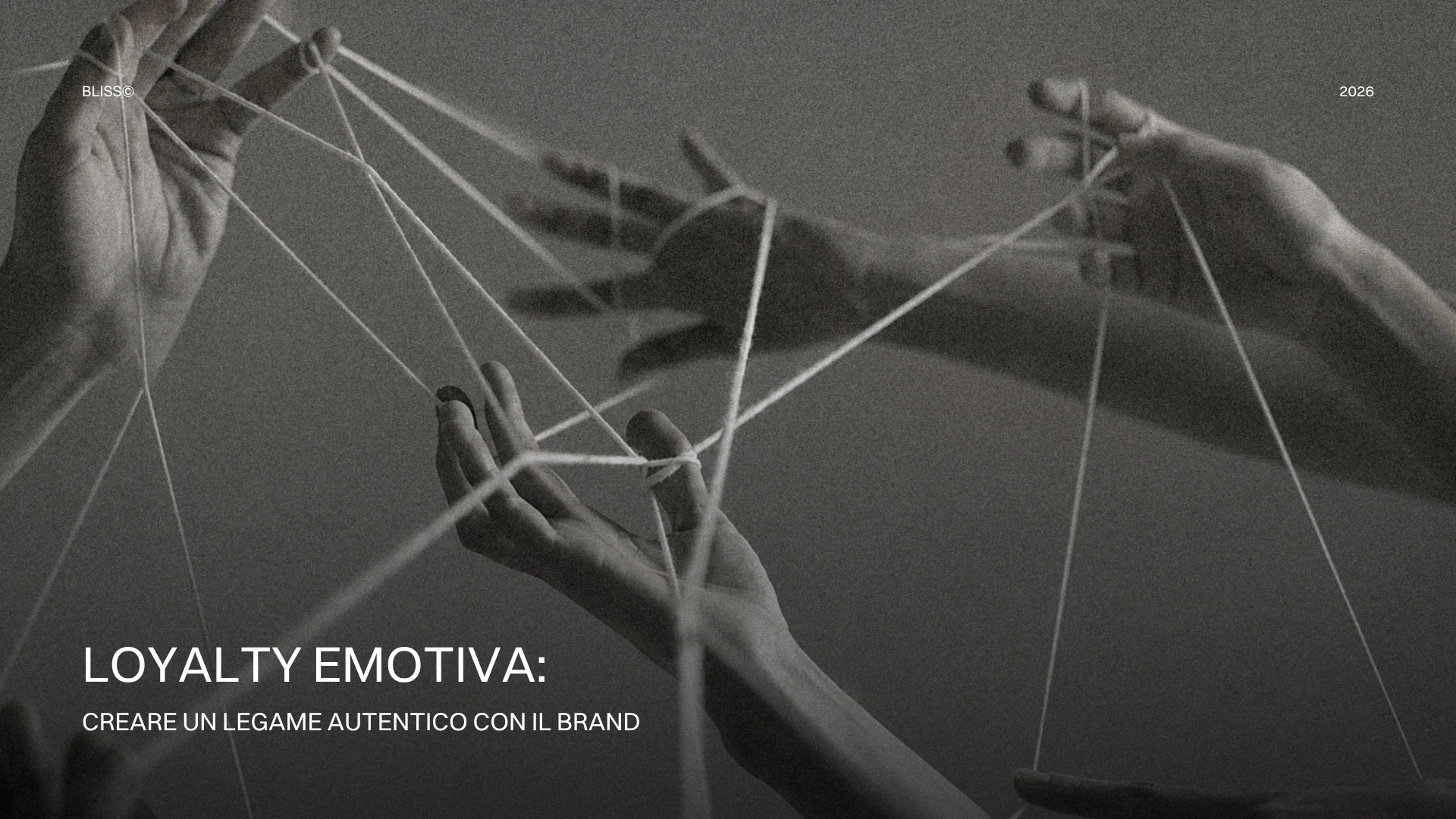
Within loyalty, emotional loyalty is the loyalty that arises when customers do not merely buy again but attribute trust, personal meaning and identity value to the brand. It does not depend solely on price, convenience or rewards: it withstands alternatives because the relationship is perceived as relevant and hard to replace.
Emotional loyalty and behavioural loyalty are not the same thing
When customers buy again, it can depend on many factors: habit, proximity, lack of alternatives. Emotional loyalty adds an attitudinal component: the customer wants to maintain the relationship.
Thomson, MacInnis and Park measured brand attachment through affection, passion and connection, distinguishing it from satisfaction (Journal of Consumer Psychology). Chaudhuri and Holbrook, across 107 brands, linked trust and affective response to purchase and attitudinal loyalty (Journal of Marketing).
| Type of loyalty | Why the customer stays | Observable signal | Fragility |
| Transactional | Earns points or discounts | Responds to promotions | Migrates to the best incentive |
| Behavioural | Has formed a habit | Repurchases regularly | May be mere inertia |
| Emotional | Trusts and identifies with it | Recommends and takes part | Collapses if the promise is broken |
The true opposite of emotional loyalty, then, is not dissatisfaction but substitutability: the perception that a competitor could offer the same thing without any relational or identity loss.
How a genuine bond between customer and brand is formed
Emotion becomes loyalty when customers find consistent proof of what the brand claims. Four mechanisms turn the promise into a relationship: (i) consistency, (ii) recognition, (iii) participation and (iv) repair.
Turning the promise into a verifiable experience
Positioning establishes what the brand wants to stand for; experience proves whether the promise is credible. A brand that communicates simplicity and then imposes complex procedures creates a rift. One that promises care but responds with standardised messages reduces the relationship to a process.
Consistency requires the website, product, sales and customer service to produce the same interpretation of the brand. This is the principle of brand governance: translating identity into operational criteria, so that trust does not depend on any single department.
Recognising the customer without turning data into surveillance
Personalisation creates value when it reduces effort, anticipates a need or restores continuity. It becomes intrusive when it uses unnecessary data or personalises purely to sell. Salesforce finds that the share of customers with an emotional bond to brands fell from 62% in 2022 to 54% (Salesforce).
Every piece of data requested should therefore deliver a recognisable benefit. Stated preferences and interaction history can improve the experience; opaque profiling and over-frequent communications erode trust.
Giving the customer a role
Loyalty grows stronger when people can choose, contribute or leave their mark. Reviews that are listened to, beta tests and co-creation increase psychological ownership. The IKEA Effect explains why we place more value on what we help to build.
Another example is LEGO Ideas, which lets fans submit concepts and turns some of them into official sets, with recognition for the creator (LEGO Ideas). Customers thus contribute to the brand’s story.
Handling mistakes as a moment of truth
Trust does not require perfection, but predictability: customers need to know how the brand will react when something goes wrong. PwC found that 32% of consumers could abandon even a brand they love after a single bad experience (PwC).
Good recovery acknowledges the problem, takes responsibility, offers a proportionate solution and checks the outcome. Automating the ticket can speed up the process; automating empathy and responsibility can make the person feel like a case to be cleared.
Designing emotional loyalty along the customer journey
Linking each stage to an emotional proof point and a consistent metric is essential to designing emotional loyalty that lasts. Here is how:
| Stage | Emotional proof point | Concrete action | Signal |
| Discovery | “This brand understands me” | Content grounded in real tensions | Brand searches, sentiment |
| Purchase | “I can trust them” | Clarity on price and terms | Drop-off, conversion |
| Use | “The promise was true” | Onboarding and contextual support | Activation, CES, returns |
| Relationship | “They recognise me” | Relevant benefits and messages | Opt-in, share of wallet |
| Critical issues | “They take responsibility” | Rapid recovery | Post-complaint churn |
| Advocacy | “This brand is about me too” | Community and co-creation | NPS, referrals, reviews |
Caution: the useful emotion is not always enthusiasm. At purchase it may be relief; in customer service, feeling heard; in the community, belonging. Constantly chasing spectacle produces peaks, not necessarily a relationship.
From emotion to brand memory
Customers do not retain every detail: they reconstruct their judgement through salient moments and meanings already associated with the brand. That is why experience and memory are not the same thing. Optimising a funnel does not guarantee that a distinctive trace remains.
Patagonia, with Worn Wear, extends the relationship beyond the sale through repair and reuse (Patagonia Worn Wear). The stated value thus becomes a verifiable experience: memory arises from the opportunity to experience the principle first-hand.
How to measure emotional loyalty
Attachment should be measured by combining what people say, what they do and how well the relationship withstands competitive pressure. Park and colleagues showed that brand attachment adds predictive power beyond attitude strength alone, including for demanding behaviours and share of purchases (Journal of Marketing).
A useful system integrates three levels:
- Attitudinal: trust, identification, connection, irreplaceability;
- Behavioural: retention, frequency, share of wallet, voluntary participation;
- Relational: NPS, unprompted reviews, referrals and response after a service failure.
NPS measures the propensity to recommend, but it should not be read in isolation. An incentivised promoter is not the same as an emotionally engaged customer; a silent customer may show high retention without identifying with the brand. The real picture comes from cross-referencing surveys, CRM, customer care, social listening and interviews.
The mistakes that make the relationship feel artificial
The first mistake is confusing authenticity with informality: using the customer’s name does not create closeness if the experience remains impersonal. The second is declaring values that cannot be verified; the third, rewarding spend alone.
Then there is a deeper mistake: designing loyalty within marketing alone. The bond is often built or destroyed by logistics, product, administration and customer care. Emotional loyalty is not a campaign but the cumulative effect of a coherent organisation.
New Connections (FAQ)
What is the difference between emotional branding and emotional loyalty?
Emotional branding uses narratives, sensory codes and meanings to generate an affective response. Emotional loyalty emerges when that response is confirmed by consistent experiences. A campaign can move people without producing loyalty; loyalty requires time, trust and repeated proof.
How do you build an emotional loyalty strategy that involves the whole company?
Emotional loyalty requires consistency between what the brand promises and what the customer experiences at the different moments of the relationship. The strategy must therefore involve communication, product, sales, customer service, logistics and complaints handling, assigning each function behaviours, responsibilities and indicators consistent with the positioning.
Bliss works on this alignment through Brand Governance, translating the brand’s identity into criteria that can be applied along the customer journey. The aim is to ensure that recognition, personalisation and error handling do not depend on isolated initiatives, but become a stable part of the experience offered to the customer.
Does emotional loyalty work in B2B too?
In B2B it emerges through trust in the account contact, risk reduction, continuity and the internal reputation of whoever selects the supplier. It arises when the brand protects the client’s decision, keeps its promises and makes the choice easy to justify to stakeholders.
BLISS®
© 2026. ALL RIGHTS RESERVED