




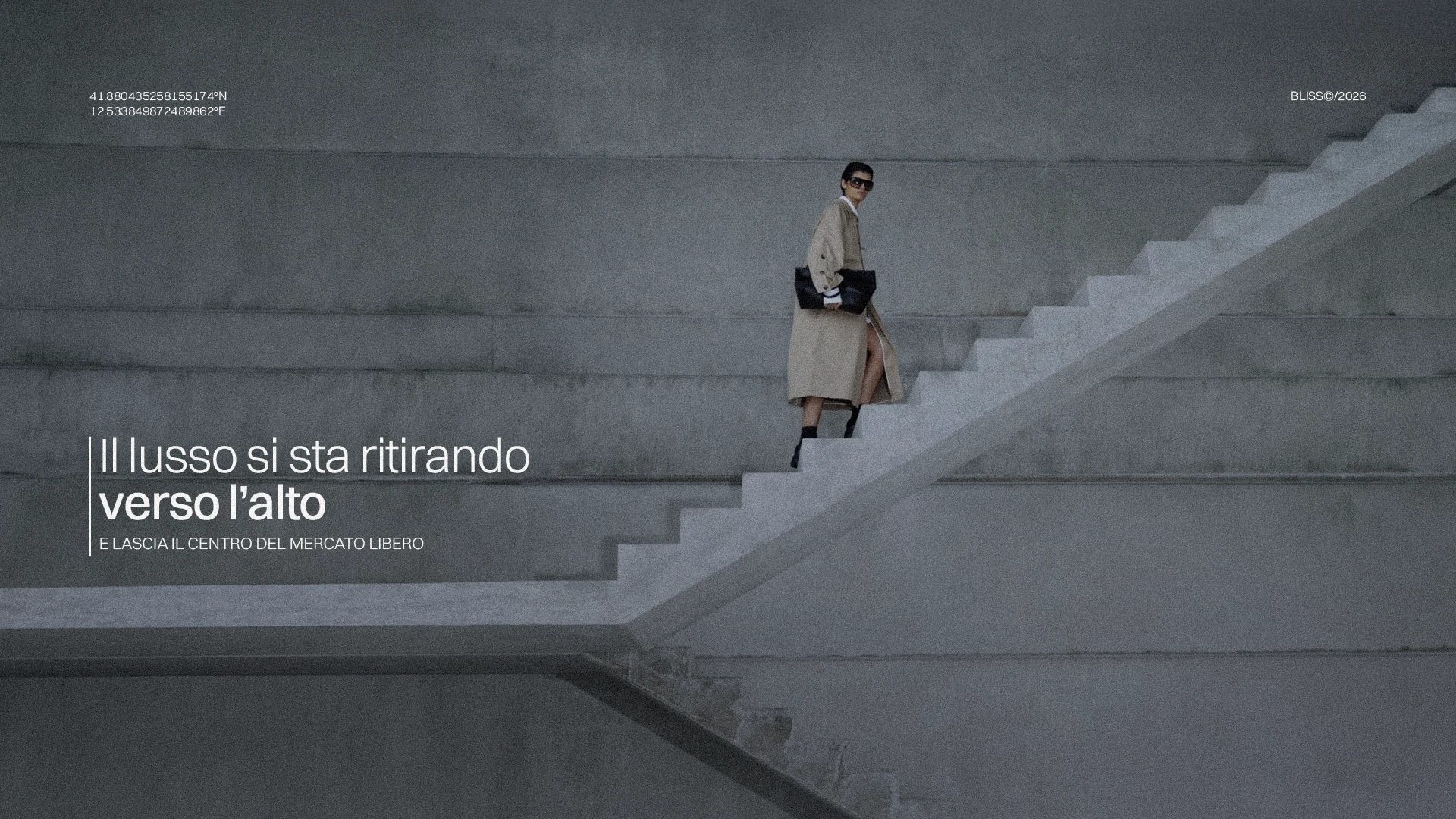
The BoF-McKinsey State of Fashion 2026 has just recently described a trend affecting the entire fashion industry.
Brands, it seems, are moving upmarket.
Between 2023 and 2025, value brands such as Bershka and H&M reduced the share of stock held in their lower price tiers. They did so both to protect themselves from competition from Shein and Temu (which cannot be beaten on affordability) and to capture the customers that traditional luxury, with its ever-rising prices, has now let slip away.
And so what has emerged is, we might almost say, a mass migration of fashion brands, all striving to move upmarket.
In this article we set out the various reasons for this process and its possible consequences.
Polarised numbers
According to the State of Fashion 2026 report, Inditex has unseated LVMH as the world’s most profitable fashion group.
H&M generates more revenue than Louis Vuitton and Dior combined. Fast Retailing (Uniqlo’s parent company) reaches 19 billion dollars in revenue, while Kering stops at 17.
At the other end, Bain reports a contraction in the active base of personal luxury goods consumers: around 330 million in 2025, down from 350 million in 2024, and 70 million fewer than at the 2022 peak.
Based on these figures, McKinsey observes growing polarisation in fashion consumption.
On one side are high-spending consumers who continue to generate value. On the other, the more aspirational audience is cutting back on purchases.
The result is a squeeze on the middle ground: fast fashion is moving up, absolute luxury is pulling further away at the top, and the market segment that sat between the two is shrinking from both sides at once.
Fashion as we had always known it simply no longer exists.
How brands are moving
According to BoF, the elevation strategy adopted by the most astute brands rests on three pillars: (i) price, (ii) product and (iii) the purchasing experience.
Zara was among the first to experiment with so-called affordable aspiration: accessible products with a higher perceived quality than its historical offer. COS, the H&M group label, works explicitly on the balance between sophisticated design and moderate pricing, seeking to attract both those looking for quality and those looking for value.
At the opposite end, luxury labels historically positioned at the top are expanding their offer in categories such as outerwear and leather goods, where high-spending customers still show a significant propensity to invest. This is no accident: the senior executives interviewed for the report expect further price rises in 2026, driven in part by US customs policy and international tensions.
All this will push high-end brands even further to concentrate their offer on more defensible categories.
And what about those left in the middle?
Failing to choose your positioning today (in fashion, of course, but in other sectors too) means losing ground on both fronts.
Downwards, in fact, you lose the most price-sensitive customers, drawn by the affordability of Shein and Temu or by the rising perceived quality of the value brands that are moving up. Upwards, you lose customers with larger budgets, who prefer to spend slightly more on a positioning perceived as more symbolic and more defensible over time.
In short, as always, the problem is not price. If anything, it is identity.
A mid-market brand that fails to communicate clearly why a customer should choose it, rather than the cheaper option or the more prestigious one, becomes replaceable in both directions. Meanwhile, the middle ground shrinks further every quarter.
Three recommendations for those caught in the middle
The first step is not to pursue elevation by imitation, copying competitors’ moves without a positioning logic of your own.
It is better, rather, to define which variable (price, product or experience) genuinely represents the competitive advantage worth investing in. Even at the cost of being weaker on the other two. The brands polarising successfully do not excel at everything: they choose where to win and govern that choice consistently.
Finally, the most important thing to do is stop treating price as the only positioning lever. Price signals a market position, yes, but it is the narrative that makes that position credible and defensible.
A brand can raise its prices by 15% in a single quarter. Building the credibility that justifies that price, however, takes years of consistency.
New Connections (FAQ)
Our company operates in the mid-market. Do we have to choose between moving upmarket and staying where we are?
Standing still in the mid-market, without a clear positioning rationale to justify it, is the riskiest of the three available choices. The other two, elevating deliberately or forcefully defending a mid-tier but well-argued value positioning, both require an explicit decision on what makes the brand the one chosen over the alternatives above and below it. The mid-market can still work, but only if those who occupy it know exactly why the customer should stay, and communicate it as clearly as the brands that are moving.
Is raising prices always the right move to protect against competition from Shein and Temu?
No, not unless it comes with a real change in perceived value. Raising prices without changing the product, the experience or the narrative only signals that the brand costs more, not that it is worth more. The successful cases of brand elevation documented in the BoF report always work on several levers at once: perceived product quality, purchase experience and communication of the positioning. Price alone, without these other components, risks leaving the brand exposed to direct comparison with the value segment, which, paradoxically, is improving its own perceived quality over exactly the same period.
How long does a brand elevation strategy take to deliver measurable results?
The cases analysed in the BoF report point to a horizon of several quarters, not weeks. A shift in perception requires the public to verify, through repeated experience, that the new positioning is backed by concrete facts: product quality, consistent communication, the purchasing experience. An elevation that is announced but not backed by these concrete elements risks being perceived as opportunistic, and that perception is harder to correct than it would have been to build it properly from the outset.