


We spend more time choosing what to watch than actually watching it.
The feeling is real and it has a precise name: scarcity of novelty, in an ecosystem built on abundance. Netflix, Prime Video and Disney+ now offer thousands of titles, and yet most of them feel as if we have already seen them.
Perhaps because, in some form, it is.
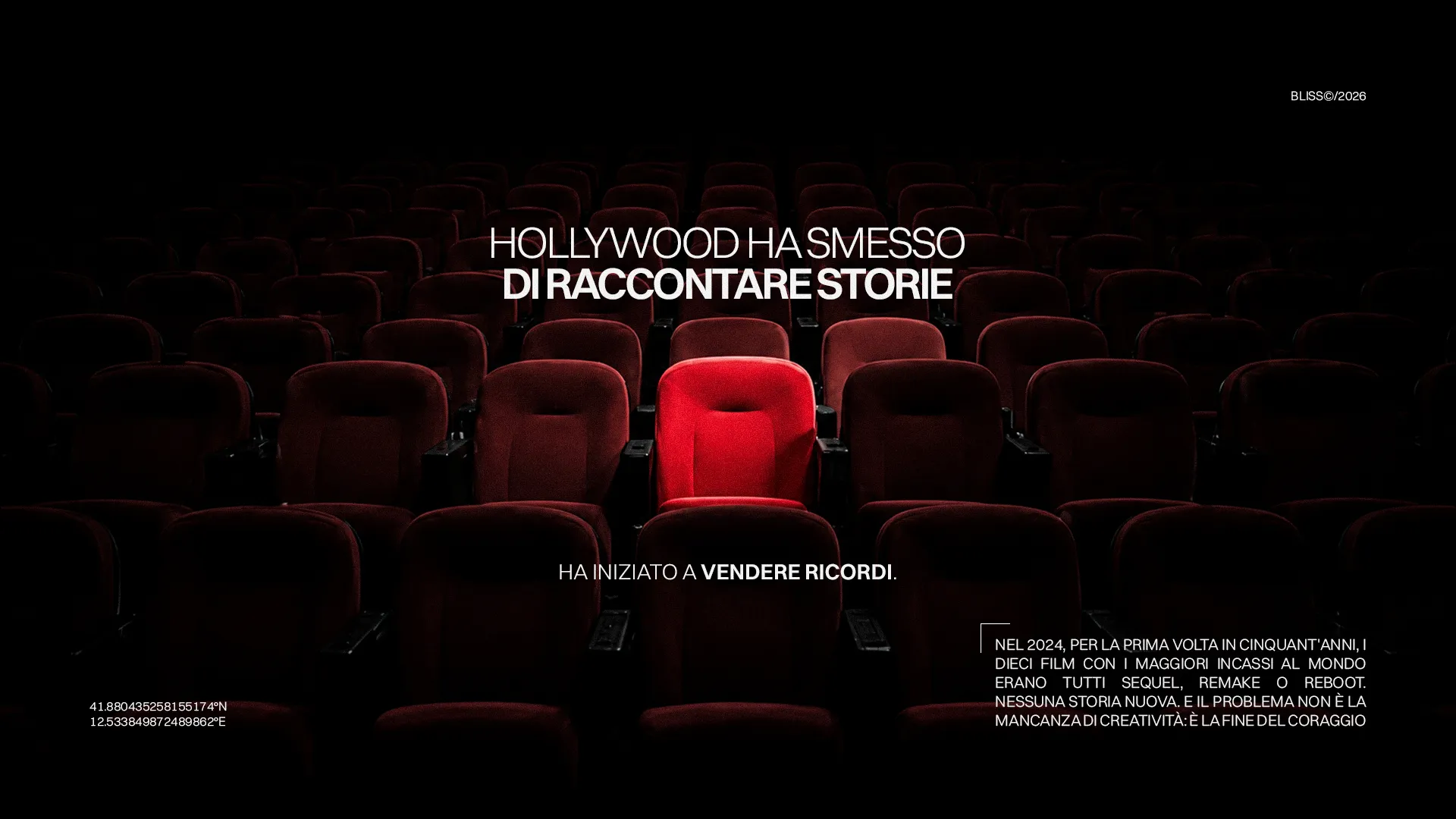
In 2024, for the first time in fifty years, the ten highest-grossing films of the year were all non-original: Inside Out 2, Deadpool & Wolverine, Despicable Me 4, Dune: Part Two. Taken together, we are talking about roughly seven billion six hundred million dollars.
Seven point six billion dollars generated by stories that already existed. By characters already introduced, worlds already built, emotions already felt. The system has found its formula: take something that worked, make another one, and then another, until audiences stop paying.
The point is that audiences have started to stop paying: and the industry does not yet know how to respond.
How we got here, and why it was inevitable
The logic that produced this landscape is understandable. It is pure economic rationality applied to a system where budgets have become astronomical and the margin for error has shrunk to zero.
Hollywood has become an oligopoly dominated by a handful of extremely powerful players, and none of them wants to risk their own capital at a time when a contracting economy makes loans hard to obtain. Today the film industry thinks like an investment fund: it diversifies, but covers its losses with safe titles.
Every film tied to an existing franchise carries a guarantee that an original film cannot offer: a pre-existing audience.
Those who saw the first film are statistically more likely to go and see the second. Marketing becomes simpler because it works on recognition that has already been built. Investors sleep better because the risk is measured.
Between 50% and 70% of the six major studios’ films for 2025 are tied to existing IP. The nostalgia factor drives people to spend more than a product’s real value, which partly explains the rise at the box office.
Nostalgia is a drug with a precise neurological mechanism. It activates the brain’s reward system before the film has even begun, because the brain anticipates the pleasure of rediscovering something familiar. The majors know this. They exploit it systematically. And for a while, it worked.

The moment the formula broke down
The problem is that the formula began to deliver diminishing returns at the very moment everyone started applying it in the same way.
Many industry insiders have called 2025 the year of “Survive ’til ’25”, an expression coined after the union strikes that paralysed Hollywood in 2023 and forced numerous films to be postponed. Expectations were high, but the results proved largely disappointing. The failures outnumbered the successes.
No 2025 release has replicated the phenomenon of Inside Out 2 (1.69 billion in 2024), Barbie (1.44 billion in 2023) or Top Gun: Maverick (1.49 billion in 2022). Thunderbolts stalled at 382 million and The Fantastic Four at 471 million, far below Marvel standards. Mission: Impossible – The Final Reckoning grossed 597 million on a 400 million budget, making it a heavy flop despite its absolute takings.
Yet the crisis is not just about falling takings in absolute terms. The crisis is structural: the model that guaranteed safe returns has stopped guaranteeing them, and no studio yet knows for certain what comes next.
Perhaps we are not witnessing a temporary crisis but the end of a business model. The cycle has been broken; the formula for success has stopped working. No certainty seems to have survived this brutal four-year period, which began with a pandemic, continued with a double strike, first by screenwriters and then by actors, and saw a general shift in audiences whose interests and viewing habits have become unknowable.
The audience paradox: saying one thing and doing another
Here we need to be honest about a contradiction that almost no one wants to confront directly.
Audiences complain about sequels, remakes and endless franchises. On social media they voice fatigue, irritation and nostalgia for a cinema that dared more. But then, when original films come out (those without a pre-existing narrative universe, those that demand an effort to get your bearings, those that do not offer the comfort of the familiar), they ignore them.
Everyone was complaining about the Marvel Cinematic Universe films, and about the fact that five Fast & Furious films too many had been made. Except that original films were there, and people actually watched them. Today the situation looks the same as far as the complaints go. It is the outcomes that have changed. Coppola’s Megalopolis. Mickey 17. Novocaine. The Alto Knights. Films that have nothing to do with comics, video games or toys, yet were still completely ignored by audiences.
This is a precise cognitive mechanism: lamenting nostalgia for past creativity coexists with the present-day choice of the familiar. The brain craves novelty in the abstract and comfort in practice. The majors know this. And they have learnt not to listen to what audiences say, but to monitor what they do.
The Lord of the Rings and the telling clue
We had to call on Peter Jackson, the director who closed his cycle with The Lord of the Rings twenty years ago, to produce the cinematic emotion that the industry on its own can no longer generate systematically. Not because Jackson is the greatest living director. Because the combination of “epic material” plus “an auteur with vision” plus “uncompromising investment in worldbuilding” has become so rare that it seems exceptional.
This is the most worrying symptom of all. The system no longer produces contexts in which that combination can emerge organically. It produces it only when it calls back someone who has already proven it: and even then, with production risks and creative interference that did not exist to the same extent twenty years ago.
The way Hollywood works now, the half of Barbenheimer that will continue to be taken as the model will always and only be Barbie, not Oppenheimer. Not least because you cannot build a narrative universe on Oppenheimer, with dedicated films for every member of the Manhattan Project who then assemble in an event film like the Avengers of quantum physics…
The system selects what is replicable. And Oppenheimer is not replicable. An original, ambitious story with no sequel built into its narrative structure is not replicable. So it is not chosen.

Where originality is heading, and where it already exists
The most important answer this article must give is not where cinema is heading, but where originality has moved.
Independent films are struggling with the competition: in 2024 they took 300 million dollars less than the previous year, a drop of almost 20%. Not even Conclave, Civil War and The Substance were enough to turn things around. Original ideas hold no interest for the major studios.
But original ideas do exist. They live at festivals, in A24 productions, in the choices of studios such as Apple and Amazon, whose business model does not depend solely on the box office. They live in directors who find a way to bring vision into a franchise.
Paradoxically, companies such as Apple and Amazon, which do have streaming platforms but usually release the films they produce in cinemas, are two of the leading producers of original projects. Their business model is radically different from that of a traditional major studio: they can afford to spend extraordinary sums on outsized films such as Martin Scorsese’s Killers of the Flower Moon because, even if box-office performance is far from stellar, there are ways to recoup through home video, digital and the move to streaming.
Cinema as an art form is not dying. It is migrating. It is leaving behind the distribution systems that have hosted it for a century and finding new infrastructures that tolerate different levels of commercial risk.
The real problem goes beyond cinema
There is a dimension to this crisis that concerns something broader than the box office and franchise takings.
The creative class is abandoning Los Angeles and, in many cases, the creative profession itself. Creatives have by now resigned themselves to being a cuttable cost in an industry that has no qualms about replacing the human verb “create” with the mechanical “generate”.
The industry that produced Coppola, Kubrick, Scorsese and Spielberg was an industry that tolerated (and at times actively sought out) creative eccentricity: the non-negotiable vision, risk as a form of competition. It was an industry in which a screenwriter could afford to live in Los Angeles while working on a story that had not yet found a producer.
Today that person no longer exists in the system, or exists in conditions so precarious that the creative focus behind quality work becomes almost impossible. The industry has outsourced creative risk to individuals and concentrated the returns in titles already validated by the market.
The result is an impoverished, self-perpetuating ecosystem: less creative risk produces less originality, and less originality produces fewer memorable stories. Fewer memorable stories produce an audience less willing to take a chance on anything new, and majors even more inclined to retreat into franchises.
It is a cycle. And breaking cycles takes someone who decides to behave differently, even when it comes at a cost.
What remains, and why it still matters
Cinema goes through phases. It always has. The most creative periods in Hollywood’s history (the New Hollywood of the 1970s, the independent cinema of the 1990s) emerged after or during deep crises of the previous model.
The difference between now and then is the speed with which platform algorithms have replaced human curatorial judgement in selecting what to watch. Netflix does not suggest what might broaden your horizons. It suggests what you are statistically most likely to choose to watch. And what you are statistically most likely to choose to watch is almost always something you already know.
The question is not whether cinema will end. Cinema will not end, because humanity needs stories, and stories cannot be fully automated without something being lost.
The question is who will choose to do the hard work. That is, developing stories that do not yet have a predefined audience. Investing in directors who have not yet proven they can generate a franchise. Distributing films that ask audiences to meet them halfway, rather than going all the way to meet the audience.
Those choices do not produce guaranteed short-term returns. They produce the films that, twenty years from now, someone will cite when talking about the cinema that changed something.
The industry knows it. It always has.
It is simply waiting for someone else to take the risk.
New Connections (FAQ)
Why does Hollywood make almost nothing but sequels and remakes instead of new stories?
Because the incentive system rewards what is measurable and punishes risk. A sequel brings a pre-existing audience, simpler marketing and a calculable risk. An original story means building everything from scratch, with astronomical budgets and zero margin for error. It is not a lack of creativity: it is economic rationality applied to a market where a 200 million flop can sink a studio.
Why do audiences complain about franchises yet keep going to see them?
Because of a documented cognitive mechanism: the brain craves novelty in the abstract and comfort in practice. Familiarity lowers the cognitive cost of choosing and activates the reward system before the film has even begun: the same logic as nostalgia as a neurological mechanism. The majors have stopped listening to what audiences say and monitor what they do. And what they do, almost always, is choose the familiar.
Do original films still exist, or have they vanished from the system?
They exist, but they have moved. They live in productions by A24, Apple and Amazon: organisations with business models that do not depend solely on the box office and can absorb a commercial flop without compromising the entire structure. The problem is not a lack of originality: it is that the dominant distribution system selects only what is replicable. And an original story, by definition, is not.
BLISS®
© 2026. ALL RIGHTS RESERVED