


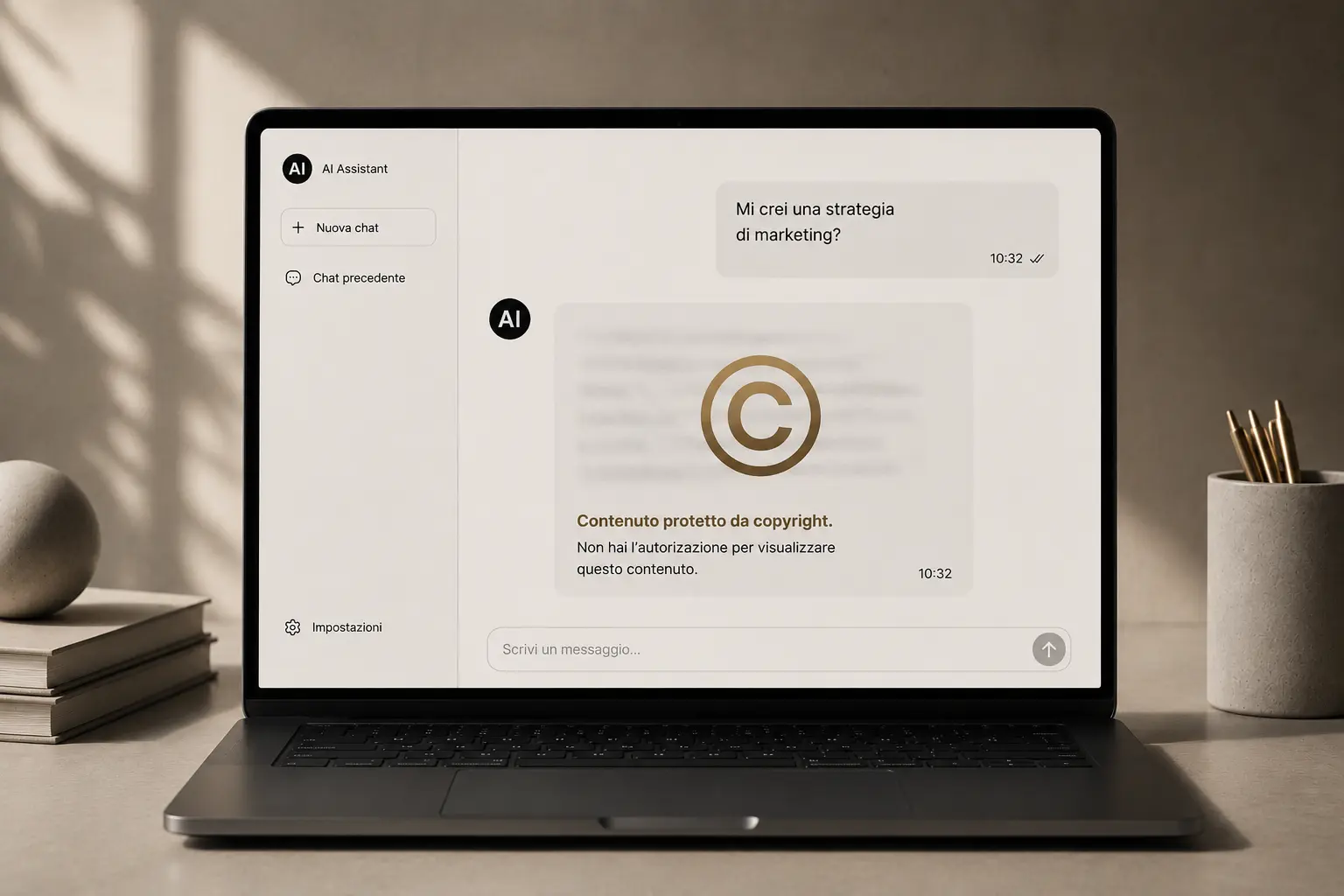
Only human beings can hold copyright.
This was established by the US Supreme Court, which on 2 March 2026 declined to review the ruling in Thaler v. Perlmutter.
An artificial intelligence cannot be the author of anything. Any output generated autonomously by a machine is without protection.
At the time, the matter seemed closed. Yet the question remains pressing, and over the years it is likely to become ever more relevant: what if AI could one day claim copyright? What would happen to what we have produced with it, and what would become of the choices many organisations are making today?
Let us find out together.
The training paradox
Before turning to the hypothesis, let us examine this fact.
Language models such as Claude, ChatGPT and Gemini have been trained on billions of human works: articles, novels, screenplays, essays, code, correspondence. Whether this training constitutes infringement of the original authors’ copyright is still at the heart of dozens of legal proceedings. The NYT v. OpenAI case will force OpenAI to produce internal documents on its training process. And the matter is still ongoing.
The paradox is this: the machines now asking to be recognised as authors were built on the intellectual heritage of millions of human authors who never consented to training. If machines held copyright, they would have turned humanity’s collective heritage into private property.
What would change for those who use AI
Now, however, let us turn to the hypothesis.
What would happen if Claude, ChatGPT and Gemini imposed copyright on their outputs, effectively making every response a protected work?
Whoever wrote the prompt would no longer be the author, as they are today. At best, they would be the commissioning party. To use the work commercially, they would need a licence; to publish it under their own name, an assignment of rights. The system on which today’s productivity is built would collapse.
Every blog article written with AI, every strategy worked out in a chat, every verbal identity built on generated output, naming, positioning or taglines would require a licence. The market for AI-assisted work would collapse.
The problem for brands that have built their voice on AI
The category most exposed to this scenario, even in its partial versions, is brands.
Over the past three years, they are the ones who have used AI tools the most to build their tone of voice and verbal identity in general. And so, those organisations already do not own a voice of their own: they have the use of it.
The legal distinction set out by the US Copyright Office in 2025 is already in force: an AI-assisted work is protectable if the human contribution is sufficiently substantial. Entering a prompt is not enough. Editing an output is not enough. The threshold requires the human creative process to have governed the final expressive choices.
A brand that has entrusted its voice to a generative system without tracking, documenting and claiming the specific human input at every step simply has a service agreement with a machine.
The advantage of those who chose human authorship
The hypothetical AI copyright scenario has a side effect: it increases the value of everything human.
Organisations like ours that have invested in recognisable authors, in a declared and traceable method, and in a voice that bears the signature of real people, will hold a competitive advantage that grows over time, for reasons of ownership.
And that is because their identity will always remain in their possession.
This holds true even outside the extreme hypothesis. Already today, in many legal and commercial contexts, demonstrable human authorship has value. Public tenders require declarations on the use of AI. Publishing contracts prohibit it. Platforms penalise it.
The conversation about AI copyright may sound absurd, then, but it is not, whether or not this dystopian scenario comes to pass.
Those who govern a brand as an architecture of recognisable human choices build something no language model can claim. Those who build it on the output of a generative system, without verifiable human oversight, will find themselves only and always renting.
New Connections (FAQ)
AI has no copyright today: does that mean everything it produces is in the public domain?
Under US jurisdiction, yes: a work generated autonomously by an AI system, without sufficient creative human input, is not protectable and falls into the public domain. In practice, this means anyone can reuse, modify or publish pure AI output without infringing any right. The consequence for brands is symmetrical: if their text was produced mainly by a generative system and the human input cannot be documented as substantial, that text does not belong to the brand. It belongs to no one.
Is the AI copyright hypothesis genuinely plausible, or is it legal science fiction?
Today it is ruled out by current law in all major jurisdictions. But the legal process that led to the final 2026 ruling took four years of court battles, and the academic and political debate is far from closed. Some jurisdictions, such as the United Kingdom, already grant limited protection to computer-generated works. The question is whether the pace at which AI is penetrating the creative market will generate enough legislative pressure to reopen the issue. It is not science fiction. It is a question of timing.
How do you build a verbal identity that is verifiably human, even when using AI tools?
The legal distinction already in force is the key: an AI-assisted work is protectable if human input governs the final expressive choices. In practice, this means AI can produce drafts, variants and structures. But the decisions that matter, the tone, the key words, the positioning choices, the rhythm, must be made and documented by identifiable natural persons. A traceable editorial process, with named authors and documented revisions, is already the difference between an identity that belongs to the brand and one that belongs to the machine.