


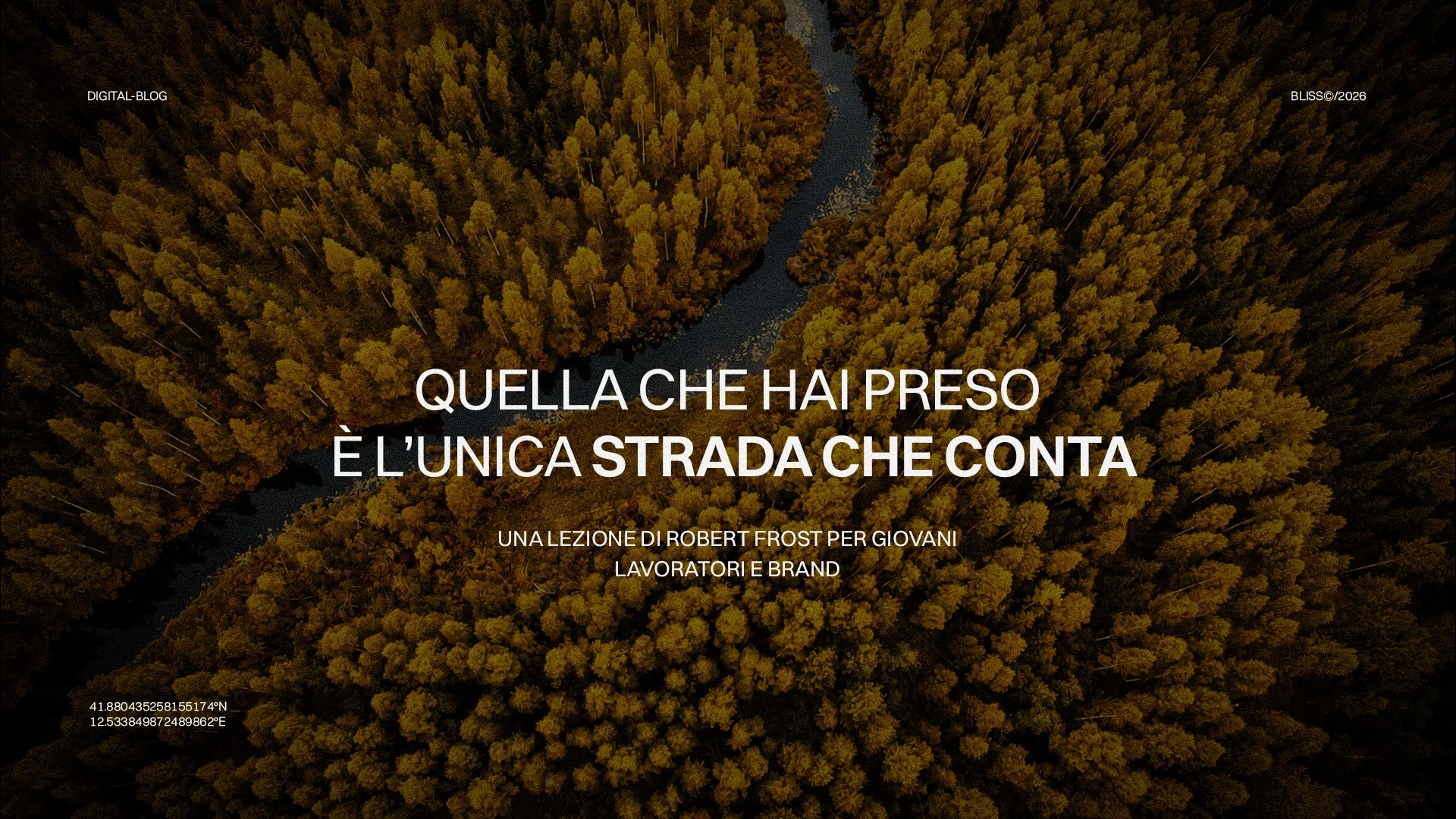
Two roads diverged in a yellow wood,
And sorry I could not travel both
And be one traveler, long I stood
And looked down one as far as I could
To where it bent in the undergrowth.
I came across this poem, I remember, one night many years ago, on the threshold of autumn.
At the time, the thought of all the choices I had made in life, the ones that had brought me to that point, was often with me. Perhaps because I was not satisfied with where I found myself, or perhaps because it was not yet clear to me where I was heading.
And so, one sleepless night, drifting aimlessly through YouTube, I stumbled upon a reading of these lines by Robert Frost, and they bewitched me.
The image of the yellowing wood forking before the reader.
The regret of not being able to become TWO people, to travel both roads.
The doubt, the leap into the void. Up to the great final revelation: the satisfaction of having taken the road less travelled. And the idea that it was precisely that choice which made all the difference in the world.
Robert Frost’s The Road Not Taken is one of the gentlest poems of the twentieth century, and perhaps that is partly why it is one of the most quoted of our time. It features in graduation speeches and in the biographies of many figures: by now, it has been adopted as a manifesto of individual courage. Poetic proof that choosing the difficult path pays off.
The problem is that this is not what Frost meant.
In the original text we see the narrator standing at a fork, facing two roads. Having examined both, he admits that they are essentially the same. The same wear, the same grass: an indistinguishable direction in the darkness of the undergrowth. And so the choice is no longer between the obvious and the courageous, between a complex path and a banal one, but between two options that, at the moment they are weighed, show no difference between them. And it is this, precisely this, that creates doubt within us.
After all, where should you go? Which road should you choose, if it is not just a question of courage?
There is no way to do it. That is why fear exists: that is why, along the path, the thought of the other road lingers and becomes almost obsessive.
I knew that doubt: I had felt it at my fingertips every time, for years, that I picked up a pencil.
No, Frost is not celebrating courage. The narrator of his poem simply imagines the future, and tells us:
Lo racconterò con un sospiro
da qualche parte tra molti anni:
Because this is how we give meaning to our decisions.
A profound lesson which, beyond the person I was all those years ago, can still teach a great deal to a great many, about life as much as about work.
Great texts do not age because they speak of human conditions that markets, management and history have never resolved. The same questions about choices, direction and meaning that Robert Frost asked himself before a yellowing wood are the questions a young person asks on their first day at work in 2026. Contexts change. Structures remain.
And so, in this new column devoted to art and literature, Bliss brings the great texts into the present. Because the solutions to the problems every person and every company faces have already been found.
You only have to look for them.
There is no right road
This may be hard to accept, but admitting it is necessary. The idea that at some point the right road will reveal itself clearly to us, that it will light up and give us unmistakable signs, is misleading.
Most of the time, roads look alike. They all lead into the unknown: none determines anything on its own, since each one crosses other people’s roads. So the difference lies not in the choice, but in how you walk once you have made it.
For anyone building a career, the risk is not taking the wrong road. If anything, it is walking the road you chose while constantly looking the other way, calculating what you are missing and comparing every metre with the imagined alternative.
This kind of attitude consumes energy that should go into direction instead, and produces professionals who are capable, yes, but dissatisfied. Perhaps not even because of their path, but because of their expectations.
Consistency is finding meaning in what you do, rather than waiting to do what you believe might have meaning.
A subtle difference, but a significant one.
Brands at the edge of the wood
The same mechanism governs organisations, with more measurable consequences.
In 1991 Nike launched Just Do It on a small budget and with a message that many inside the company considered too generic. First-season results came nowhere near justifying the investment. The temptation to correct course, test variants and chase immediate feedback was strong, yet Nike did not give in. It held its course. It kept going straight. Today Just Do It is one of the most recognisable communication assets in the history of global marketing. Perhaps precisely because it has been used for so long.
The same cannot be said of Gap, which in those same years proved it lacked that patience when faced with pressure from competitors.
The brand was following a clear road. American basics, accessible quality, a recognisable identity. The 1993 Who Wore Khakis campaign had built genuine cultural positioning. Then Zara and H&M accelerated, and Gap looked at their results with envy. It was not that Gap’s strategy was wrong, nor that its competitors’ was inherently right: it was simply different. And Gap chose to follow it.
So it immediately abandoned basics to chase fast fashion. But without Zara’s supply chain or H&M’s prices, it soon simply stopped being Gap.
Realising its mistake, it tried to turn back. In 2010 it changed its logo to signal a new direction. Six days later it reinstated the original. It was the sign that the brand no longer knew where to go. Meanwhile, the basics road had been taken. Uniqlo had built its own architecture there. Quality, essentiality, absolute coherence. That space was no longer available.
Gap still exists. It generates billions in revenue, but occupies no precise mental space in buyers’ minds. It is a brand everyone recognises but no one chooses first.
The rush to correct course produced the one outcome there is no coming back from: irrelevance.
The road of the young
As for young professionals, on the other hand, an entire generation has internalised flexibility as an absolute value.
Changing jobs every eighteen months. Keeping every option open. Never committing to any direction too early. It is a rational response to a labour market that has stopped offering certainty in exchange for loyalty.
But all of this comes at a cost.
Those who do not choose a road build nothing recognisable. They accumulate experiences, none of which speak to one another. After five years of strategic flexibility, they end up with a profile that is hard to read for anyone who has to make a decision about them. Varied skills. No evident direction. No signature.
The market does not reward those who kept every option open. It rewards those who built something specific for long enough to become recognisable in that territory.
This does not mean refusing to change or becoming rigid. It means changing along a trajectory: always maintaining internal coherence. Because changing course constantly leads nowhere: and, more than that, it does not shape you.
What remains
Frost had a friend, the poet Edward Thomas, who on their walks always regretted the road not taken. He would stop, look back, wonder what he would have found in the other direction, and then talk about it over and over, a thousand times a day. The Road Not Taken was written for him. Not as a celebration of courage, then, but as an affectionate observation of a habit that cost him dearly.
Frost’s, then, is not a story about making brave choices, but about the courage to honour your choices: about how you inhabit a choice once you have made it.
The yellow wood exists for everyone. The fork exists for everyone. The difference is not in the road.
The point has always been to keep going to the end, without looking at others.
New Connections (FAQ)
How do you tell perseverance from resistance to change?
By the direction of the evidence. Persevering means continuing to build along a defined trajectory even when short-term results do not yet confirm the choice. Resisting change means ignoring structural evidence that the direction needs correcting. The first is governance. The second is immobility disguised as consistency.
Why do brands abandon the right strategies too early?
Because measurement systems reward the short term. A brand that judges every communication choice on the next quarter builds a system that rejects any investment whose return is measured in years. Nike would not have kept Just Do It with a CFO assessing the campaign at ninety days. Governing direction requires the ability to defend a choice from the system that measures it.
What does it mean for a young professional to “stay on the road”?
It means building a professional positioning with the same logic used to build a brand. Defining a direction. Holding that direction consistently over time. Resisting the pressure to adjust one’s professional identity at every external signal of approval or disapproval. Solid careers are not built by chasing every opportunity. They are built by making the value one brings recognisable, until the market knows where to find it.
BLISS®
© 2026. ALL RIGHTS RESERVED