


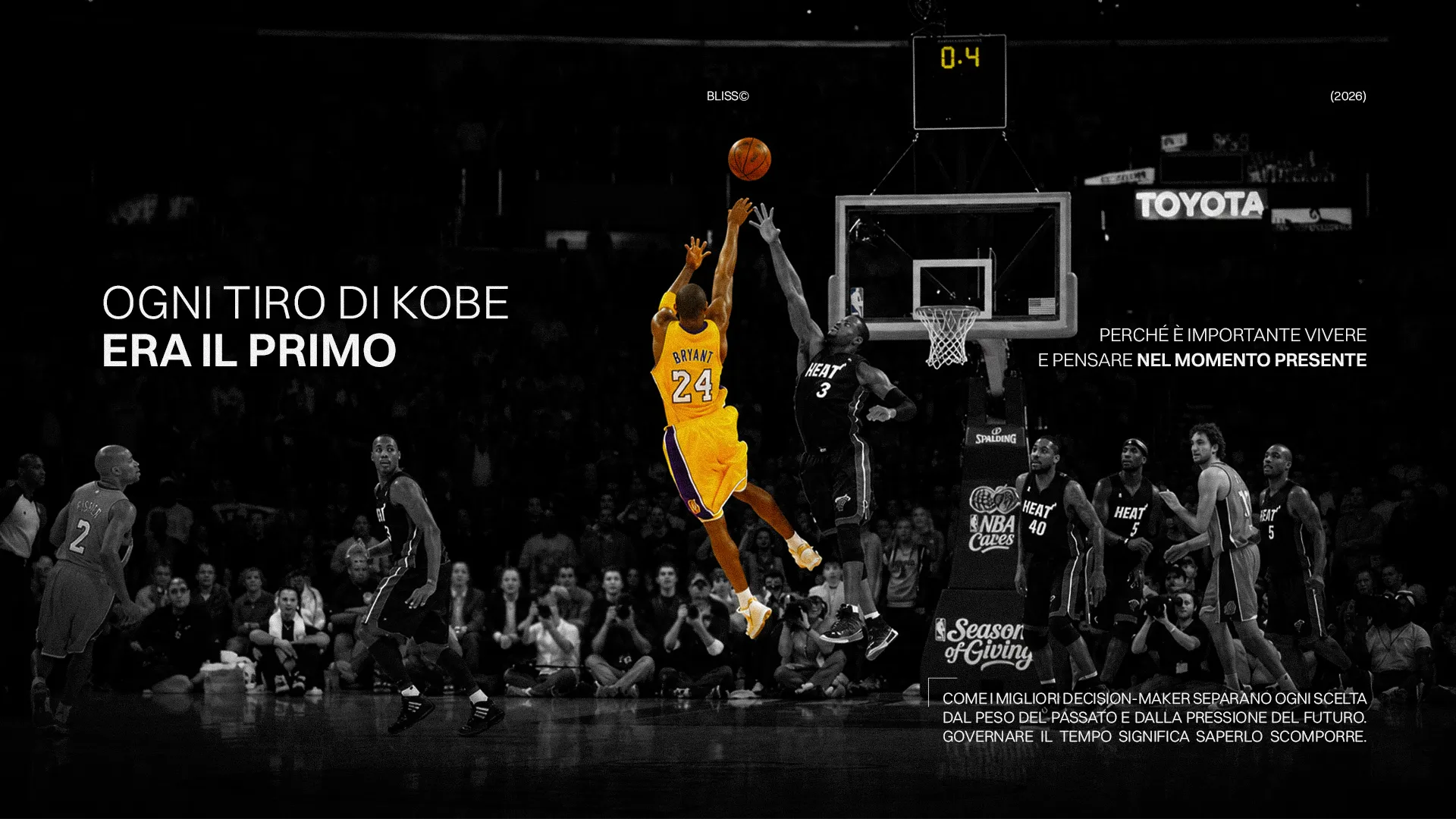
In 2014 Kobe Bryant set the NBA record for missed shots in the league’s history. 13,418 failed attempts: more than any other player in history.
Not exactly the record a champion would ever want to hold.
When someone told him after the game, though, he simply shrugged.
“I’m a shooting guard who has played for 19 years,” he replied.
And that was it.
No defence. No calculation. No retrospective assessment.
For Kobe, that statistic had no operational relevance whatsoever.
The next shot would be the first.
This is not a motivational anecdote. The answer from #24 in fact did no more than describe a precise cognitive structure. And separating Kobe Bryant’s ability from that structure means failing to understand where his expertise truly lies.
And how useful it could instead prove to everyone.
Memory is ballast
The brain does not record past experiences neutrally.
It records them with an emotional weight skewed towards losses.
Kahneman and Tversky documented the phenomenon in their Prospect Theory: losses weigh twice as much as an equivalent gain. This mechanism, loss aversion, was selected by evolution because avoiding loss mattered more than seizing an opportunity.
In a survival environment, this was an adaptive advantage.
But today, in a complex decision-making environment, it risks producing distortions.
A leader who made a wrong decision six months earlier risks carrying the weight of that choice into every subsequent meeting: because their risk-assessment system is calibrated on a past mistake rather than on the information available at the present moment.
In other words, the present weighs on him: and that weight comes from the past.

The pressure of the future
If the past can be seen as a burden, the opposite pole of this dimension of time is no less distorting in its consequences.
The future is just as dangerous.
Expectations, above all, create pressure that narrows the field of vision towards a horizon that does not yet exist. The present decision problem is then read through the lens of what must happen. It is a tendency we all share: we all project ourselves into tomorrow. But when it happens at the point of decision, the information available in the moment takes a back seat.
In sport psychology this mechanism is known as outcome orientation. A 2022 meta-analysis examining 27 studies precisely measured the effect of this focus on performance. Process goals produce an effect size of d = 1.36 on performance, against d = 0.09 for outcome goals. The difference is an order of magnitude.
Or, in plain terms: those who think about the next shot perform at an incomparably lower level than those who think about the game.
The present moment is the only true operational unit
The concept Bryant applied to shooting is a reading of time shared by the best performers in every field.
The present moment is the only unit of time in which direct action is possible.
It may seem obvious, but the obvious always disappears in practice. The ability to separate each moment from the others is not a natural disposition. Rather, we should consider it a competence. A cognitive structure that is deliberately built and trained, to produce measurable results.

How it works in organisations
Organisations reproduce, on a collective scale, the same mechanism that operates in the individual mind.
An organisation that has launched a failed product carries that failure into every subsequent development decision. Risk is assessed asymmetrically. Opportunities that resemble the earlier choice are systematically underestimated. And so the defensive system built around that failure consumes cognitive resources that should be available for reading the present.
The most visible signal is the slowdown in decision-making after a crisis. The organisation builds additional layers of approval, redundant reviews, categories of ideas that can no longer be put forward. What it feels it has learnt from the past settles into an operating system that slows down present decisions.
The missing distinction is the one between lesson and weight. Extracting the structure from a failure is a valuable operation. Carrying its emotional weight into subsequent decisions is an operational distortion. The two require different actions: but the system does not separate them automatically. It has to be shaped to do so.
The other form is subtler. Organisations operating under very high expectations measure every present decision against the final goal rather than against the information available in the moment. They optimise for the imagined future. They miss the real opportunity.
The operational lesson
Separating moments does not mean ignoring the past or failing to plan for the future.
The past is there to extract structure from. Patterns, principles, skills. Taking on these lessons and letting go is what needs to be done.
The future, by contrast, is there to set the direction. When you enter the moment of execution, the plan has already been made. That moment demands its own attention, not additional pressure. Bryant studied every game in detail. Then he stepped onto the court and shot.
And when he missed, that was fine too, because the only objective assessment to make was whether or not that shot fitted the strategy devised for the game. Those who govern organisations must be able to make the same distinction.
Every moment that produces a result is separate from the previous one. The previous one belongs to an operation already closed.
The weight that counts, then, is always the one generated in the moment of action.
Carrying it with us only risks slowing us down.
New Connections (FAQ)
How do I keep past mistakes from conditioning me when I start a new project?
By distinguishing two operations the brain tends to confuse: extracting the lesson and carrying the weight. The lesson is extracted deliberately after every significant event, codified into an operating principle, and then the operation is closed. The weight, by contrast, has no function at the moment of execution. The mechanism for not carrying it is not forgetting. It is recognising that the past lies outside the present’s field of action. Bryant studied every game in detail. Then he stepped onto the court and shot.
In organisations, does this principle apply to individuals or to systems?
To both, with different dynamics. In organisational systems the weight of the past often settles into processes: in the extra approval layers built after a crisis, in the redundant reviews born of a previous failure, in the categories of ideas nobody proposes any more because “last time it went badly”. The work of governance is to identify these sediments and to distinguish those that produce useful structure from those that produce only operational friction.
Isn’t staking everything on the final goal the best way to reach it?
Direction may well be necessary, of course, but the pressure of goals at the moment of execution is a distortion. The meta-analysis cited in the article is precise: process goals produce an effect size of d = 1.36 on performance, outcome goals of 0.09. Knowing where you want to go serves to build the system. Yet, at the moment of execution, the direction is already built into the system. Adding the pressure of the result at that moment compresses the quality of execution.
BLISS®
© 2026. ALL RIGHTS RESERVED