


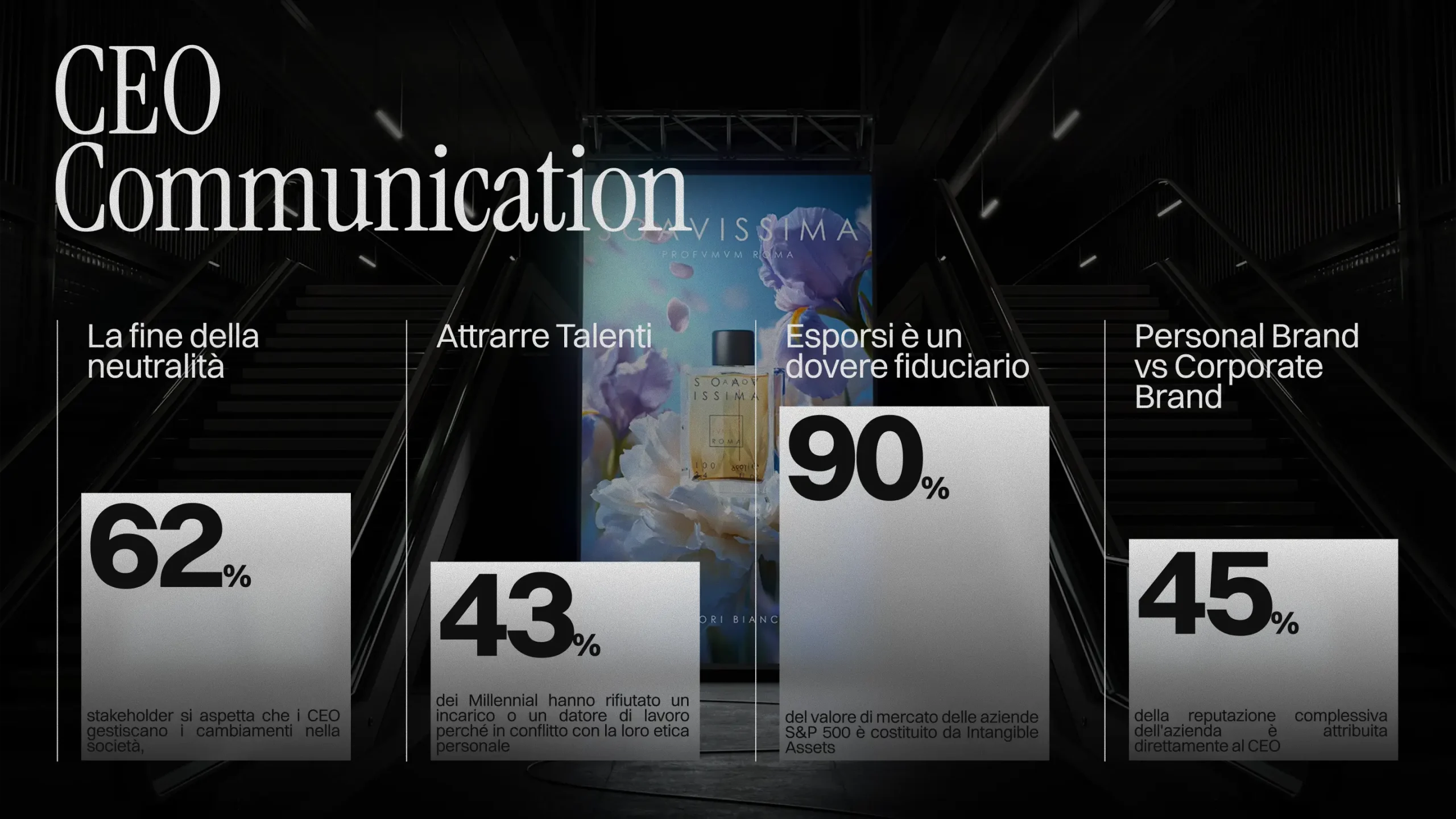
Introduction: The end of Swiss neutrality
In today’s context, CEO neutrality is no longer a tenable position.
By neutrality we mean the business leader’s deliberate choice not to take any public position on social, political or ethical issues relevant to society.
This approach, considered governance best practice for decades (“the business of business is business”), has today become a reputational risk factor.
Employees, customers and investors, ESG funds in particular, read silence not as impartiality but as an absence of leadership, or worse, as complicity. In this scenario, the CEO is no longer merely an operational decision-maker but the chief public interpreter of corporate values.
CEO Activism is not the same as political activism.
It is a discipline of strategic reputation management, concerning how a company takes a stance on issues that directly affect its stakeholders, its business and its social legitimacy.
When properly governed, the CEO’s public intervention accumulates reputational capital.
When improvised or inconsistent, it can destroy in a matter of hours value built over years.
This article examines when, how and why a CEO should take a public stand, and which governance mechanisms are needed to prevent public leadership from becoming a systemic risk for the business.
Bliss
Speak to a
consultant
Tell us about your project. Together, we will find the right way forward.
Contact usWhy speaking out is a fiduciary duty
Why should a Board authorise the CEO to take a stand on divisive issues? The answer lies in the data.
Data: According to the Edelman Trust Barometer, 81% of employees expect the CEO to speak publicly on social issues. Moreover, consumers are 4 times more likely to buy from companies with a strong, leadership-driven “purpose”.
The leader’s public exposure serves to:
- Attracting Talent: The best candidates do not work for “anonymous companies”; they work for visionary leaders who share their values.
- Humanising the Corporate Narrative: People trust people, not logos. A visible CEO transfers trust to the brand (halo effect).
- Crisis Management: If the CEO has built up “reputational credit” in peacetime, the market will be more lenient in wartime.
The Intervention Matrix: When to speak?
The greatest risk is indiscriminate activism. A CEO who comments on everything loses authority and risks being accused of opportunism (Woke-washing).
At Bliss, we use a Relevance Matrix to guide the Board’s decisions. The CEO should speak ONLY if the issue meets two criteria:
- Business Relevance: Does the issue affect our operations or our direct stakeholders?
- Credible Authority: Have we done something concrete about it? (If we have not cut emissions, we cannot talk about climate.)
If either is missing, the Advisor’s advice is unequivocal: Strategic Silence.
Personal Brand vs Corporate Brand: Who is in charge?
What happens when the CEO’s personal views diverge from the company’s interests? This is the breaking point that demands iron-clad governance.
The CEO’s Personal Branding is not a private hobby; it is a corporate asset.
- Values Alignment: Before appointing a CEO, the Board must verify compatibility of values, not just technical expertise.
- The Social Media Protocol: This is not about censorship but about coordination. The leader’s social channels must be managed in synergy with Investor Relations and Corporate Comms.
- Succession Plans: If the brand is too closely tied to the founder’s face, the company loses value. Advisory works to institutionalise charisma, transferring it from the individual to the corporate culture.
The risk of “Strategic Narcissism”
There is a fine line between a CEO who leads and a celebrity CEO. When media exposure feeds the manager’s ego rather than the company’s reputation, it creates a misalignment of interests (Agency Problem).
The external Advisor acts as a critical mirror. Our role is to ask the uncomfortable question: “Is this interview selling the product or selling your next book?”
Strategic Positioning of the C-Suite
The public exposure of senior leadership involves complex risk dynamics and unrivalled opportunities to influence markets. Long-term advisory guides the C-suite in aligning personal positioning with socio-economic megatrends. A considered CEO Activism & Communication plan is the ultimate embodiment of Corporate Storytelling & Brand Narrative, requiring sophisticated integration of Brand Heritage to ensure that the board’s advocacy is always authoritative, incisive and calibrated.
Conclusion: The Leader as Brand Guardian
In the attention economy, the CEO is the first Brand Guardian. Their voice, their tone and their battles define the company’s ethical perimeter.
We are not asking CEOs to become politicians. We are asking them to be conscious leaders, aware that every word they utter is an allocation of reputational capital. At Bliss, we help you spend that capital wisely, integrating activism into the overall Corporate Narrative.
FAQ – CEO Activism & Communication
Doesn’t taking a stand risk alienating market segments?
It is an exercise in strategic value segmentation. In today’s context, neutrality (the old “Swiss” approach) is no longer a sustainable position: today it generates “competitive indifference”. Data from the Edelman Trust Barometer confirm that consumers are 4 times more likely to buy from companies with a strong, leadership-driven purpose. We prefer to consolidate the advocacy of our core target,
What is the objective criterion for choosing an issue to engage on?
We apply the ESG Materiality Principle. We intervene only on “material” issues, namely those with a direct impact on our operations or on stakeholders’ ability to generate value. If an issue does not intersect our value chain or our core competencies, we apply “Strategic Silence” to preserve our authority.
How do you manage the misalignment between personal opinion and shareholder interests?
Through Communication Governance. The CEO acts as a fiduciary representative (Agent), and every public statement must reflect solely the Corporate Identity approved by the Board. Consistency between stated values and corporate actions is the only tool for protecting the share price from fluctuations caused by “off-the-cuff remarks”.
A tangible example of how to structure this rigour is the Aostae 2025 case study. In this project, communication governance is not limited to aesthetics but defines a clear institutional perimeter, demonstrating that a centralised, coherent narrative is essential to preserving brand integrity and stakeholder trust.
Does activism distract from short-term financial results?
On the contrary, it is reputational Risk Management. Institutional investment funds (such as BlackRock) also assess leadership on its ability to navigate social complexity. A silent leader is a risk in a crisis; an active leader builds a “trust buffer” that stabilises brand value in periods of volatility.
How do you respond to a media attack or a boycott?
Through Strategic Resilience. You do not react on impulse. We analyse whether the attack comes from our core target or from external fringes. If our core values are solid, we hold our position. Retreating under pressure destroys credibility with one’s loyal supporters.
Bliss explores this concept in the report “Brand Advisory: Building and protecting your company’s intangible value“, where we define resilience not as passive defence but as the engineering of a brand infrastructure capable of absorbing reputational shocks.