


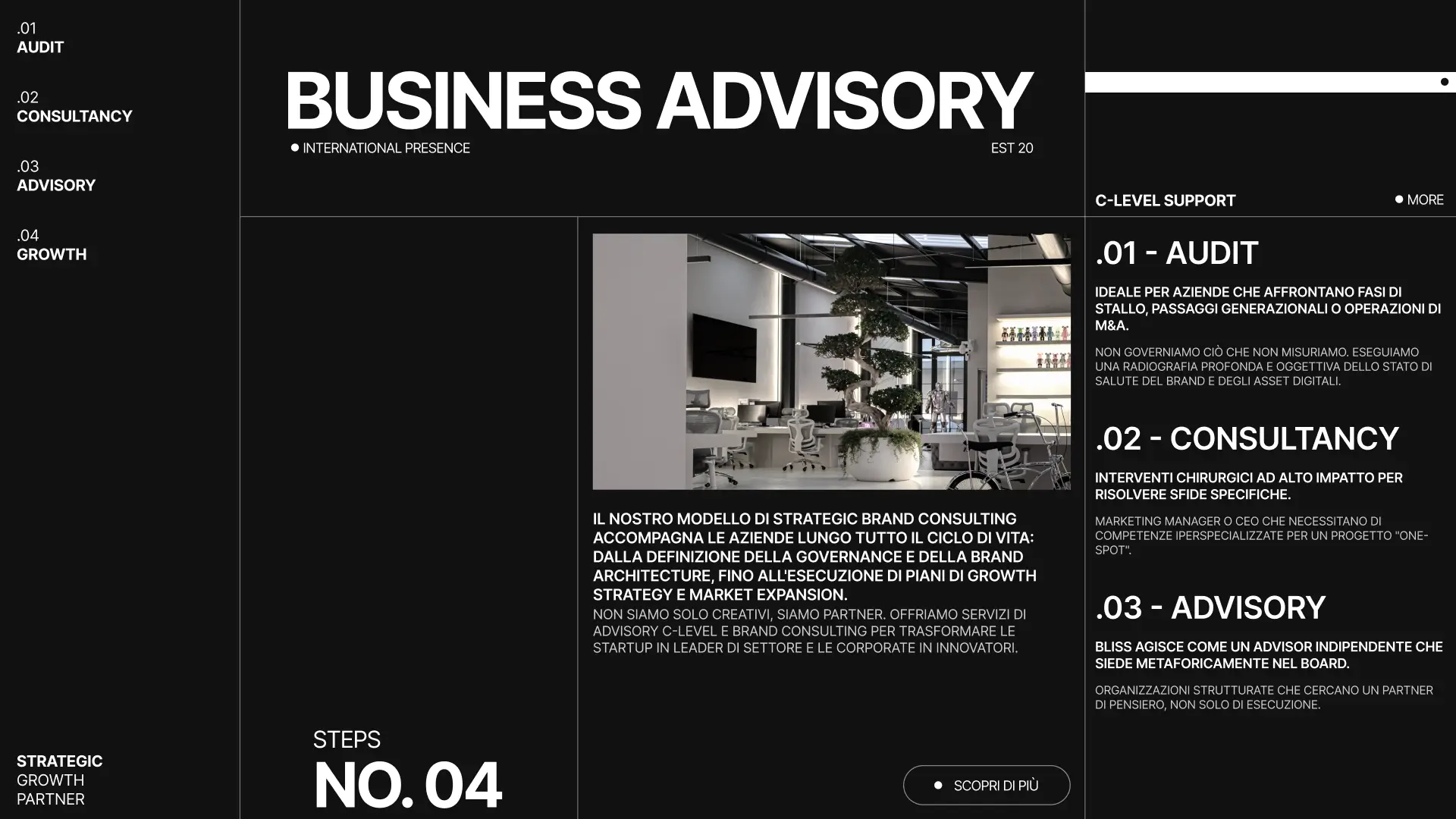
Business Advisory is an ongoing strategic relationship between a seasoned professional and a company’s leadership, with the aim of supporting the high-impact decisions that determine long-term growth, competitiveness and value. Unlike traditional consulting, which addresses specific, well-defined problems under a fixed-term mandate, Business Advisory operates over an extended time horizon, acting as a critical internal function supporting executive decision-making.
In encyclopaedic terms, Business Advisory sits at the intersection of strategic advisory, management advisory and executive coaching, without coinciding with any of the three. It is the discipline that answers the question “where is this company heading, and who is leading it with method and clarity?” rather than “how do we solve this operational problem?”. It is, in essence, the highest level of professional support a business can receive from a Brand Advisory firm such as Bliss.
In quantitative terms, the global consulting services market is expanding steadily: according to Business Research Insights, in 2026 it will reach an estimated value of around 345 billion dollars, with projections of up to 485 billion by 2035, at a CAGR of 3.87%. In Italy, according to Mordor Intelligence data updated in January 2026, the operations consulting market will reach 1.95 billion dollars in 2026 alone, up from 1.86 billion in 2025. And according to the 16th Assoconsult Report, the Italian management consulting sector recorded growth of 8.5% in the latest cycle surveyed: an unmistakable sign of rising structural demand.
Bliss
Talk to an adviser
Tell us about your project. Together, we will find the right way forward.
Contact usAdvisory: meaning and scope of the discipline
The term advisory properly denotes qualified decision support, provided on an ongoing basis and with accountability for the judgement given. The meaning of advisory differs from that of consulting in one precise respect: advisory is organised not around projects with a start and an end, but around a relationship, and its value accumulates over time through the knowledge of context that the professional builds by staying.
In Italian professional usage the term spread as a direct borrowing from English, and today it denotes very different families of services, united by the same engagement logic.
| Family | Scope | Counterpart | Typical horizon |
|---|---|---|---|
| Business advisory | Direction, growth, business model | Founder and top management | One to three years |
| Financial advisory | Financial structure, capital, investment | CFO and owners | Ongoing or transaction-based |
| Transaction advisory | Extraordinary transactions and due diligence | Owners and investors | Duration of the transaction |
| Brand advisory | Brand identity, positioning and value | Marketing and general management | Ongoing |
| Risk and compliance advisory | Regulatory compliance and risk management | Board of directors, legal | Ongoing, with regulatory peaks |
This page treats advisory as a discipline: what it is, how it differs from consulting, which areas it covers and how the relationship is structured. For the professional who practises it, including the skills required and the selection criteria, see business advisor: who they are and what they do.
What Business Advisory Is: Answers to the 5 Fundamental Questions
Who needs Business Advisory? Entrepreneurs, CEOs and boards of SMEs and large companies going through phases of high complexity: accelerated growth, generational transitions, reorganisations, mergers or acquisitions, positioning crises or preparation for an exit strategy.
What is Business Advisory? It is ongoing strategic support that produces no operational outputs, but instead steers outcomes: the fundamental choices that set the company’s future direction. It is not a deliverable; it is a guided decision-making process.
When is it needed? When the company is growing but its structure cannot keep pace, when the founder faces alone decisions where a mistake could cost millions of euros, when the business must sell, buy or plan the next five years without counterparts of the right calibre.
Where does it sit? The Business Advisor sits, metaphorically, on the same side of the table as the CEO: not an external supplier, not an auditor, but an intellectual partner with skin in the game on the strategic vision.
Why do it now? Because, according to Accenture, 80% of strategies fail to deliver consistent growth, and because in 2026 regulatory, technological and competitive complexity has reached levels that make navigating by sight untenable.
Advisory versus Consulting: A Strategic Distinction, Not a Semantic One
One of the most common mistakes founders and managers make is treating the terms “advisor” and “consultant” as interchangeable synonyms. They are professionally distinct roles, with radically different mandates, time horizons and terms of engagement.
| Size | Consultant | Business Advisor |
|---|---|---|
| Time horizon | Defined project (3-6 months) | Ongoing relationship (1-3 years) |
| Objective | Specific output (plan, audit, report) | Strategic outcome (growth, value, governance) |
| Approach | Vertical and technical | Horizontal and systemic |
| Position | External supplier | Partner to leadership |
| Accountability | On the deliverable | On business results |
| Cognitive biases | Possible (specialisation) | Minimised (independence) |
The most effective metaphor for grasping the distinction is a medical one: the consultant is the specialist who treats a specific condition with deep technical expertise. The Business Advisor is the family doctor who knows the company’s entire medical history, monitors its health over time and guides it towards a sustainable entrepreneurial lifestyle for the next twenty years.
When a Consultant Is Not Enough
Traditional consulting meets an occasional, well-defined need. It works well when the task is implementing an ERP system, launching a campaign, restructuring debt or certifying a process. But when an entrepreneur faces a high-risk strategic choice, the specialist consultant is not necessarily the right figure: they lack the overall view, in-depth knowledge of the company and, above all, the ability to challenge the CEO with intellectual honesty.
This is precisely where Business Advisory sits: not in “doing”, but in deciding what to do and what to avoid.
The Invisible Value of Business Advisory: Why CEOs Choose It
The most underestimated advantage of Business Advisory is the removal of cognitive biases from top management’s decision-making ecosystem. Those who work inside an organisation are, by definition, influenced by the corporate culture, by internal political dynamics and by short-term pressures. An external advisor, independent and with no ulterior motives, brings a perspective rarely found within the company’s walls.
According to the B2B Marketing 2025 report, 48% of companies plan to increase their budget for integrated consulting services over the next two years. But it is the quality of support, not the quantity, that distinguishes businesses that scale methodically from those that grow and then implode.
At Bliss, Business Advisory was created to address what is referred to internally as “the loneliness of the number one”: the situation in which the founder or CEO must make the most important decisions of their professional life without a peer-level counterpart to talk them through with. Not a partner in the business, not an employee, not the accountant: an intellectual partner who sits on the same side of the table.
In the project with Würth, for example, the work of Bliss focused on aligning strategic vision with operations, building an advisory framework that made it possible to assess every investment against its expected return, eliminating initiatives of low strategic value and maximising overall ROI. This was not operational consulting, but genuine, ongoing oversight of the quality of decisions.
Business Advisory Focus Areas in 2026
Business Advisory covers a broad spectrum of critical business situations. In 2026, with the growing complexity of the competitive landscape, the most relevant areas of intervention can be summarised in four macro-domains:
Growth and Scalability
When a company grows at double-digit rates, its organisational structure, decision-making processes and governance systems risk falling behind. The advisor helps build the capacity to scale before growth turns into disorder. This includes redefining the organisational model, building a system of strategic KPIs and identifying structural bottlenecks.
Generational Transition
In Italy, where the economy is dominated by second- and third-generation family businesses, the transition from the founder’s governance to that of the heirs or of professional management is one of the most critical and risky moments in a company’s life. The Business Advisor acts as a neutral, expert figure, able to mediate between differing interests, protect the value built and design an orderly transition.
M&A and Exit Strategy
Preparing a company for sale is not a legal or financial process: it is first and foremost a strategic and brand transformation. Every aspect of the company, from competitive positioning to brand narrative, from the governance model to the quality of the management team, contributes to the valuation perceived by the buyer. The advisor supporting an exit strategy works on these elements years ahead of the negotiation phase.
Governance and Conflict Resolution
Disputes between shareholders, board dysfunction, tensions between incompatible strategic visions: these are all situations in which an external, independent advisor adds value that no technical consultancy can replace.
The Luxury Still Life Case: When Advisory Becomes Brand Vision
One of the least understood aspects of Business Advisory is its role in building and protecting the brand as a strategic asset. At Bliss, this dimension comes through clearly in our Luxury Still Life Photography work: product photography is never merely aesthetic; it is the visual translation of a positioning strategy.
Every compositional choice, every lighting choice, every element of the set tells you who the brand is and which consumer it addresses. When an advisor enters the creative process of a luxury company, they assess not only the numbers but the coherence between brand identity, visual communication and competitive positioning. This is the level at which strategy and creativity meet, and where Business Advisory delivers its hardest-to-imitate value.
The Profumum Roma project is a telling example: redefining the digital presence of an artistic perfumery brand required not only creative and technological expertise, but a strategic vision able to open the brand to a new generation of consumers without diluting its exclusivity. This is the typical tension of luxury advisory: growing without betraying oneself.
A Guide to Elevating a Brand: The Bliss Method
Elevating a brand is not a creative project. It is a structured strategic process that runs from analysis to execution, by way of defining the positioning, governing the identity and building the communication touchpoints.
At Bliss, this process unfolds across four sequential levels:
The first level is the Audit, an objective snapshot of the company’s past and present, its brand, its competitive positioning and market perceptions.
The second is Consulting, where the strategy is defined: where to compete, how to differentiate, which levers to activate to grow coherently and sustainably.
The third is Advisory, the level at which strategy becomes an ongoing criterion for decision-making. Not a 200-page document, but a permanent safeguard of the quality of choices.
The fourth is Governance, the system that ensures the brand stays true to itself as the organisation grows, markets change and people move on.
Bliss
Talk to an adviser
Tell us about your project. Together, we will find the right way forward.
Contact usBusiness Advisory Trends in 2026
2026 marks a turning point for the Business Advisory market. According to Business Research Insights, over 50% of companies are focusing on AI-based solutions, and 65% of them are investing in AI-driven consulting. This means the advisor’s role is evolving: no longer merely a source of experience and human judgement, but increasingly an integrator of data-driven insight with strategic vision.
Three trends dominate the landscape in 2026:
The first is vertical specialisation with a horizontal outlook: the best advisors are no longer pure generalists, but professionals with deep sector expertise who can apply the logic of one industry to another, generating innovation through transposition.
The second is the convergence of brand advisory and business advisory: in the competitive markets of 2026, the brand is no longer a marketing function. It is a financial asset, a competitive advantage and a value multiplier in company valuation. An advisor who does not understand the brand does not understand the business.
The third is advisory-as-a-service: more flexible engagement models, with a monthly retainer fee instead of large one-off projects, ensuring continuity of presence and adaptability to context without the rigidity of traditional consulting mandates.
Cluster Pages: Explore the Bliss Advisory Ecosystem
Business and Strategic Consulting: If you are looking for a partner to support you in building structural solutions for your company’s growth, Bliss’s business consulting offers an integrated approach that runs from analysis to implementation. Find out how.
Business Advisor: Who They Are and Why They Are the Crucial Figure Your Company Is Missing: Still unsure whether you need an advisor or a consultant? This article clarifies the distinction and helps you understand when and why a Business Advisor can make the difference in your company. Read more.
Brand Advisory: Building and Protecting Your Company’s Intangible Value: Your brand is the asset that is hardest to build and easiest to destroy. Bliss Brand Advisory supports you in building, protecting and enhancing it over time. Discover the approach.
Management Consulting: Optimising Processes and Structure to Scale Without Chaos: Growing fast without structure means building on sand. Bliss Management Consulting helps you build the organisation that can sustain growth. Explore the method.
Strategic Advisory: Setting the Course for the Next 3 Years: Without a clear course, every decision is navigation by sight. Bliss’s strategic advisory builds the plan for the next three years with you, with priorities, metrics and measurable milestones. Find out how.
Increasing Company Revenue: Strategies, Data and Management Approaches for Sustainable Growth in 2026: The numbers don’t lie, but without the right strategy, numbers alone are not enough. Read the complete guide to revenue growth strategies for 2026, with market data, management frameworks and practical approaches. Go to the guide.
Frequently Asked Questions about Business Advisory
What is Business Advisory and how does it differ from traditional business consulting?
Business Advisory is an ongoing strategic relationship that supports company leadership in high-impact decisions. Unlike traditional consulting, which addresses specific problems through a fixed-term mandate, Business Advisory operates over a medium-to-long-term horizon, acting as a permanent intellectual partner to the CEO or entrepreneur. The consultant produces an output (a plan, a report, an analysis). The advisor shapes the outcomes: the strategic choices that determine the company’s future direction.
When does it make sense for a company to engage a Business Advisor?
Business Advisory becomes crucial at four specific stages in a company’s life: during accelerated growth, when the organisational structure risks not keeping pace; during a generational transition, to ensure an orderly handover; ahead of an M&A or an exit strategy, to maximise the value perceived by the buyer; and finally when the entrepreneur finds themselves alone facing decisions that could have irreversible consequences for the company’s future.
How much does a Business Advisory service cost?
The cost of a Business Advisory engagement varies with the complexity of the organisation, the professional’s experience and the engagement model. The most common models in 2026 are a monthly retainer fee (advisory-as-a-service), which guarantees continuity and permanent oversight, or a project package with defined objectives and measurable milestones. The investment should be weighed against the cost of the strategic errors it is meant to prevent: in most cases, a single error avoided fully repays years of advisory.
What is the difference between a Business Advisor and a Business Coach?
A business coach works mainly on the leader’s psychology, motivation and personal skills. A Business Advisor works on the business model, strategy, numbers and corporate governance. The coach helps you become a better leader. The advisor helps you build a better company. The two roles are complementary but not interchangeable: in highly complex contexts, they can coexist with distinct, non-conflicting remits.
Is Business Advisory suitable for SMEs too, or only for large companies?
Business Advisory is particularly suited to SMEs, especially those in a phase of growth or transformation. Large companies generally have in-house planning and strategy functions. SMEs, by contrast, cannot afford to build a high-level strategic function in-house, yet they urgently need one, above all at critical stages. In Italy, where SMEs make up almost the entire economy, Business Advisory is one of the most effective and underused levers for value creation.
How is the return on investment of a Business Advisory programme measured?
Measuring the ROI of an advisory engagement requires clear metrics to be defined upfront: revenue growth, margin improvement, reduced time-to-decision, higher perceived brand value, the success of an M&A transaction or of a launch into a new market. A good advisor sets up an outcome measurement system from the outset, allowing impact to be assessed over time and avoiding the trap of unquantifiable “soft value”.
Build Your Strategic Advantage with Bliss
If you have read this far, you probably already recognise in these words a situation you know: a company that is growing but lacks clear direction, a brand identity still to be built or protected, a transition phase that requires more than operational consulting.
Bliss is not a service provider. It is the strategic partner that sits on the same side of the table as the CEO, brings intellectual honesty where it is most needed and builds with you the vision that turns a good company into an excellent one.
If you are ready to turn complexity into competitive advantage, the first step is a conversation. Contact Bliss to find out how a Business Advisory engagement can redefine your company’s trajectory over the next three years.