


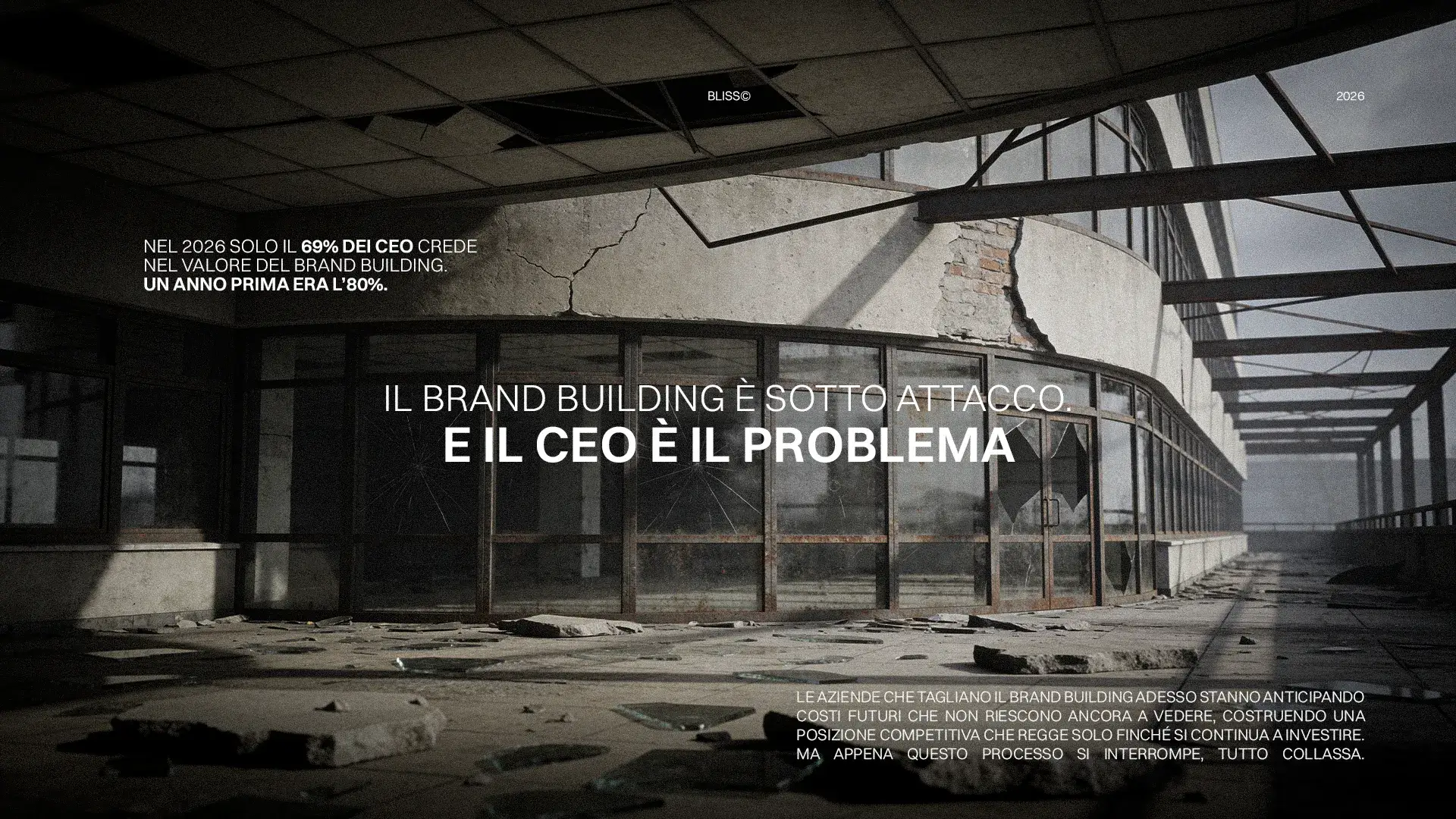
In 2026, 69% of CEOs said they still believe in the value of long-term brand building.
Decent numbers, we might think.
If only the figure the year before had not been 80%…
Eleven percentage points in a year is a worrying figure. A drop that has no precedent in recent marketing history.
A crisis of results or a lack of trust?
Finding the answer (and understanding the difference) will matter.
The incentive system distorts everything
When a CEO or CFO stops believing in brand building, it is usually not because brand building does not work. It is because they cannot see it working within the timeframes they have to report on.
The human brain is structurally oriented towards the present. Neuroscience research on temporal discounting shows that the ventromedial prefrontal cortex tends to systematically discount future rewards relative to immediate ones: the subjective value of an outcome decreases non-linearly as the time needed to achieve it increases. This mechanism is evolutionarily functional.
On the savannah, today’s fruit is worth more than the promise of a harvest six months from now.
In a listed company with quarterly reporting, however, this same mechanism produces the wrong decisions.
84% of CMOs now say they use ROI as the primary metric for budget allocation. ROI is measurable. It is immediate. It is defensible in a board presentation. Brand building is not, at least not with the same tools. So it loses in every budget meeting and every planning cycle.
The result is that money moves to where measurement is easiest, regardless of where the value is highest.
What the research management doesn’t read actually says
Les Binet and Peter Field analysed 996 advertising effectiveness cases collected in the IPA database. Their conclusion was that sales activation campaigns deliver immediate results, but their effects decay rapidly once investment stops. Brand building works slowly, but it accumulates over time, building memory structures, mental availability and pricing power that do not depend on media budget pressure.
The most uncomfortable point for anyone managing a P&L is that when a company cuts brand building to chase performance, short-term results improve. The following quarter seems to go well. Then, over 12-18 months, its competitive position begins to erode. Customer acquisition costs rise. Price resilience falls. Loyalty fades.
The damage is real. But it arrives well after the decision that caused it. And whoever decided the cut is often no longer in the same position when the bill comes due.
The optimal ratio that emerges from the research by Binet and Field is roughly 60% investment in brand building and 40% in activation. Today most companies are far from that point of balance, pushed towards performance by an incentive system that rewards what is measurable now.
Two incompatible languages
Brand building loses this conversation not because it does not work. It loses because those who defend it speak a language that management does not recognise as financially relevant.
CMOs bring metrics on awareness, consideration and sentiment. They are real metrics. They have documented predictive value. But they sit two degrees removed from the language a CFO uses to assess an investment: expected return, risk, measurable causality between input and output.
54% of CMOs cite the difficulty of connecting data from different sources as the main obstacle to generating insight. A third use between 5 and 15 separate tools to measure ROI. Only 37% have a centralised repository accessible to all stakeholders. This fragmentation is not the cause of the problem, but it makes it worse. It makes it even harder to build a financially coherent case around brand value.
As long as brand building is defended with perceptions and performance is defended with numbers, performance always wins. Not because it is right, but because it speaks the language in which decisions are made.
Building structures that can be measured
This is the fracture that Bliss has chosen to address as the central problem of its work.
Most Italian companies do not have a brand quality problem. They have a translation problem: they cannot prove to their own management that the brand produces measurable value in the metrics that matter. And without that proof, every budget cycle becomes a battle lost before it begins.
The Bliss method starts with a precise diagnosis of where the brand creates or destroys value, and of how to make this visible to those who keep the accounts.
The result is a brand that can prove why it is stronger: through which levers, over what timeframe and with what impact on the metrics the CFO actually looks at.
The cost nobody accounts for
Companies cutting brand building now are bringing forward future costs they cannot yet see, increasing their dependence on media budget, to build a competitive position that holds only as long as they keep investing in pressure.
When this process breaks down, it collapses.
The market does not wait. Every quarter in which the brand fails to build cognitive advantage is a quarter in which a competitor builds it instead.
Because the problem is not working out whether brand building works. The problem is that the incentive system CEOs operate within rewards those who cut and punishes those who build.
Until this structure changes, the conversation will start from scratch every year.
And every year, the brand will lose another piece of itself.
New Connections (FAQ)
Why have CEOs stopped believing in brand building?
Because pressure for short-term reporting has intensified and brand building does not yet speak the financial language that boards require. Eleven percentage points in twelve months is the signal that the incentive system has won out over strategy. When the CFO asks for quarterly results and the CMO brings sentiment metrics, the conversation always ends up in the same place. Not because brand building does not work, but because it is not translated in a way that counts.
How do you prove the value of brand building to a CFO who wants immediate numbers?
By translating the brand into financial metrics before the intervention, not after. Key person discount, customer acquisition cost over time, valuation multiples, price resilience: these are all variables the brand influences measurably. The problem is not that the data do not exist; it is that almost no one explicitly links them to brand decisions.
What happens to a company that cuts brand building for two or three years?
Short-term results improve, which makes the decision hard to challenge at the moment it is taken. Then, over 12-18 months, customer acquisition costs rise, price resilience weakens and loyalty erodes. Binet and Field’s research across 996 documented cases measures this precisely. The damage is real but arrives well after the decision that caused it, and whoever decided the cut is often no longer in the same position when the bill comes due.