


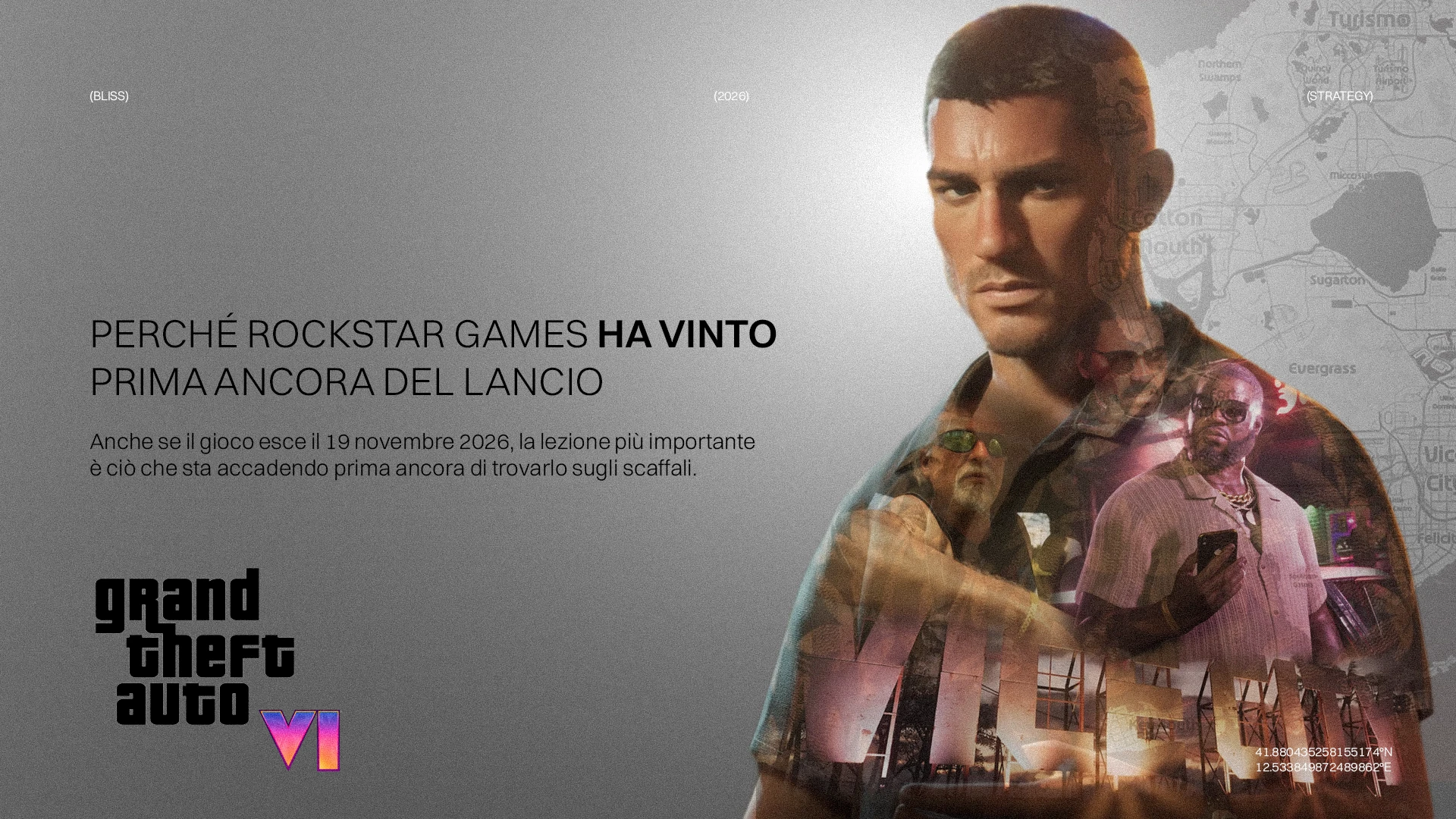
The second trailer for Grand Theft Auto VI racked up 475 million views in the first twenty-four hours after release. The previous record belonged to the launch of a blockbuster film. Rockstar did not spend a single euro on advertising to achieve it. It released a video and the world stopped to watch.
The game comes out on 19 November 2026. What has already happened before it even exists on the shelves is the most interesting lesson.
The brand that does not need to persuade
Rockstar invested around €2.4 billion in developing GTA VI between 2019 and 2025. It is a figure that exceeds the combined budgets of most blockbuster films, and it should be read for what it is: an act of faith in its own brand. A bet that the Rockstar name, paired with the three letters GTA, can generate an autonomous cultural phenomenon before the product even exists.
Market projections point to 40 million copies sold and $3.2 billion in revenue in the first year alone. Competitors have already rearranged their release schedules to avoid sharing the same window. A Polish politician ironically mentioned the launch delay during a parliamentary session. Grand Theft Auto V, released twelve years ago, is still among the best-selling video games in Italy in 2025.
No marketing campaign can produce all of this. Only a brand system that has accumulated value over time, with a consistency so obsessive that it turns the name into a cultural expectation, can produce it.

GTA V never ends
To understand what Rockstar has built, the starting point is GTA V. Launched in September 2013, it has sold more than 200 million copies to date. It has generated over 10 billion dollars in revenue, becoming one of the most profitable entertainment products in history. Not a film. Not a series. A video game released twelve years ago, still selling at full price, still generating monthly revenue through its online mode.
This is the tangible result of brand governance that has kept its promise over time. Every GTA Online update has respected the aesthetic and narrative code of the original game. Every expansion has added without diluting. The brand held because someone decided it should hold, every time there was a temptation to force growth.
GTA V is proof that a well-governed brand does not depend on novelty to stay relevant. It depends on consistency. And it is on this consistency that Rockstar has built the anticipation for GTA VI.
What the brain does before the product exists
The neuroscience of perception has a precise name for what happens when a brand of this scale announces something. It is called anticipatory pleasure: the dopaminergic system activates not when the product is enjoyed, but when the expectation forms. The brain rewards anticipation as much as it rewards satisfaction. Sometimes more.
Rockstar has built decades of consistent expectations. Each instalment of the saga has kept the promise of the previous one, raising the bar without betraying the code. Audiences have learnt, at a neural level, that expecting GTA means expecting something that will surpass everything they have seen before. This expectation, however, is not created with a simple campaign. It accumulates through years of precise execution, faithful to a single direction.
After the second trailer was released, Spotify recorded a 182,000% increase in streams of “Hot Together” by the Pointer Sisters, the song featured in the footage. And so the brand carried along with it everything it touched.

Silence as a brand tool
Between 2013 and 2023, Rockstar communicated nothing about GTA VI. Ten years of development under way, ten years of total silence. No interviews, no controlled leaks, no teaser campaigns. In an industry that communicates every stage of development to keep media attention, Rockstar chose the opposite direction.
This is no accident. Controlled silence is one of the most powerful levers available to a brand with established authority. It generates demand without offering answers. It fuels speculation without relinquishing control of the narrative. Every year without announcements was a year in which the community fuelled the anticipation by itself, for free, organically.
In 2022 a leak revealed hours of unfinished gameplay. A disaster for any other company. For Rockstar, it became an amplifier. The game already looked extraordinary even in an unfinished state of development. The public response turned a potential reputational crisis into further proof of the product’s value.
And yet silence comes at a high price. It requires internal governance solid enough to withstand the pressure to communicate, to justify investment, to reassure the market. Most organisations lack that solidity. Rockstar built it over time, and used it as a competitive advantage.
The distinction management almost never makes
There is a line that separates brands that generate cultural phenomena from those that chase them. It is not about budget, creativity or product quality. It is about brand governance over time.
Rockstar has never given in to the temptation to spread itself thin, to democratise its offering in order to reach wider audiences, or to sell off its identity to grow faster. For twenty years it has refused every form of dilution. Each chapter of the saga has come out when it was ready, not when the market demanded it. Every delay has been communicated as a choice in favour of quality. The postponement of GTA VI to November 2026 drew mixed reactions, but no collapse in trust in the brand.
This is brand governance. The ability to protect identity even when the market pushes in the opposite direction. The ability to reject short-termism in order to build a self-sustaining system of value.
It is the rarest condition in modern business. And also the most valuable.

When the market reorganises itself around you
The most tangible measure of Rockstar’s brand power is not in the trailer numbers. It is in the behaviour of its competitors.
When Rockstar announced the delay to November 2026, several competing companies reorganised their release schedules to avoid direct competition. They moved their launches, changed their windows, ceded ground to a product that does not yet exist. Nobody forced them. Rockstar’s brand generated a gravitational pull that altered the movements of the entire industry.
This is the ultimate test of brand power. Not how many people watch your trailer, but how many organisations change their strategies to avoid occupying the same space. A brand of this scale no longer competes.
It occupies territory that others consider impracticable in its presence.
The Polish politician who mentioned GTA VI in parliament was not talking about video games. He was describing a cultural phenomenon that has crossed the boundaries of its industry to become a shared reference point in completely different contexts. This is what happens when a brand has governed its identity long enough to become embedded in the culture.
The lesson beyond gaming
Every organisation managing a high-potential brand sooner or later faces the same question. How far is it willing to resist the pressure to grow quickly at the expense of consistency? How far is it willing to invest in the accumulation of value rather than short-term acquisition? How far is it willing to protect its identity even when the market asks for something different?
Rockstar’s answer to these questions is documented in the numbers. 2.4 billion in investment. Ten years of silence. A trailer that breaks film records. A brand that forces competitors to reorganise their schedules. A game not yet available that is generating cultural phenomena in sixteen countries simultaneously.
The principle behind these results is not specific to the video game industry. It applies to any organisation that governs its brand with the same discipline. Controlled scarcity creates desire. Consistency over time creates authority. Quality defended against market pressure creates trust. And trust, once it settles in, generates phenomena that no marketing campaign can buy.
In other words, a brand that generates cultural phenomena on its own, before the product exists.
New Connections (FAQ)
Can a company outside gaming replicate the logic Rockstar Games has applied to GTA VI?
The sector is irrelevant. The logic is identical: obsessive consistency over time, refusal of dilution, governance of the promise that is more rigid than market pressure. What changes is the scale and the context. What remains unchanged is the principle: brand value either builds up over time or is never built at all. There is no shortcut that produces the same result.
How do you measure the moment a brand has achieved this form of cultural authority?
The most precise signal is the behaviour of competitors, not that of customers. When other companies reorganise their strategies around what you are about to do, the brand has stopped competing in the market and started setting its rules. Rockstar has not competed with anyone for years. Others position themselves relative to Rockstar.
How much does product quality matter compared with brand governance in the case of Rockstar Games?
The product is the necessary condition. Governance is the sufficient condition. Without quality, nothing lasts. But quality alone is not enough to build a self-sustaining system of value: it takes the governance decisions that protect it, enhance it and make it legible to the market in a consistent, continuous way.
Sources
Wikipedia, Grand Theft Auto VI (data on trailers, views, launch date and competitor behaviour)
NotebookCheck, The GTA franchise has sold over 455 million units (GTA VI market projections)
TheGameFortress, GTA VI: the record investment (analysis of Rockstar North development costs 2019-2025)
Libero Tecnologia, GTA V among the best-selling games in Italy in 2025 (IIDEA/Ipsos data on the Italian market)
BLISS®
© 2026. ALL RIGHTS RESERVED