


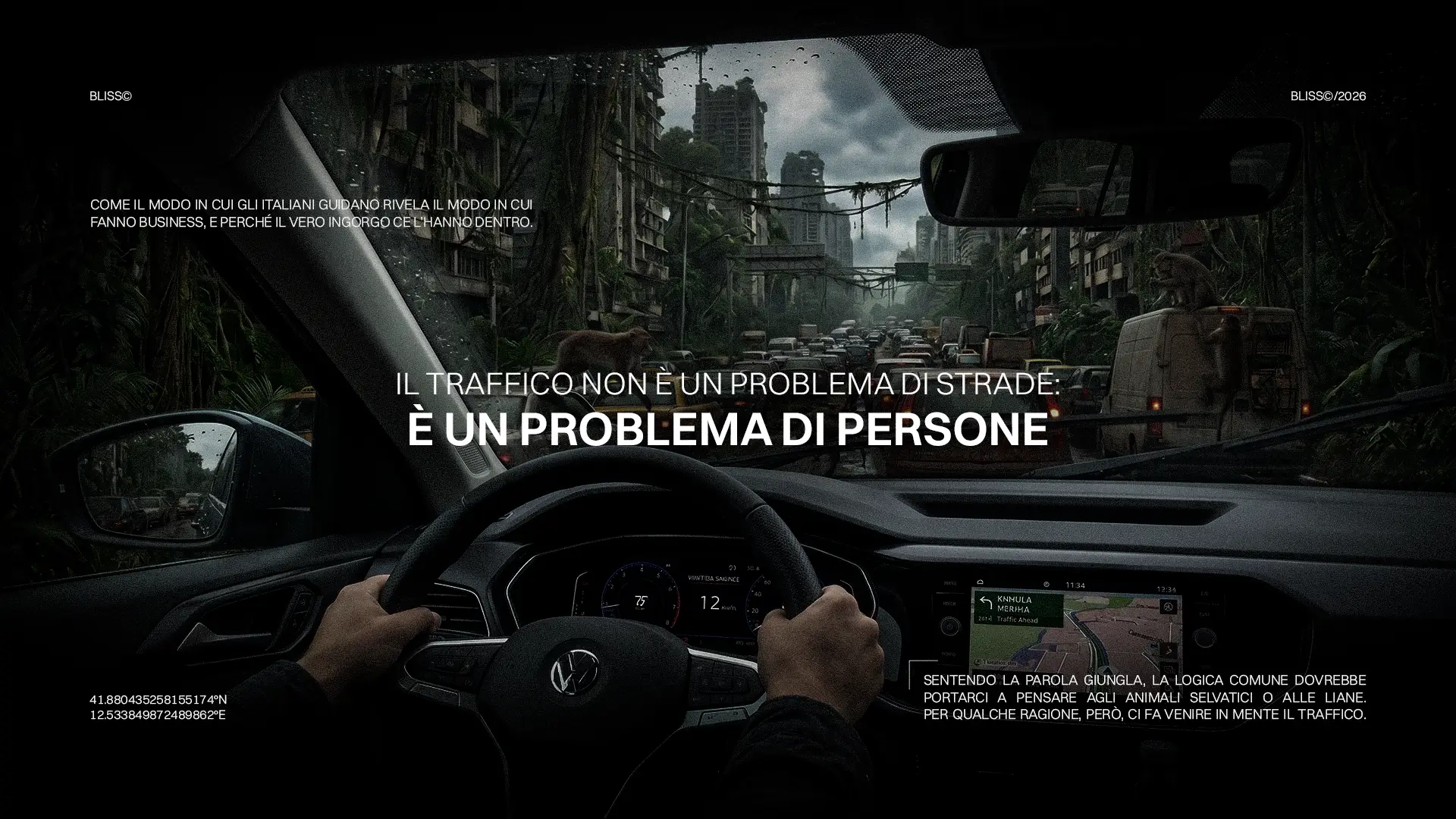
On hearing the word jungle, common logic should lead us to think of wild animals or lianas.
For some reason, though, it brings traffic to mind.
It is not us saying this, but a study conducted by Sapienza University of Rome, which asked Roman drivers to describe the traffic in their city. The most common metaphor was the jungle: a system without shared rules, governed by the law of the strongest.
The most interesting part, however, is perhaps not even this metaphor, but the fact that none of the respondents saw themselves as part of the problem. Each attributed the chaos to other people’s behaviour and felt “forced to respond aggressively to the context”. Nobody was building the jungle. Everyone was suffering it.
And indeed, this powerful, invisible mechanism lives in all of us, even off the road. Even in the world of work.
The queue nobody wants to join
Let us start with a specific case: the easiest to observe and the easiest to recognise.
Most urban queues do not arise from an excessive volume of vehicles; they arise (as the data show) from turns. At the point where a lane narrows, where someone has to give way and trajectories intersect, a behaviour emerges that is almost universal among Italian drivers.
Nobody wants to queue. Everyone pushes as far forward as possible before cutting in, convinced that their manoeuvre is smarter than everyone else’s.
The collective result of a thousand clever individual manoeuvres is a jam nobody wanted; one that suddenly vanishes just past the turn, and that everyone blames on others. Queuing would have solved the problem at source. But by now the queue is there, and people want to jump it.
Neurobiology calls this mechanism the tragedy of the commons: when a shared resource is exploited by each individual to maximise their own advantage, the resource runs out for everyone. Nobody is stupid. Nobody is acting in bad faith. Yet the outcome is worse than it would have been had each person given up a small part of their individual advantage.
Replace ‘road’ with ‘work’ and you will get the same result.

Everyone overtaking, no one left to overtake
The second behaviour is even more instructive, above all for the paradoxical result it produces.
The overtaking lane on the motorway exists for a reason: to let faster vehicles pass slower ones and then return to the normal driving lane. It is a system designed for flow, not for position.
In Italian practice, the overtaking lane is permanently occupied by those who do not want to be overtaken. At the root of this mechanism lies an act of identity defence: being in the overtaking lane means being among the fastest. It means not being passed.
The problem is that when everyone occupies the overtaking lane so as not to be overtaken, nobody overtakes anybody. The lane meant to speed the system up becomes the lane that slows it down. And this is exactly what happens in markets where competition is perceived as status rather than as a process.
When every company tries to position itself ‘at the top’ without that position reflecting genuine structural differentiation, the market becomes crowded at the high end and empties out in the segments where there would be room.
The jungle system: when it is always someone else’s fault
Let us return to the Sapienza study. The detail worth exploring is that every driver felt obliged to behave aggressively not by choice, but as a necessary response to the behaviour of others. It was the context that imposed it, not their personality.
Traffic psychology calls this mechanism situational regression: under high cognitive pressure and prolonged frustration, people tend to display primal behaviours (such as overbearingness, aggression and rejection of rules), even when these do not match their usual profile. The car interior amplifies this mechanism. It offers anonymity, reduces the perceived consequences of one’s actions and creates a sense of impunity that lowers the threshold of acceptable behaviour.
In the world of work, the equivalent of the driver’s seat is the hierarchy.
The anonymity of the organisational structure, the perception that decisions are ‘systemic’ rather than individual, and the distance between those who decide and those who bear the consequences lower the threshold of acceptable behaviour and produce the same result: a dysfunctional system.

What traffic reveals about the Italian market
Italian traffic has specific characteristics not found with the same intensity in other European countries. Not because Italians are worse drivers in absolute terms, but because, here, the relationship between formal rules and actual behaviour has a precise cultural structure. The rule is respected when there are checks and ignored when there are none. And it is creatively circumvented in every case in between.
This is not a character flaw. It is a rational adaptation to decades of systems in which formal rules did not match real rules, and in which cunning was rewarded.
We can see the same in finance, the economy and business. In Italy, trust between players in the same sector is minimal; transaction costs are high, collaboration is sporadic and competition is destructive. All this not out of bad faith but because of the system: after all, we live in a country that has trained us to hate anyone who pulls into our lane, and to pretend nothing happened when we are the ones cutting in.
How to get out of the gridlock
Preaching better behaviour is pointless.
It would not work on the road, and it will not work in markets.
The only way out of the gridlock is to design systems in which cooperative behaviour is, in fact, the most advantageous behaviour for each individual. With well-marked lanes and junctions with clear right of way, acting selfishly would bring no advantage. The same applies to contracts, organisational processes and governance structures.
The winning brand is not the one that shouts the loudest or refuses to give way in the overtaking lane. It is the one that has understood where there is open space, positioned itself there and moves without friction while the others fight over a single lane.
Always remembering that, more often than not, the right road is the one others are not yet taking.
New Connections (FAQ)
How do traffic dynamics explain communication problems between company departments?
Traffic is the tragedy of the commons applied to mobility: everyone optimises their own route while ignoring the impact on the system. The same happens in companies when departments work in silos: each maximises its own efficiency while producing systemic inefficiency. The solution is not to eliminate individual objectives, but to build a governance system that makes cooperation structurally more advantageous than isolated optimisation.
Why do people tend to blame the system instead of recognising their own contribution to problems?
Because of a self-absolving mechanism documented by social psychology: the fundamental attribution error leads us to overestimate the external causes of our own failures and underestimate the internal ones. In a company, this translates into a culture in which everyone sees other people’s problems but not their own contribution to the chaos. Changing this dynamic requires leadership that models individual accountability before demanding it from the team.
How do you remove bottlenecks between departments without adding bureaucracy?
By building clarity rather than control. Bottlenecks almost always stem from ambiguity: who decides what, when, and by which criteria. Precisely defining the decision-making boundaries of each role reduces friction without adding layers of approval. Bureaucracy is the dysfunctional substitute for clarity: it grows when rules are absent or not shared, not when rules exist and are applied.
Does ethical behaviour in a company have a measurable impact on financial results?
Yes, through the cost of coordination. An organisation in which people trust one another has structurally lower operating costs: less control, less conflict, less time spent protecting themselves instead of producing. Paul Zak’s research on the neuroscience of trust has documented that high-trust organisations show 50% higher productivity, 76% lower absenteeism and 40% higher engagement than low-trust ones.
BLISS®
© 2026. ALL RIGHTS RESERVED